
The KO, or Knock-Out, system is one of the simplest ways to count cards in blackjack. It was built specifically to remove the step that most beginners find hardest in other counts: the division you normally do to turn a raw tally into a usable number. Because it skips that step, KO is often described as the easiest practical counting system, and it is most often weighed against the better-known Hi-Lo count. This guide explains exactly how KO works, walks through its numbers, and compares it to Hi-Lo so you can see where each one is easier and where each one is more accurate.
Key Points
- What it is: KO (Knock-Out) is a Level-1, unbalanced card counting system for blackjack, published by Olaf Vancura and Ken Fuchs in 1996.
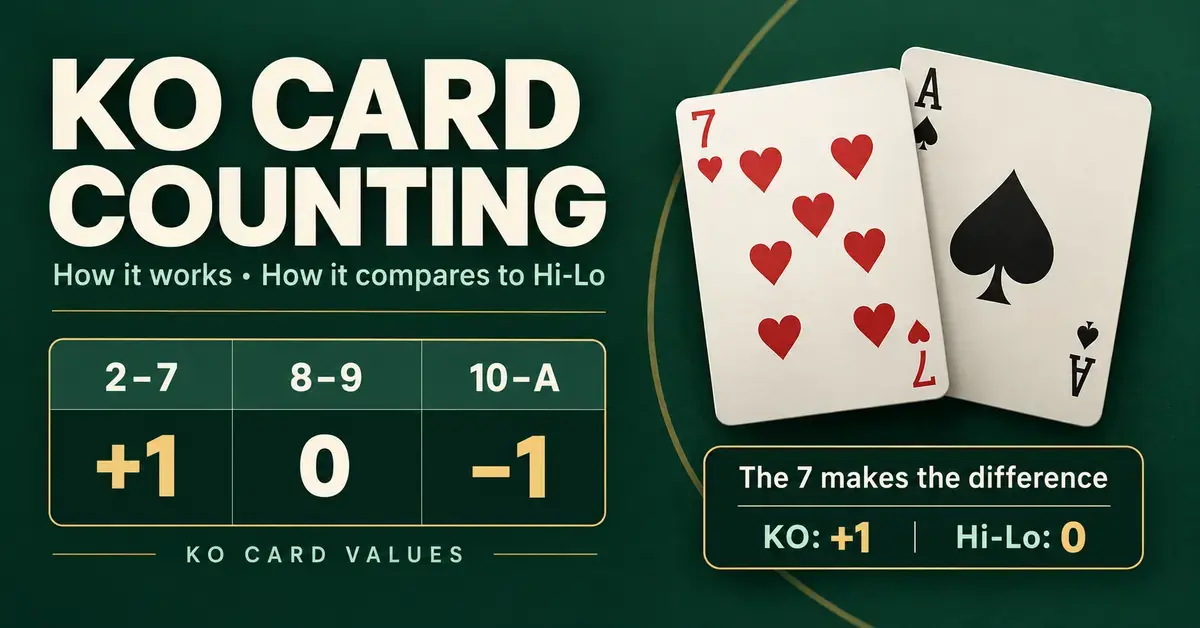
- Card values: 2-7 = +1, 8-9 = 0, 10 through Ace = -1.
- Key feature: no true-count conversion — you bet straight from a single running count.
- Vs Hi-Lo: KO counts the 7 (Hi-Lo does not) and skips the division step, which makes it easier to run but tied to a fixed pivot point of +4.
- Reality check: counting only shifts a small edge under good conditions and never guarantees a win.
What is the KO (Knock-Out) card counting system?
KO is a card counting system: a method of tracking the mix of high and low cards left in the shoe (the box that holds the decks) so you can tell when the remaining cards favour the player. It was published in 1996 by Olaf Vancura and Ken Fuchs in the book Knock-Out Blackjack, which set out to be, in their words, the easiest professional-level count ever devised.
KO is a “Level 1” count, meaning every card is worth at most one point. The big idea behind it is that it is unbalanced — a term explained in detail below — which lets you make betting decisions straight from a running total, with no extra arithmetic in the middle of a hand. That is the single feature that sets it apart from the Hi-Lo card counting system, which requires an extra conversion step.
KO card values and the running count
Counting starts with the value KO assigns to each card. These values build on the standard card values in blackjack but serve a different purpose — they track the deck’s composition rather than the total of your hand.
| Cards | KO value |
|---|---|
| 2, 3, 4, 5, 6, 7 | +1 |
| 8, 9 | 0 |
| 10, J, Q, K, Ace | -1 |
As each card appears, you add or subtract its value from a single number called the running count. You keep one running total going the whole time the shoe is in play. A higher running count means more low cards have already come out, so the remaining shoe is richer in tens and aces — the cards that help the player by producing more blackjacks and more strong starting hands. A lower count means the opposite.
In practice, counters cancel cards in pairs to stay fast: a +1 card and a -1 card dealt together net to zero, so you simply ignore them and only adjust the count for what is left over.
Why KO is an “unbalanced” count
If you add up the KO value of every card in a single 52-card deck, the total is +4, not zero. The 2 through 7 give you 24 cards worth +1 (that is +24), the ten-value cards and aces give you 20 cards worth -1 (that is -20), and the eights and nines are worth 0 — so +24 minus 20 leaves +4. Because the deck does not balance out to zero, KO is called an unbalanced count.
That imbalance is the whole trick. In a balanced system like Hi-Lo, the deck sums to zero, so a running count of, say, +6 could mean a strong edge with one deck left or only a mild edge with four decks left. To fix that, balanced systems convert the running count into a “true count” by dividing by the number of decks still in play. KO’s built-in +4 per deck does that scaling for you automatically, so a single running number stays meaningful without any division. The trade-off is that you must start the count at a specific negative number rather than at zero.
The KO Preferred method: IRC, key count and pivot
The most-used version of KO is the one the authors call KO Preferred. It relies on three reference numbers that change with the number of decks: the initial running count, the key count and the pivot point.
| Game | Initial running count (IRC) | Key count | Pivot point |
|---|---|---|---|
| 1 deck | 0 | +2 | +4 |
| 2 decks | -4 | +1 | +4 |
| 6 decks | -20 | -4 | +4 |
| 8 decks | -28 | -6 | +4 |
Initial running count (IRC)
Instead of starting at zero, KO starts the count at a set negative number so the key reference points land in the same place regardless of deck size. The rule is simple: IRC = 4 minus four times the number of decks. A six-deck shoe therefore starts at -20. You set this number the moment the dealer shuffles and begin adding and subtracting from there.
Key count — when to raise your bet
The key count is the running count at which the player first gains the advantage. Until the count reaches it, you bet the table minimum; once the running count climbs to the key count or above, the remaining cards favour you and you raise your bet. Because the IRC is pre-set, you watch for one fixed number for the whole shoe — there is nothing to divide.
The pivot point and insurance
The pivot point is always +4 and is the count at which KO is most accurate. It is the reference for the handful of strategy adjustments KO recommends — for example, changing a hit/stand decision when the shoe is rich. KO also handles one side bet cleanly: take the insurance bet only when the running count reaches +3 or higher. Counting the 7 (which Hi-Lo ignores) makes KO slightly sharper for this specific decision.
KO vs Hi-Lo: how they compare
Both counts are Level-1 systems that assign +1, 0 or -1 and both are built on the same logic of tracking high versus low cards. The differences are narrow but they shape which system suits which player.
KO vs Hi-Lo at a Glance
| Feature | KO (Knock-Out) | Hi-Lo |
|---|---|---|
| Count level | Level 1 (+1 / 0 / -1) | Level 1 (+1 / 0 / -1) |
| Balanced? | Unbalanced (deck sums to +4) | Balanced (deck sums to 0) |
| Value of the 7 | +1 | 0 (neutral) |
| Starting count | Negative IRC (e.g. -20 for six decks) | Always 0 |
| True-count division | Not needed | Required every bet |
| Betting correlation | ~0.98 | ~0.97 |
| Playing efficiency | ~0.55 | ~0.51 |
| Best for | Beginners who want fewer steps | Players wanting precise bet sizing |
What is the same
- Both are easy-to-learn Level-1 counts with only three values to memorise.
- Both assign -1 to every ten-value card and ace, and both ignore the 8 and 9.
- Both only work on top of solid basic strategy — counting tells you how to bet and tweak a few plays, not how to play every hand.
What is different
- The 7: KO counts the 7 as +1; Hi-Lo treats it as neutral. That one change is what makes KO unbalanced.
- The true count: Hi-Lo requires you to divide the running count by the decks remaining on every betting decision. KO removes that step entirely.
- The starting number: Hi-Lo always starts at zero; KO starts at a deck-dependent negative IRC that you must remember.
Which is easier, and which is more accurate?
For ease of use at the table, KO wins for most people. Estimating decks remaining and dividing under pressure is where counters most often slip, and KO cuts that out — you track one number and compare it to one threshold. Beginners and casual players tend to make fewer costly errors with it.
On raw accuracy the two are remarkably close. Standard figures put Hi-Lo’s betting correlation (how well the count predicts a profitable betting situation) at about 0.97 and its playing efficiency (how well it guides strategy changes) at about 0.51; KO comes in at roughly 0.98 and 0.55. On paper KO even edges ahead on these measures.
In real play, though, independent simulations give Hi-Lo a slight overall advantage. The reason is subtle: an unbalanced running count is perfectly calibrated only around its pivot, whereas Hi-Lo’s true count tells you precisely how strong your edge is at any point in the shoe, which allows more finely tuned bet sizing. The practical conclusion most analysts reach is that the gap is small enough that choosing the system you can run accurately for hours matters far more than the fraction of a percent between them. Neither one changes the basic reality of whether you can win at blackjack over the long run — both only shift a thin, hard-won edge, and only under favourable conditions.
Common mistakes with the KO system
- Starting at zero. Forgetting to set the negative IRC throws off every later reference and is the most frequent KO error.
- Dividing anyway. Old Hi-Lo habits die hard; converting KO to a true count defeats the purpose and introduces mistakes.
- Counting without basic strategy. A count is worthless if you misplay the hands it is sitting on top of.
- Expecting a sure thing. Counting shifts the odds slightly in the player’s favour at best; swings and losing sessions are normal, and no count guarantees a profit.
- Ignoring conditions. Shallow shuffling, 6:5 payouts and frequent reshuffles can wipe out any edge a count would otherwise provide.
Is card counting legal in Canada?
Keeping a count in your head is not illegal anywhere in Canada — you are simply using your memory and basic arithmetic, not a device. Using a phone, app or any mechanical aid to count is a different matter and is prohibited. That said, casinos are private businesses: staff watch for advantage play and are within their rights to change the game, shuffle early, ask a suspected counter to stop playing blackjack, or bar them from the tables. Counting is legal, but it is not protected from the house’s response.
Responsible gambling
This article is educational and does not encourage gambling or claim that card counting guarantees a profit. Blackjack is a game of chance with a built-in house edge, and card counting only shifts a small advantage under specific conditions that most casinos work to prevent. Never bet money you cannot afford to lose. If gambling is affecting you or someone you know in Canada, free, confidential support is available 24/7 through ConnexOntario (1-866-531-2600) and the Responsible Gambling Council. You can also read our responsible gambling resources.
Sources
- Las Vegas Advisor — Battle of the Babies: A Comparison of the Red 7, Hi-Lo and KO Systems
- Olaf Vancura & Ken Fuchs — Knock-Out Blackjack (book sample, KO Preferred tables)
- Action Network — How to Count Cards: An In-Depth Guide for Blackjack Players
- ConnexOntario — free, confidential gambling support
- Responsible Gambling Council (Canada)
Frequently Asked Questions (FAQ)
Is the KO system better than Hi-Lo?
Neither is clearly better. KO is easier because it removes the true-count division, while Hi-Lo gives slightly more precise bet sizing across the whole shoe. Independent simulations show them performing very closely, with Hi-Lo marginally ahead overall. For most players the easier system to run accurately is the better choice.
Why does the KO count start at a negative number?
Because KO is unbalanced, a full deck adds up to +4 rather than zero. Starting at a negative initial running count (for example -20 in a six-deck game) lines up the key count and the +4 pivot in the same place no matter how many decks are used, so you never have to divide.
Does KO count the 7?
Yes. KO assigns the 7 a value of +1, whereas Hi-Lo treats the 7 as neutral. That single difference is what makes KO an unbalanced count and gives it a small edge on the insurance decision.
Do I still need basic strategy to use KO?
Absolutely. A counting system only tells you when to raise your bet and when to adjust a few plays. Every other decision still follows basic strategy, so you must have that mastered before counting adds any value.
Can KO be used in multi-deck and online games?
KO works in single- and multi-deck live games as long as the dealer deals deep enough into the shoe before shuffling. It does not work against online games that shuffle after every hand, and most live-streamed tables also reshuffle often, which removes the edge counting would otherwise create.
