
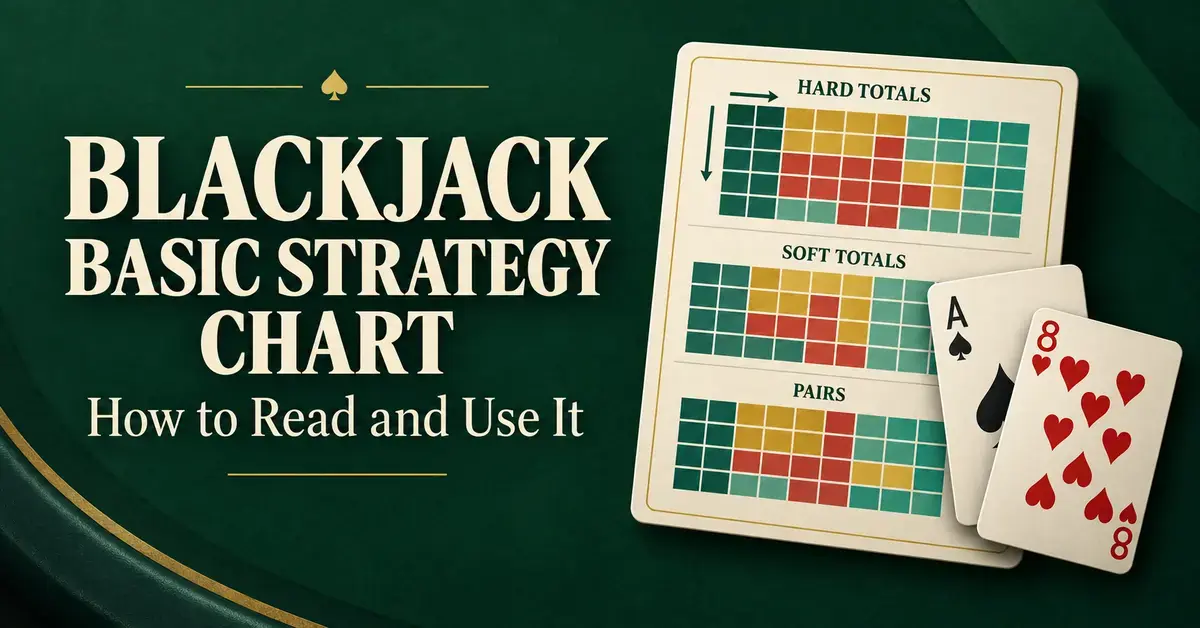
A blackjack basic strategy chart is a compact table that tells you the mathematically best move for every possible hand you can hold against every card the dealer is showing. It is not a betting system or a way to beat the casino — it is simply the play that loses the least money over the long run. Learn to read one strategy card and you can cut the house edge on a standard game to roughly 0.5%, which is about as good as blackjack gets without counting cards.
This guide explains what the chart is, how it is built, and exactly how to use the hard-hand, soft-hand and pair tables below. Every cell reflects the most common modern game: four to eight decks with the dealer standing on a soft 17.
Key Points
- A basic strategy chart shows the mathematically best move for every hand against every dealer upcard.
- Correct play cuts the house edge on a standard game to roughly 0.5%.
- The chart has three tables: hard totals, soft totals (containing an ace worth 11) and pairs.
- Read down for your hand, across for the dealer’s card; the meeting cell is your play.
- Always split aces and eights; never split fives or tens.
- The tables here assume 4–8 decks, dealer stands on soft 17, and double-after-split allowed.
What is basic strategy?
Basic strategy is the complete set of correct plays for blackjack, worked out by computer simulations that play out every hand millions of times. For any combination of your two (or more) cards and the dealer’s single visible “upcard,” there is one decision — hit, stand, double down, split or surrender — that produces the best expected result. The chart is just that answer written down.
The word “basic” matters: this is the baseline strategy for a player who does not track which cards have already been dealt. It assumes a fresh, well-shuffled shoe, so every decision depends only on the cards currently in front of you. Card counting sits on top of basic strategy and adjusts a handful of plays based on the mix of cards left — but you must master the chart first.
Why the chart lowers the house edge
Blackjack’s built-in disadvantage for the player comes mainly from the fact that you act before the dealer: if you bust, you lose immediately, even if the dealer would have busted afterwards. Playing on instinct throws away far more than most people realise.
- Basic strategy: on a typical six-deck game where the dealer stands on soft 17, correct play leaves a house edge of roughly 0.5%.
- “Never bust” (always stand on 12 or more): the house edge jumps to about 3.91%.
- “Mimic the dealer” (always hit to 17): around 5.48%.
In other words, following the chart instead of guessing can save several percent of everything you wager. That is why the strategy card is the single most valuable thing a new player can learn, and why it is the core of any serious blackjack strategy plan.
Hard, soft and pair hands
The chart is split into three tables because your hand falls into one of three categories. Understanding the difference is essential — the same total can call for a different play depending on which type it is. If you are unsure how a hand is scored, review the blackjack card values first.
- Hard hand: a hand with no ace, or one where the ace must count as 1 to avoid busting (for example 10-6 = hard 16). There is no flexibility.
- Soft hand: a hand containing an ace counted as 11, so it cannot bust with one more card (for example A-6 = soft 17). You get a “free” hit.
- Pair: two cards of the same rank, which you may choose to split into two separate hands.
How to read the strategy tables
Find your hand down the left column, then move across to the dealer’s upcard along the top. The cell where they meet is your play. The abbreviations are:
- H — Hit (take another card)
- S — Stand (take no more cards)
- D — Double down if allowed, otherwise Hit
- Ds — Double down if allowed, otherwise Stand
- P — Split the pair
- SUR — Surrender if the table offers it, otherwise Hit
For a refresher on what each of these moves actually does at the table, see the guide to blackjack player actions.
Hard totals
| Your hand | 2 | 3 | 4 | 5 | 6 | 7 | 8 | 9 | 10 | A |
|---|---|---|---|---|---|---|---|---|---|---|
| 8 | H | H | H | H | H | H | H | H | H | H |
| 9 | H | D | D | D | D | H | H | H | H | H |
| 10 | D | D | D | D | D | D | D | D | H | H |
| 11 | D | D | D | D | D | D | D | D | D | H |
| 12 | H | H | S | S | S | H | H | H | H | H |
| 13 | S | S | S | S | S | H | H | H | H | H |
| 14 | S | S | S | S | S | H | H | H | H | H |
| 15 | S | S | S | S | S | H | H | H | SUR | H |
| 16 | S | S | S | S | S | H | H | SUR | SUR | SUR |
| 17+ | S | S | S | S | S | S | S | S | S | S |
Notice the pattern: against a weak dealer upcard (2 through 6, cards the dealer often busts with) you stand on stiff totals of 12–16 and let the dealer take the risk. Against a strong upcard (7 through Ace) you hit those same totals because standing on 16 against a likely 20 is almost certain to lose.
Soft totals
| Your hand | 2 | 3 | 4 | 5 | 6 | 7 | 8 | 9 | 10 | A |
|---|---|---|---|---|---|---|---|---|---|---|
| A,2 (soft 13) | H | H | H | D | D | H | H | H | H | H |
| A,3 (soft 14) | H | H | H | D | D | H | H | H | H | H |
| A,4 (soft 15) | H | H | D | D | D | H | H | H | H | H |
| A,5 (soft 16) | H | H | D | D | D | H | H | H | H | H |
| A,6 (soft 17) | H | D | D | D | D | H | H | H | H | H |
| A,7 (soft 18) | S | Ds | Ds | Ds | Ds | S | S | H | H | H |
| A,8 (soft 19) | S | S | S | S | S | S | S | S | S | S |
| A,9 (soft 20) | S | S | S | S | S | S | S | S | S | S |
Soft 18 (A,7) is the hand beginners get wrong most often. It looks strong, but it is not 18 in the usual sense — it is a hand you can improve for free. Against a strong 9, 10 or Ace you should hit it, and against a weak 3 through 6 you should double down.
Pairs
| Your pair | 2 | 3 | 4 | 5 | 6 | 7 | 8 | 9 | 10 | A |
|---|---|---|---|---|---|---|---|---|---|---|
| A,A | P | P | P | P | P | P | P | P | P | P |
| 10,10 | S | S | S | S | S | S | S | S | S | S |
| 9,9 | P | P | P | P | P | S | P | P | S | S |
| 8,8 | P | P | P | P | P | P | P | P | P | P |
| 7,7 | P | P | P | P | P | P | H | H | H | H |
| 6,6 | P | P | P | P | P | H | H | H | H | H |
| 5,5 | D | D | D | D | D | D | D | D | H | H |
| 4,4 | H | H | H | P | P | H | H | H | H | H |
| 3,3 | P | P | P | P | P | P | H | H | H | H |
| 2,2 | P | P | P | P | P | P | H | H | H | H |
Two pair rules never change and are worth memorising on their own: always split aces and eights, and never split fives or tens. Splitting aces gives you two chances at a strong hand; splitting eights breaks up a losing hard 16. A pair of fives is a powerful hard 10 — you double it — and a pair of tens is already a winning 20, so you stand.
Quick Reference
Rules worth memorising first:
- Always split aces and eights.
- Never split tens (stand on 20) or fives (double as a hard 10).
- Always double a hard 11 (except against an Ace).
- Never take insurance — the chart never calls for it.
- Stand on hard 12–16 against a dealer 2–6; hit them against 7 through Ace.
- Always stand on hard 17 or more.
How the chart changes with the rules
The tables above assume the most player-friendly common rules: four to eight decks, the dealer stands on soft 17, and you are allowed to double after splitting (DAS). Two rule changes shift a few cells:
- Dealer hits soft 17 (H17): this is slightly worse for you and adds a few plays — for example, doubling soft 18 (A,7) against a 2, and surrendering hard 17 against an Ace. It raises the house edge by about 0.2%.
- No double after split (no DAS): you split a little less often. Without DAS, split 2s, 3s and 6s only against slightly stronger dealer cards, and do not split 4s at all.
- No surrender offered: simply hit the hands marked SUR.
Always check the rules printed on the table felt before you sit down, because a game paying 6:5 on a natural instead of the standard 3:2 costs you far more than any single strategy decision. To understand why that payout matters so much, see the explanation of what a blackjack pays.
Common mistakes to avoid
- Standing on soft 17: A,6 can only improve — hit or double it, never stand.
- Not hitting 16 against a high card: it feels risky, but standing loses even more often.
- Splitting tens: breaking up a made 20 to chase two weaker hands is a costly habit.
- Taking insurance: it is a losing side bet regardless of your hand; the chart never recommends it. See why in the guide to blackjack insurance.
- Changing your play based on a hunch or a streak: the correct move for a hand is the same whether you are winning or losing.
How to practise and memorise the chart
Do not try to learn all three tables at once. Most players start with the hard totals, which come up most often, then add the pair splits and finally the soft hands. Printed strategy cards are legal to bring to the table in most casinos — dealers see them constantly — and free online trainers let you drill hands until the plays become automatic. A few sessions of focused practice is usually enough to internalise the vast majority of decisions.
Responsible Gambling
This article is educational and explains the mathematics of blackjack decisions. It is not betting advice and does not improve your chances of a winning session — blackjack keeps a house edge even with perfect basic strategy. Gambling in Canada is restricted to ages 19+ (18+ in Alberta, Manitoba and Quebec). Play only with money you can afford to lose and never chase losses. If gambling is causing you or someone you know harm, free confidential support is available through responsible gambling resources, ConnexOntario and the Responsible Gambling Council.
Sources
Frequently asked questions (FAQ)
Does basic strategy guarantee I will win?
No. Basic strategy minimises the house edge, but blackjack still favours the casino over the long run. It ensures you lose the least amount possible and win as often as the math allows, but no strategy turns a negative-edge game into a guaranteed profit without additional advantage techniques.
Can I bring a strategy chart to the casino?
In most places, yes. Using a printed strategy card at the table is generally permitted because it does not give you an unfair advantage — it only helps you play the mathematically correct move. Rules can vary by venue, so it is worth a quick check, but dealers are used to seeing them.
Why does the chart tell me to hit a 16 against a 10?
Because standing on 16 against a dealer 10 loses even more often than hitting. The dealer will make 17 or better most of the time, so a made 16 is usually a loser either way. Hitting simply gives you the smaller of two bad outcomes over the long run.
Is there one chart for every blackjack game?
No. The correct chart depends on the number of decks and the house rules, especially whether the dealer hits or stands on soft 17 and whether doubling after a split is allowed. The chart on this page covers the common four-to-eight-deck, stand-on-soft-17 game; other rule sets shift a handful of decisions.
Do I need to count cards to use basic strategy?
No. Basic strategy is completely separate from card counting and requires no memory of past cards. Every decision depends only on your current hand and the dealer’s upcard, which is exactly why beginners can learn and apply it right away.
