
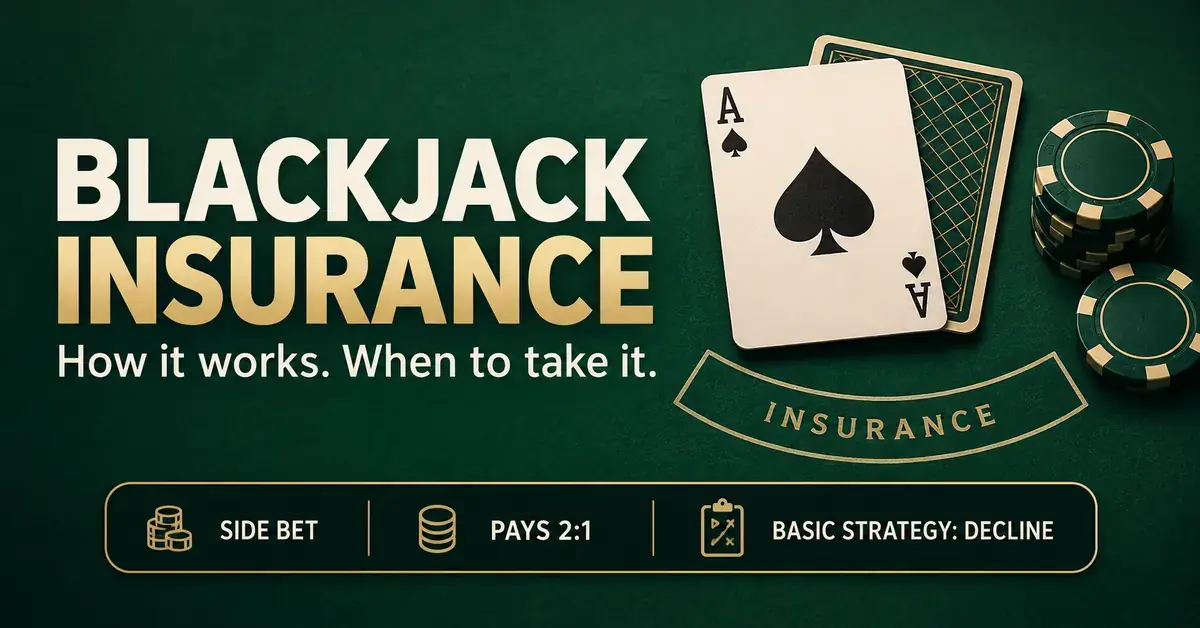
Insurance is one of the most misunderstood offers at the blackjack table. Every time the dealer turns up an Ace, you hear the same question — “Insurance?” — and players who have never read the math often say yes out of instinct. This guide explains exactly what the insurance bet is, how it works, what it really pays, and why almost every strategy chart tells you to decline it. If you are still learning the basics, it helps to first understand how to play blackjack before adding side bets to the mix.
Key Points
- Insurance is an optional side bet offered only when the dealer’s upcard is an Ace.
- It costs up to half your main bet and pays 2:1 if the dealer has blackjack.
- The dealer completes a blackjack only about 30.8% of the time, but 2:1 is only fair at 33.3% — so the bet loses money over time.
- Basic strategy says decline insurance (and “even money”) on virtually every hand.
- Only card counters tracking a ten-rich deck can turn insurance into a profitable bet.
What Is Insurance in Blackjack?
Insurance is an optional side bet — a wager separate from your main hand — that the dealer offers only when their face-up card (the “upcard”) is an Ace. Because an Ace can combine with any 10-value card to make a natural blackjack, the dealer is asking whether you want to protect yourself against the chance that their hidden “hole” card completes that blackjack.
Despite the reassuring name, insurance is not a refund or a safety net in the everyday sense. It is a standalone bet on a single outcome: whether the dealer’s hole card is worth 10. If it is, you win the side bet; if it is not, you lose it and play your hand normally.
How the Insurance Bet Works
The mechanics are simple and always follow the same sequence:
- The dealer deals the round and shows an Ace as the upcard.
- Before anyone plays their hand, the dealer offers insurance to the table.
- You may place an insurance bet of up to half your original wager in the marked insurance area.
- The dealer checks the hole card. If it is a 10, Jack, Queen or King, the dealer has blackjack and the insurance bet pays 2:1. If it is anything else, the insurance bet is collected and the round continues as usual.
Quick Facts
| Feature | Detail |
|---|---|
| When it is offered | Only when the dealer’s upcard is an Ace |
| Maximum stake | Up to half of your original bet |
| Payout | 2:1 |
| You win if | The dealer’s hole card is a 10-value card (10, J, Q, K) |
| Chance of winning | About 30.8% (roughly 4 in 13) |
| House edge | About 7.5% multi-deck, up to about 8.75% single-deck |
| Basic-strategy advice | Decline |
A quick dollar example
Say you bet $10 on your hand and the dealer shows an Ace. You add a $5 insurance bet (half of $10). Two things can happen:
- Dealer has blackjack: your $10 main bet loses, but the $5 insurance pays 2:1, returning $10. You break even for the round.
- Dealer does not have blackjack: your $5 insurance is lost, and you play your $10 hand normally — you are now effectively $5 behind before the hand is even resolved.
That second outcome is the catch. You pay the insurance cost far more often than the dealer actually turns over a blackjack, and those small, frequent losses add up.
The Math Behind Insurance — Why the House Wins
Insurance really pays 2:1, so it would be a fair, break-even bet if the dealer completed a blackjack exactly one time in three (33.3%). But that is not how the cards fall.
When the dealer shows an Ace, the hole card wins the insurance bet only if it is one of the four 10-value ranks — 10, Jack, Queen or King. In a fresh single deck, 16 of the remaining 51 unseen cards are worth 10, which is about 30.8% of the time (roughly 4 in 13). Understanding this depends on knowing your blackjack card values — every 10, Jack, Queen and King counts as ten.
The gap between the 30.8% chance of winning and the 33.3% you would need for a fair payout is exactly where the casino’s edge lives. In practice, that translates to a house edge of about 7.5% in multi-deck games, rising to roughly 8.75% in single-deck games. For comparison, a player using correct blackjack strategy faces a house edge well under 1% on the main game. Insurance is one of the worst-value wagers on the entire table.
“Even Money” — Insurance When You Have Blackjack
There is one special case that confuses many players. If you are dealt a blackjack and the dealer shows an Ace, the dealer may offer you “even money” instead of the usual 3:2 payout. Taking even money is mathematically identical to taking full insurance on your blackjack: you lock in a guaranteed 1:1 profit no matter what the dealer’s hole card turns out to be.
It feels safe, because a normal blackjack pushes (ties) when the dealer also has blackjack, and a push pays nothing. But the numbers still favour declining. Since the dealer completes a blackjack only about 30.8% of the time, you will win the full 3:2 on your natural far more often than you will be pushed. Over the long run, always turning down even money earns more than always accepting it.
Should You Take Insurance?
For the vast majority of players, the answer is a clear no. Basic strategy — the mathematically optimal set of decisions for every hand — tells you to decline insurance on every hand and to refuse even money as well. The bet loses money over time regardless of how strong or weak your own hand looks, because insurance has nothing to do with your cards. It is purely a wager on the dealer’s hidden card.
A few common myths are worth clearing up:
- “I should insure a good hand like 20.” Your hand total is irrelevant to the insurance bet; the odds on the dealer’s hole card are the same either way.
- “Insurance protects my bankroll.” On average it drains it faster, because you pay the premium far more often than it pays out.
- “Even money is free profit.” It is a guaranteed smaller profit that costs you the bigger 3:2 win you would collect most of the time.
When Insurance Can Actually Make Sense
There is a narrow exception. The bet becomes profitable only when the remaining shoe is unusually rich in 10-value cards, because that pushes the dealer’s chance of blackjack above the 33.3% break-even point. The only reliable way to know that is card counting — tracking the ratio of high to low cards left to be dealt.
Card counters using a system such as Hi-Lo will take insurance only when their running count indicates a heavily ten-loaded deck (commonly a true count of about +3 or higher). This is an advanced advantage-play technique, not a casual move, and it does not change the verdict for everyone else: without an accurate count, insurance is a losing bet. Casinos are perfectly happy to offer it precisely because so few players count.
Insurance and the Canadian Table
Insurance rules are consistent whether you play in a land-based casino or online, and the same 2:1 offer appears across licensed sites available to Canadian players. If you are getting to grips with the wider game and the local landscape, our overview of blackjack in Canada covers where and how the game is played. The math on insurance, however, does not change by province or platform — it is a fixed feature of the rules.
Responsible Gambling
Gambling should be treated as paid entertainment, not a way to make money, and no side bet or system can overcome the built-in house edge. Set a budget and time limit before you play, never wager money you cannot afford to lose, and never chase losses. If gambling stops feeling like fun, free and confidential help is available in Canada from the Responsible Gambling Council and, in Ontario, from ConnexOntario at 1-866-531-2600. You can also read our own responsible gambling guide. You must be of legal gambling age in your province or territory (18 or 19) to play.
Sources
- WinStar — Blackjack Insurance: The Side Bet Explained
- CasinoBeats — What Is Insurance in Blackjack and How Does It Work?
- BlackjackRules.org — Blackjack Insurance: A Comprehensive Guide
- Wizard of Odds — Blackjack House Edge Calculator
- PokerNews — What Is Insurance in Blackjack?
- Responsible Gambling Council — Help for Canadians
Frequently Asked Questions (FAQ)
What is insurance in blackjack?
Insurance is an optional side bet offered only when the dealer’s upcard is an Ace. It is a wager that the dealer’s hidden hole card is a 10-value card, which would give them a blackjack. It is completely separate from how strong your own hand is.
How much does insurance cost and what does it pay?
You can bet up to half of your original wager. If the dealer turns over a blackjack, insurance pays 2:1; if the dealer does not have blackjack, you lose the insurance bet and continue playing your hand normally.
Should I take insurance?
In almost every case, no. Basic strategy recommends declining insurance because the dealer completes a blackjack only about 30.8% of the time, while the 2:1 payout would only be fair at 33.3%. That gap gives the house an edge of roughly 7.5% or more on the bet.
What is “even money” in blackjack?
Even money is offered when you have a blackjack and the dealer shows an Ace. Accepting it gives you a guaranteed 1:1 payout instead of the usual 3:2. It is mathematically the same as insuring your blackjack, and over the long run declining it earns more.
Is insurance ever a good bet?
Only for skilled card counters. When the remaining cards are unusually rich in 10-value cards, the dealer’s chance of blackjack rises above the break-even point and insurance can become profitable. Without an accurate count, it is a losing wager for everyone else.
