
Surrender is the most misunderstood move in blackjack. Giving up a hand and handing back half your bet feels like quitting, yet on a few specific hands it is the mathematically correct play — it loses you less money over time than fighting on. The catch is that surrender comes in two very different forms, and most casinos that offer it only offer the weaker one. This guide explains what surrender is, how early and late surrender differ, exactly which hands to surrender, and how to use the move without giving away value.
Key Points
- Surrender lets you fold your first two cards and keep half your bet; the other half is lost.
- It is a first-decision-only move, available on some tables but not all — usually only when the dealer shows 9, 10 or an ace.
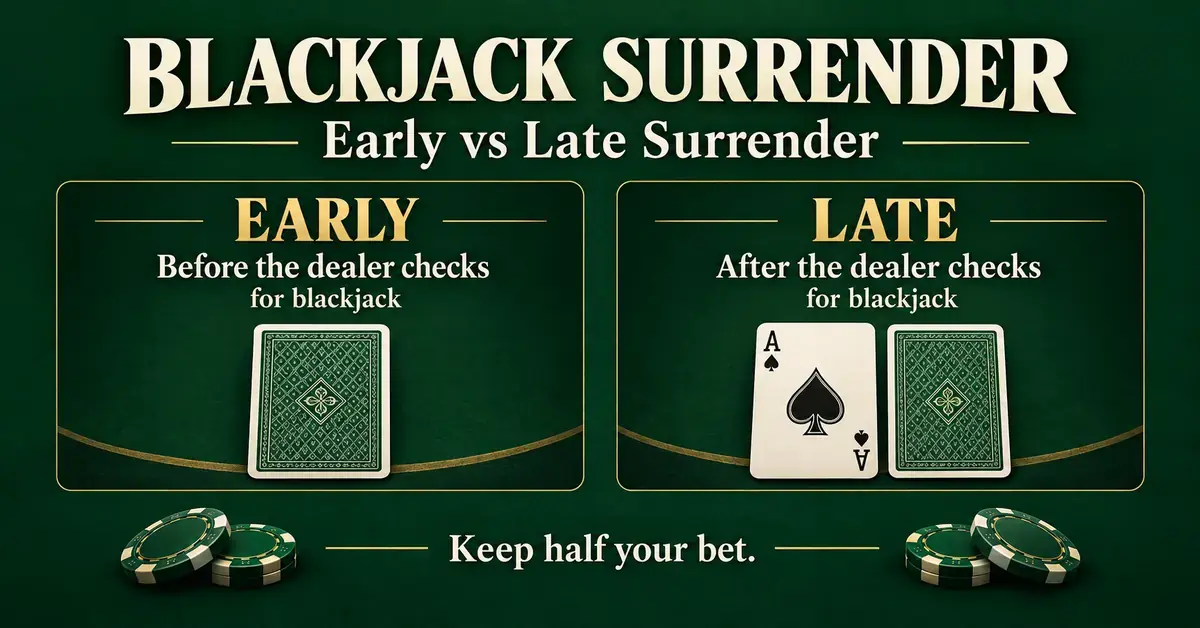
- Late surrender (common) is offered only after the dealer checks for blackjack. Early surrender (rare) is offered before that check and is far more player-friendly.
- Standard late-surrender hands: hard 16 (not 8-8) vs 9/10/Ace, and hard 15 vs 10. If the dealer hits soft 17, add hard 15 and hard 17 vs Ace, plus 8-8 vs Ace.
- Surrender lowers the house edge a little (about 0.07%–0.08% for late surrender); it reduces losses rather than creating a winning edge.
What surrender means in blackjack
Surrender is an optional move that lets you fold your hand immediately after seeing your first two cards and the dealer’s upcard (the dealer’s face-up card). Instead of playing the hand out, you forfeit it and lose only half your bet; the other half is returned to you. If you bet $20, you keep $10 and give up $10.
You can only surrender as your first decision, before you hit, double or split. Once you take another card, the option is gone. Surrender is one of the five core blackjack player actions, but it is the only one that is not offered at every table — many casinos leave it out entirely, so always check before you sit down.
Why would you ever throw a hand away? Because some starting hands are so weak against a strong dealer card that playing them out loses, on average, more than half your bet. A hard 16 against a dealer 10, for example, loses roughly 0.54 units for every unit wagered over the long run. Surrendering locks in a loss of exactly 0.50 units instead — a small but real saving every time the situation comes up.
Early vs late surrender: the key difference
The two versions of surrender differ by one detail: when you are allowed to fold relative to the dealer checking for blackjack. That single difference makes one version mildly helpful and the other so player-friendly that it has all but disappeared.
Late surrender
Late surrender is the common form. When the dealer shows an ace or a ten-value card, they first peek at their hole card (the face-down card) to check for a natural blackjack. Only after confirming they do not have blackjack are you offered the chance to surrender. If the dealer does have blackjack, the hand ends and you lose your full bet — surrender is not available.
Early surrender
Early surrender lets you fold before the dealer checks the hole card. That means you can escape for half your bet even when the dealer turns out to have a blackjack. Being able to bail out against a potential natural is enormously valuable to the player, which is exactly why casinos removed it. Early surrender was common in Atlantic City in the late 1970s, but once operators realised how much edge it handed back, it was phased out. Today it is extremely rare; if you see “surrender” advertised, assume it is the late version unless the rules clearly state otherwise.
Comparison
| Feature | Late surrender | Early surrender |
|---|---|---|
| When you can fold | After the dealer peeks for blackjack | Before the dealer peeks for blackjack |
| Fold against a dealer blackjack? | No — you lose your full bet | Yes — you keep half your bet |
| How common | The usual form where surrender is offered | Very rare; mostly phased out decades ago |
| Hands you surrender | A short list (mainly hard 15–16) | A much longer list vs ace and ten |
| Value to the player (house-edge drop) | About 0.07%–0.08% | Up to roughly 0.6% when offered vs ace and ten |
When to surrender: late surrender strategy
For the common multi-deck games (four to eight decks) that most Canadian players meet online and in live casinos, the correct late-surrender hands are short and easy to memorise. They depend on whether the dealer stands on soft 17 (S17) or hits soft 17 (H17) — a “soft 17” being a 17 that includes an ace counted as 11, such as ace-6. If you are unsure which rule your table uses, our guide to dealer rules on soft 17 explains how to spot it.
| Your hand | Dealer upcard | Rule |
|---|---|---|
| Hard 16 (not a pair of 8s) | 9, 10 or Ace | S17 and H17 |
| Hard 15 | 10 | S17 and H17 |
| Hard 15 | Ace | H17 only |
| Hard 17 | Ace | H17 only |
| Pair of 8s | Ace | H17 only (otherwise split) |
A “hard” hand is one with no ace, or one where the ace must count as 1 to avoid busting — so hard 16 means totals such as 10-6 or 9-7, not a soft ace-5. If you want the full picture of how these totals fit the rest of play, see the complete blackjack basic strategy chart.
Two points trip people up. First, a pair of 8s is a special case: a 16 made of 8-8 should normally be split, not surrendered, because splitting two 8s turns one bad hand into two playable ones. The only common exception is 8-8 against an ace in an H17 multi-deck game, where surrendering edges ahead. Second, hard 16 is the hand you will surrender most often — and for good reason, since 16 is the total most likely to bust when you draw. You can see just how punishing it is in our breakdown of blackjack bust probability.
When to surrender: early surrender strategy
If you ever find a true early-surrender game, the strategy is far more generous because you can fold against the dealer’s strongest cards before the blackjack check. The standard early-surrender hands are:
- Against a dealer ace: surrender hard 5, 6 and 7; hard 12 through hard 17; and pairs of 3s, 6s, 7s and 8s.
- Against a dealer 10: surrender hard 14, 15 and 16; and pairs of 7s and 8s.
These lists look alarming compared with late surrender, but that is the whole point — early surrender rescues you from hands that are near-certain losers when the dealer may be holding a natural. Because it is so rare, treat this as a “nice to know” rather than a table you will use often.
How to surrender at the table
There is no universal hand signal for surrender, which is one reason beginners miss the option. In a live casino the usual method is to say “surrender” clearly, and some players also draw an imaginary horizontal line behind their bet with a finger. The dealer then removes half your wager and takes your cards. Online, surrender simply appears as a button when the move is allowed.
Because signals are easy to misread, speak up and wait for the dealer to confirm before touching your chips. If the option is not offered on that hand, the dealer will tell you — it usually only appears when the dealer shows a 9, 10 or ace.
Common surrender mistakes
- Surrendering too many hands. Surrender is correct on a handful of totals only. Folding a hard 14 against a 7, or any hand against a weak dealer card like a 5 or 6, simply throws money away.
- Surrendering a pair of 8s by habit. In almost every game 8-8 should be split; only the H17-versus-ace case favours surrender.
- Assuming surrender is always available. Most tables do not offer it. Confirm the rule before you rely on it in your plan.
- Forgetting the move is first-decision only. You cannot surrender after hitting, doubling or splitting.
Over-surrendering is one of several avoidable errors covered in our list of common blackjack mistakes.
Is surrender worth it?
Used correctly, surrender lowers the house edge — the casino’s built-in long-run advantage. Late surrender trims it by only about 0.07% to 0.08%, a genuine but modest gain that matters mainly to disciplined, high-volume players. Early surrender is worth far more — roughly 0.6% in total when offered against both the ace and a ten — which is precisely why you will almost never see it today.
The practical takeaway: when a game offers late surrender, learn the short list of hands above and use it, because it costs nothing and saves a little on every qualifying hand. But surrender is a fine-tuning tool, not a way to beat the game — it reduces how much you lose, it does not turn the odds in your favour.
Disclaimer
This article is for information and entertainment only and is not betting advice. Blackjack is a game of chance with a built-in house edge; surrender reduces losses on certain hands but does not make the game profitable, and no strategy guarantees a win. Only gamble with money you can afford to lose, and only if you are of legal age in your province or territory. If gambling is affecting you or someone you know in Canada, free, confidential support is available through the Responsible Gambling Council and provincial helplines. You can also read our responsible gambling page.
Sources
Frequently Asked Questions
What does it mean to surrender in blackjack?
Surrendering means you fold your hand right after the deal and give up half your bet, getting the other half back. You use it on a few weak hands where playing on would, on average, lose more than half your wager.
What is the difference between early and late surrender?
Late surrender is offered only after the dealer peeks for blackjack, so you cannot use it if the dealer has a natural. Early surrender lets you fold before that check, so you can escape even a dealer blackjack for half your bet. Early surrender is much more valuable and is now very rare.
Which hands should I surrender?
In common multi-deck games with late surrender, surrender a hard 16 (except a pair of 8s) against a dealer 9, 10 or ace, and a hard 15 against a 10. If the dealer hits soft 17, also surrender hard 15 and hard 17 against an ace, and 8-8 against an ace.
Should I ever surrender a pair of 8s?
Almost never. A pair of 8s should normally be split, which turns one poor 16 into two fresh hands. The only common exception is 8-8 against a dealer ace when the dealer hits soft 17 in a multi-deck game.
Does surrender improve my chances of winning?
No. Surrender only reduces how much you lose on specific bad hands. It lowers the house edge slightly but does not give you an advantage — the casino still keeps its edge over the long run.
