
If you have started learning to count cards, you have met two numbers that sound almost the same but do very different jobs: the running count and the true count. The running count is the figure you keep in your head as cards come out; the true count is that figure adjusted for how many cards are still to be dealt. Getting the conversion between them right is what separates a number that looks useful from a number that actually tells you anything. This guide explains what each count is, why the conversion exists, and exactly how to do it.
Key Takeaways
- The running count is the raw tally you keep as cards are dealt; the true count adjusts it for the cards still to come.
- Convert with one formula: true count = running count ÷ decks remaining.
- Estimate the decks remaining from the discard tray or shoe, in roughly half-deck steps (about 26 cards each).
- In multi-deck shoes the conversion is essential; in single-deck games the two counts are already close.
- Each true-count point is worth roughly a 0.5% shift in edge, with break-even near a true count of about +1 in a typical game.
- Always bet and adjust from the true count, never the running count.
What the running count is
The running count is a single tally you adjust every time a card appears. In the most common counting method, the Hi-Lo card counting system, every card is given one of three values:
- +1 for low cards: 2, 3, 4, 5 and 6
- 0 for neutral cards: 7, 8 and 9
- −1 for high cards: 10, jack, queen, king and ace
You start at zero when the shoe is shuffled and add or subtract as each card is exposed. A rising positive number means a lot of low cards have gone, so the remaining shoe is richer in tens and aces — the cards that favour the player. A negative number means the opposite. Because the Hi-Lo values add up to zero across a full deck, it is called a balanced count, and that balance is exactly what makes the true-count conversion possible.
What the true count is
The true count is the running count expressed per deck still to be dealt. It answers the question the running count cannot: how concentrated is that advantage in the cards left in the shoe? The true count is the number that actually lines up with your edge, which is why serious counters size their bets and make strategy changes from the true count, never from the raw running count.
Why you have to convert at all
In a single-deck game the running count and the true count are almost the same thing, so the conversion barely matters. In a multi-deck shoe it matters enormously, because the same running count means completely different things depending on how many cards remain.
Imagine a running count of +8. If there are four decks still to be dealt, those eight extra high cards are thinly spread across roughly 208 cards — a mild advantage. If there is only one deck left, the same +8 is packed into about 52 cards — a strong, concentrated advantage. The running count is identical in both cases; the real situation is not. Converting to a true count is simply dividing the advantage by the space it is spread over. For more on why the number of decks affects the odds, the effect is the same force at work here.
How to convert: the true count formula
The formula is short:
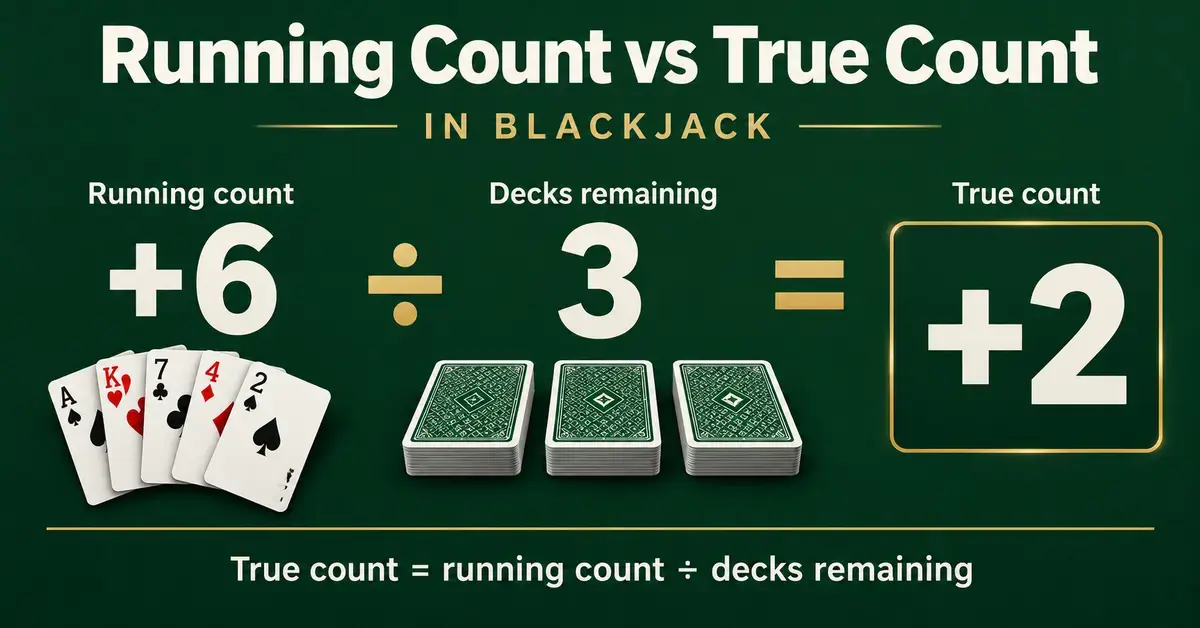
True count = running count ÷ decks remaining
So a running count of +6 with three decks left is a true count of +2. A running count of +8 with four decks left is also +2. The same +8 with one deck left is +8. The division is the whole trick.
Estimating the decks remaining
The one input you cannot read off a label is “decks remaining,” so you estimate it. Counters do this by glancing at the discard tray (the stack of already-played cards) or the cards still sitting in the shoe, and judging the amount in half-deck steps — a half deck is about 26 cards, a full deck about 52. You do not need surgical precision. Rounding to the nearest half or whole deck is normal, and most players round the decks-remaining figure in a way that keeps their estimate conservative rather than overstated. With practice, a quick look at the tray is enough to say “about two and a half decks left.”
A worked example
Say you are four decks into a six-deck shoe and your running count is +10. Two decks are left, so:
- True count = +10 ÷ 2 = +5
Now one more deck is dealt and your running count has climbed to +12 with one deck remaining:
- True count = +12 ÷ 1 = +12
Notice how the true count can jump even when the running count barely moves, simply because the remaining decks shrink. That is the conversion doing its job.
Conversion Examples
| Running count | Decks remaining | True count | What it means |
|---|---|---|---|
| +8 | 4 | +2 | Mild edge — advantage thinly spread |
| +8 | 2 | +4 | Stronger — same count, fewer cards |
| +8 | 1 | +8 | Concentrated advantage late in the shoe |
| +6 | 3 | +2 | Modest edge mid-shoe |
| +3 | 6 | +0.5 | Essentially flat early in a big shoe |
| −6 | 3 | −2 | House edge larger than normal — bet minimum |
What the true count actually tells you
As a rule of thumb, each full point of true count shifts the house edge by roughly half a percent (0.5%) toward the player. A typical multi-deck game using basic strategy starts with a house edge of around 0.5%, so the player roughly breaks even near a true count of about +1 and only moves into a genuine advantage above it. That is why counters keep their minimum bet out while the true count is low and raise it only as the true count climbs. The true count is also what triggers the small basic-strategy adjustments (sometimes called deviations) that counters use, such as taking insurance only at high counts.
None of this turns blackjack into a guaranteed win. The edge in question is tiny, it only appears for part of a shoe, and short-term swings are large. If you are weighing up whether you can win at blackjack, the honest answer is that counting narrows the gap over the very long run and does nothing to protect any single session.
Single deck vs multi-deck shoes
The conversion changes feel depending on the game:
- Single deck: with one deck or less in play, the running count is close to the true count already. Some players still divide by the fraction of a deck remaining — for example, half a deck left turns a running count of +3 into a true count of +6 — but the arithmetic is lighter.
- Multi-deck (four, six or eight decks): the division genuinely matters and a large running count can still be a weak true count early in the shoe. This is where new counters most often misread the situation.
Common mistakes when converting
- Betting off the running count. The single biggest error: a +10 running count feels exciting, but with five decks left it is only a true count of +2.
- Forgetting to divide early in the shoe. Near the start of a six-deck shoe you are dividing by five or six, so counts are heavily diluted.
- Over-estimating decks dealt. If you think more cards have come out than really have, you divide by too small a number and overstate your edge.
- Chasing precision. Agonising over whether it is 2 or 2.25 decks left costs accuracy elsewhere; a good half-deck estimate is plenty.
- Dropping the sign. A negative running count divides to a negative true count, which means the house edge is larger than usual — a cue to bet the minimum, not to keep raising.
If any of the vocabulary here is unfamiliar, the blackjack glossary defines terms like running count, true count, shoe and penetration in plain language, and the wider picture of blackjack house edge shows why these fractions of a percent are worth the effort at all.
Responsible gambling
This article explains the mathematics of card counting for educational purposes only. It is not betting advice and does not suggest any method can guarantee a profit; the long-run edge from counting is small, appears only part of the time, and does not protect any single session. Casinos may refuse service to players they believe are counting. Only ever gamble with money you can afford to lose, and keep it to entertainment. If gambling is causing harm for you or someone you know in Canada, free, confidential support is available — see our responsible gambling page, or contact ConnexOntario (1-866-531-2600) or the Responsible Gambling Council. You must be of legal gambling age in your province or territory (18 or 19 depending on where you live).
Sources
Frequently asked questions
What is the difference between running count and true count?
The running count is the raw tally you keep as cards are dealt. The true count takes that tally and divides it by the number of decks still to be dealt, so it reflects how concentrated the advantage is in the cards that remain. The true count is the number that actually matches your edge.
How do you convert a running count to a true count?
Divide the running count by the estimated number of decks remaining in the shoe. A running count of +6 with three decks left is a true count of +2. You estimate the decks remaining by looking at the discard tray or the shoe, judging in roughly half-deck steps.
Why can’t you just bet off the running count?
Because the same running count means different things at different points in the shoe. A +8 running count is a mild edge with four decks left but a strong one with a single deck left. Only the true count distinguishes the two, so betting off the running count misjudges the situation.
Do you need to convert in a single-deck game?
Barely. With one deck or less in play the running count and true count are already close. Some players still divide by the fraction of a deck remaining for accuracy, but the adjustment is small compared with a six- or eight-deck shoe.
What true count gives the player an advantage?
As a guide, each point of true count moves the edge about half a percent toward the player. In a typical multi-deck game the player roughly breaks even near a true count of +1 and only gains a real edge above it, which is why bets are raised only as the true count climbs.
