
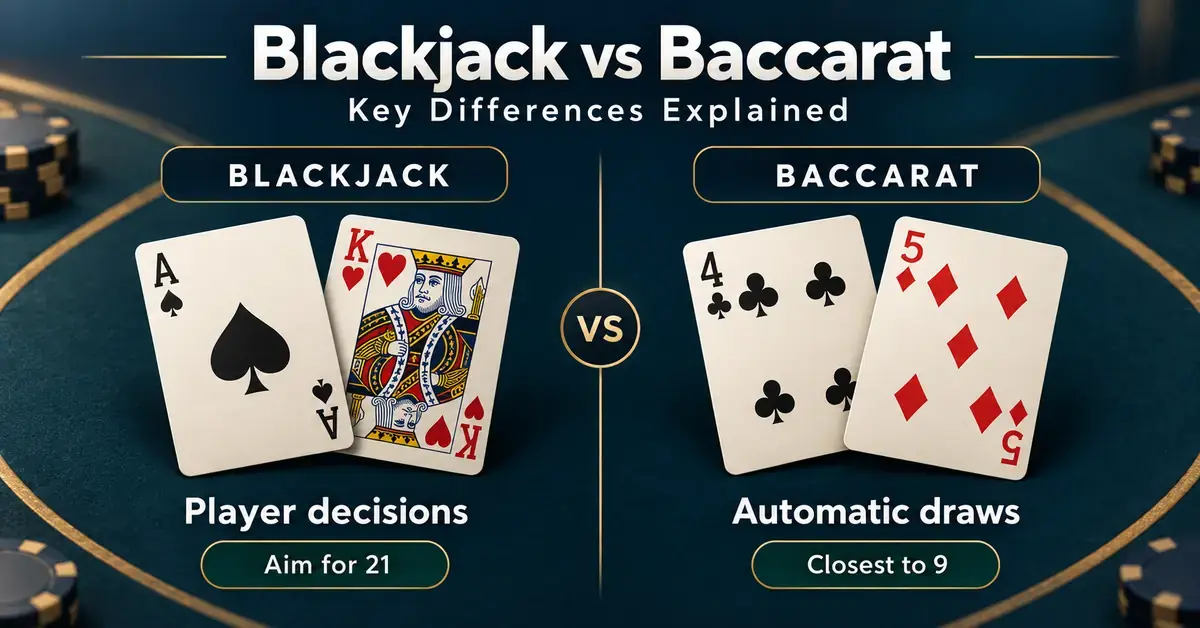
Blackjack and baccarat are two of the most recognisable card games on any casino floor, and both appear at Canadian land-based casinos and on provincially regulated online platforms. They can look similar at a glance — cards are dealt, hands are compared, and one side wins — but they play very differently. One rewards decision-making and study; the other is almost entirely automatic once you place your bet. This guide explains how each game works, where they differ, and how to decide which one fits the way you like to play.
What blackjack and baccarat have in common
Before the differences, it helps to see why the two games are often mentioned together. Both are dealt from a standard deck (or a shoe of several decks), both compare hand totals to decide a winner, and both are among the lower house-edge games available in a casino compared with slots. The house edge is the built-in mathematical advantage the casino keeps over the long run, expressed as a percentage of each bet. In both games that edge is small relative to most other options — but, importantly, the casino always keeps some edge over time. Neither game can be beaten reliably through normal play.
That is roughly where the similarities end. The way you interact with each game — and how much your choices matter — is what sets them apart.
How blackjack works
In blackjack you play your hand against the dealer, not against other players. The goal is to finish with a hand total closer to 21 than the dealer’s, without going over 21 (“busting”). Number cards are worth their face value, face cards (jack, queen, king) are worth 10, and an ace counts as 1 or 11, whichever helps your hand. If you want the full breakdown, see our guide to blackjack card values.
After you receive your first two cards, you make decisions: hit, stand, double down, split or surrender. Those choices are the heart of the game, because they directly change your odds. A two-card total of 21 (an ace plus a ten-value card) is a natural blackjack and normally pays 3:2, though some tables pay a worse 6:5. Because your decisions matter, players who follow a basic strategy chart can shrink the house edge to roughly 0.5% under common rules — one of the lowest edges in the casino.
How baccarat works
Baccarat feels almost like the opposite. You are not dealt a hand to manage; instead you bet on which of two hands — the “Player” or the “Banker” — will finish closer to a total of 9. You can also bet on a Tie. Despite the names, “Player” and “Banker” are just labels for the two hands; you are not obliged to bet on either in particular, and the Banker hand is not the casino.
Card values differ from blackjack: aces count as 1, cards 2 through 9 keep their face value, and tens and all face cards count as 0. Only the last digit of a total matters, so a hand of 7 and 8 (15) counts as 5. A two-card total of 8 or 9 is called a “natural” and usually ends the round immediately. Whether a third card is drawn is decided by fixed drawing rules — the third-card “tableau” — that the dealer or software applies automatically. You make no decisions after betting; the outcome simply unfolds.
Blackjack vs Baccarat Compared
| Feature | Blackjack | Baccarat |
|---|---|---|
| Objective | Beat the dealer; get close to 21 without busting | Bet on which hand (Player or Banker) totals closest to 9 |
| Your decisions | Many: hit, stand, double, split, surrender | One: which bet to place; cards then drawn automatically |
| Card values | Ace 1 or 11; 2–9 face value; 10 and face cards = 10 | Ace 1; 2–9 face value; 10 and face cards = 0 |
| Best-bet house edge | ~0.5% with basic strategy | ~1.06% on the Banker bet (after 5% commission) |
| Role of skill | High — decisions change the long-run edge | Minimal — fixed drawing rules, no strategy |
| Key payouts | Even money; natural blackjack 3:2 (or 6:5) | Banker/Player even money; Tie 8:1 |
| Pace | Slower, more decisions per hand | Fast, few decisions |
| Main bets | Your hand vs the dealer | Player, Banker or Tie |
Blackjack vs baccarat: the key differences
House edge and odds
Under perfect basic strategy, blackjack’s house edge sits around 0.5% with common rules and a 3:2 payout — meaning it gives back more, on average, than baccarat’s best bet. In baccarat, the Banker bet carries a house edge of about 1.06% after the standard 5% commission, the Player bet about 1.24%, and the Tie bet a much steeper 14.36%. Over many hands the Banker wins about 45.8% of the time, the Player about 44.6%, and a Tie about 9.6%. You can read more about how these numbers are calculated in our overview of blackjack odds and house edge.
Skill versus chance
This is the biggest divide. Blackjack is a skill-influenced game: your choices genuinely change the long-run result, which is why the ~0.5% figure assumes correct play — bad decisions push the edge much higher. Baccarat is close to a pure game of chance. Beyond choosing Player, Banker or Tie, there is nothing to decide, because the drawing rules are fixed. No strategy chart or betting system changes baccarat’s built-in edge.
Pace and complexity
Blackjack is slower and asks more of you each hand — reading your total, the dealer’s up-card and the correct play. Baccarat is fast and simple: place a bet, watch the cards, collect or lose. That simplicity is part of its appeal for players who want minimal thinking, and part of why blackjack appeals to those who enjoy an element of skill.
Betting options and payouts
In blackjack you bet on your own hand and win even money on most hands, with 3:2 (or 6:5) on a natural; there are also optional side bets and the insurance offer, which basic strategy usually advises skipping. In baccarat you choose among three main bets, with Banker and Player paying even money (Banker minus the 5% commission) and the Tie paying 8:1 at most tables but carrying the worst odds by far.
Which game should you play?
There is no single “better” game — it depends on what you want from the experience. Blackjack tends to suit players who enjoy making decisions, learning strategy and having some influence over the outcome. Baccarat suits players who prefer a fast, low-effort game with straightforward bets and don’t want to memorise any strategy. Both are widely available in Canada, including as live dealer versions online, and blackjack in particular has many rule variants worth understanding before you sit down.
Key Points
- Blackjack is a skill-influenced game; baccarat is almost pure chance once you bet.
- Blackjack’s edge is about 0.5% with correct basic strategy — lower than baccarat’s best bet.
- In baccarat, the Banker bet (~1.06%) beats the Player bet (~1.24%); the Tie (~14.36%) is best avoided.
- Card values differ: in baccarat, tens and face cards count as 0.
- Both games always keep a house edge — neither can be beaten reliably through normal play.
Common misconceptions
- “Betting the Banker beats the casino.” The Banker bet has the lowest edge in baccarat, but it is still a losing bet over the long run once the 5% commission is applied.
- “Baccarat has a winning strategy.” Because the drawing rules are fixed, no system changes the odds. Patterns on a scorecard do not predict future hands.
- “Blackjack and baccarat play the same.” They share the compare-the-hands idea, but blackjack is decision-driven while baccarat is automatic after your bet.
- “The Tie bet is worth it because it pays 8:1.” The high payout does not make up for how rarely ties happen; its house edge is far higher than any main bet in either game.
Responsible gambling
This article is for information only and is not betting advice or a recommendation to gamble. Both blackjack and baccarat always keep a house edge, so the casino wins over the long run and no strategy or bet guarantees a profit. If you choose to play, set a budget and time limit, treat any money spent as the cost of entertainment, and never chase losses. You must be of legal gambling age in your province or territory. If gambling stops being fun or feels out of control, free confidential help is available across Canada — see our responsible gambling resources for provincial support lines and tools.
Frequently asked questions (FAQ)
Which has the better odds, blackjack or baccarat?
Blackjack does, if you play well. With correct basic strategy and common rules its house edge is around 0.5%, lower than baccarat’s best bet, the Banker, at about 1.06% after commission. Without good strategy, however, blackjack’s edge rises quickly.
Is baccarat harder to learn than blackjack?
No — baccarat is generally easier to learn because you make no decisions beyond choosing which bet to place. Blackjack has more rules and requires learning when to hit, stand, double or split to play it well.
What is the best bet in baccarat?
The Banker bet has the lowest house edge, around 1.06% after the 5% commission. The Player bet is close behind at about 1.24%, while the Tie bet has a very high edge of about 14.36% and is best avoided.
Can you use strategy to win at baccarat like in blackjack?
No. Baccarat’s drawing rules are fixed and automatic, so no chart or betting system changes the odds. Blackjack is different because your in-hand decisions genuinely affect the long-run house edge.
Are blackjack and baccarat legal in Canada?
Yes. Both are offered at licensed land-based casinos and on provincially regulated online gambling platforms across Canada, subject to the legal gambling age in your province or territory.
