
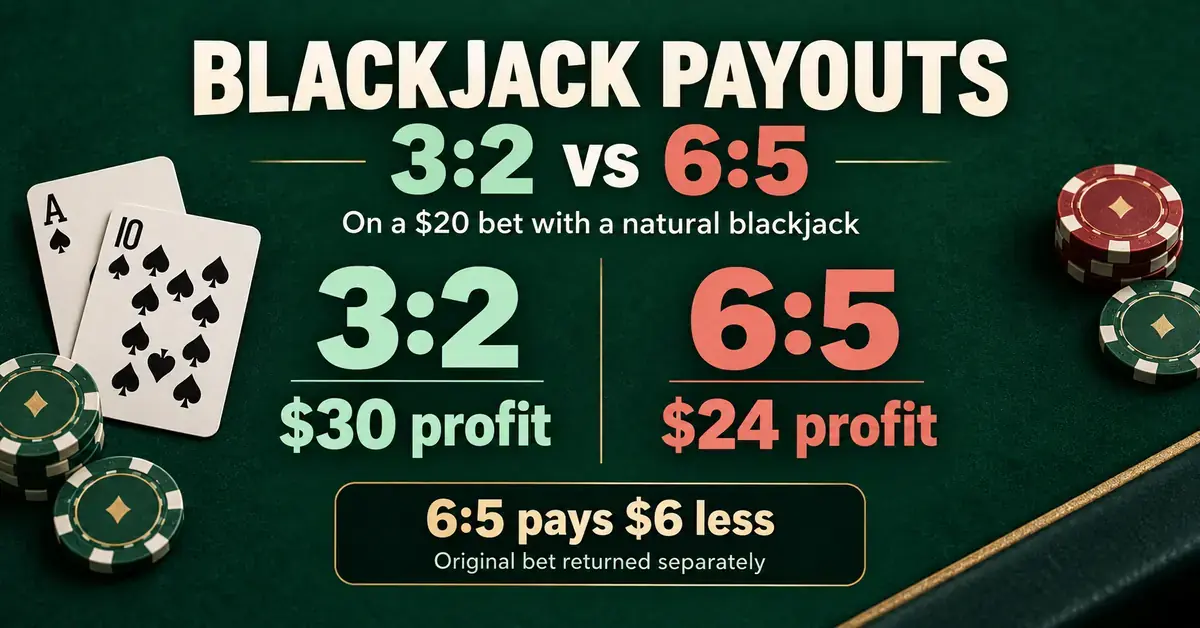
The number printed on a blackjack table — “Blackjack pays 3 to 2” or “Blackjack pays 6 to 5” — is one of the most important rules on the felt, and one that many casual players walk straight past. It only affects the hands where you are dealt a natural blackjack, but because it changes how much those winning hands pay, it quietly shifts the whole cost of playing. This guide compares the two payouts in plain numbers: what each one pays on a real bet, how much the difference costs over time, and why a 6:5 table is one to avoid whenever a 3:2 table is available.
Key Points
- 3:2 pays $3 for every $2 bet — $15 on a $10 blackjack.
- 6:5 pays $6 for every $5 bet — only $12 on the same $10 blackjack.
- 6:5 adds about 1.4% to the house edge, pushing a typical game from ~0.5% to ~1.9%.
- A natural blackjack lands roughly 1 in 21 hands (about 4.8%).
- 6:5 is most common on single-deck tables used as a lure — always read the felt and pick 3:2.
How blackjack payouts work
A payout ratio tells you how much you win relative to the amount you bet when you hit a natural — an ace plus any ten-value card dealt as your first two cards. If you want the exact definition of the hands this applies to, see our guide on what actually counts as a blackjack. The payout only applies to that natural; ordinary winning hands (say, a 20 that beats the dealer) always pay 1:1, or even money, no matter what the sign says.
Here is what each ratio means in dollars:
- 3:2 (three to two) pays $3 for every $2 you wager. On a $10 bet, a blackjack returns $15 in winnings.
- 6:5 (six to five) pays $6 for every $5 you wager. On the same $10 bet, a blackjack returns just $12 in winnings.
- 1:1 (even money) pays $1 for every $1 — the worst common option, sometimes offered as a fixed rule or taken voluntarily against a dealer ace.
So on a single $10 blackjack the difference between 3:2 and 6:5 is $3. That may sound trivial, but a natural is the one hand where the payout is supposed to reward you, and 6:5 shaves 20% off that reward every time.
The money difference on a real bankroll
The gap widens with your stake. Because 6:5 pays in fifths of your bet, the true shortfall scales directly with how much you wager per hand. The table below shows the winnings on a natural at each payout, and what you leave on the table with 6:5.
Payout Comparison
| Your bet | 3:2 winnings | 6:5 winnings | Lost to 6:5 |
|---|---|---|---|
| $10 | $15 | $12 | $3 |
| $25 | $37.50 | $30 | $7.50 |
| $50 | $75 | $60 | $15 |
| $100 | $150 | $120 | $30 |
A natural blackjack lands roughly once every 21 hands (about 4.8% of the time). At a brisk table you might see 60 to 80 hands an hour, so you can expect around three or four naturals per hour. At $25 a hand that is a $7.50 shortfall per blackjack under 6:5, or roughly $22–$30 an hour handed back to the house for nothing but a different sign on the table — before you even account for the higher house edge described below.
Why 6:5 raises the house edge
The house edge is the casino’s built-in long-run advantage, expressed as a percentage of your total bets. A standard 3:2 game played with correct basic strategy carries a house edge of only about 0.5%, which is one of the lowest in the casino. Switching that same game to a 6:5 payout adds about 1.39% to the edge, pushing it up toward roughly 1.9% — nearly four times as expensive over the long run.
The reason is straightforward. You are dealt a natural about 4.8% of hands, and 6:5 reduces the reward on each of those hands from 1.5× your bet to 1.2× your bet. Multiply that lost 0.3× by how often naturals occur and you get the extra edge the casino keeps. Independent maths references put a typical eight-deck game at about 0.41% under 3:2 versus about 1.77% under 6:5 — the same 1.4% swing.
Put another way: at a 0.5% edge you expect to lose about $0.50 for every $100 wagered; at 1.9% you expect to lose about $1.90 per $100. The cards, the strategy and the fun are identical, but your expected cost roughly quadruples. For a fuller picture of how rules move the numbers, see our overview of blackjack odds and house edge.
Other payouts you might see
3:2 and 6:5 are the two you will meet most often, but they are not the only structures on offer:
- 7:5: An in-between payout that shows up occasionally. It pays $7 for every $5 (so $14 on a $10 bet) — better than 6:5 but still worse than 3:2.
- Even money (1:1): The weakest common payout. Some low-limit and novelty tables pay all blackjacks at even money, adding roughly 2.3% to the house edge. “Even money” is also the name of a specific offer you can take against a dealer ace — see our guide to insurance and even money before you ever accept it.
- Promotional 2:1: Casinos sometimes run limited-time 2:1 blackjack promotions, which actually swing the edge in the player’s favour on that hand. These are rare and time-limited.
- Variant payouts: Some blackjack variants change the payout as part of their design. Spanish 21, for example, pays even money on some 21s but offers bonus payouts that compensate. A variant’s payout can only be judged alongside its full rule set.
How to spot the payout before you sit down
The payout is almost always printed directly on the table felt or on a small placard beside the shoe, using the words “Blackjack pays 3 to 2” or “Blackjack pays 6 to 5.” A few habits protect you:
- Read the felt first. Never assume — check the printed payout before you buy chips.
- Be wary of the single-deck lure. 6:5 is most common on single-deck and low-limit tables, which are marketed as “better” because fewer decks slightly lower the edge. That small benefit does not come close to offsetting the 1.4% that 6:5 adds; a multi-deck 3:2 table is the better bet.
- Watch online too. Digital and live-dealer tables list the payout in the rules panel or game info. Confirm it there before you play.
Does 6:5 change how you play?
No. Basic strategy — when to hit, stand, double or split — is driven by the cards, not the payout, so your decisions stay exactly the same at a 6:5 table. What changes is the outcome: every correct play is now working against a larger house edge, so the same skill earns you less. The 6:5 rule also erodes the value of advantage techniques such as card counting, because the whole point of an advantage is captured on natural blackjacks, which now pay less. The practical takeaway is simple: play the same way, but choose a 3:2 table whenever you can.
Friskrivning
This article is for information and entertainment only. It is not gambling advice, and no payout, rule or strategy changes the fact that blackjack always keeps a long-run edge for the house. The 3:2-versus-6:5 comparison here explains cost, not a way to beat the game. The legal gambling age in Canada is 18 or 19 depending on your province or territory. If gambling is affecting you or someone you know, please read our responsible gambling page for Canadian support resources and set a budget you can afford to lose before you play.
Sources
Frequently Asked Questions (FAQ)
Is 3:2 or 6:5 better for the player?
3:2 is clearly better. It pays $15 on a $10 blackjack versus $12 at 6:5, and it keeps the house edge far lower — typically around 0.5% compared with roughly 1.9% for the same game at 6:5. Choose a 3:2 table whenever one is available.
How much does 6:5 actually cost me?
On each natural, 6:5 pays 20% less than 3:2 — $3 less on a $10 bet, $7.50 less on a $25 bet. Across the roughly three to four blackjacks you would see in an hour, that adds up quickly, and the higher house edge (about 1.4% more) increases your expected loss on every bet you make.
Why do casinos offer 6:5 blackjack at all?
Because it earns them more. The lower payout increases the house edge, so 6:5 tables are more profitable per hand. They are often single-deck or low-limit tables marketed as beginner-friendly, which can make the weaker payout easy to miss.
How often is a blackjack dealt?
About 4.8% of hands — roughly once every 21 hands. The exact figure is close to 4.83% in a single-deck game and about 4.75% with six or eight decks. Because it is uncommon, the payout on those hands matters a great deal.
Should I change my strategy at a 6:5 table?
No. Basic strategy depends on the cards, not the payout, so your hit, stand, double and split decisions stay the same. The payout only changes how much you win, not how you should play — and it lowers the value of any advantage play.
