
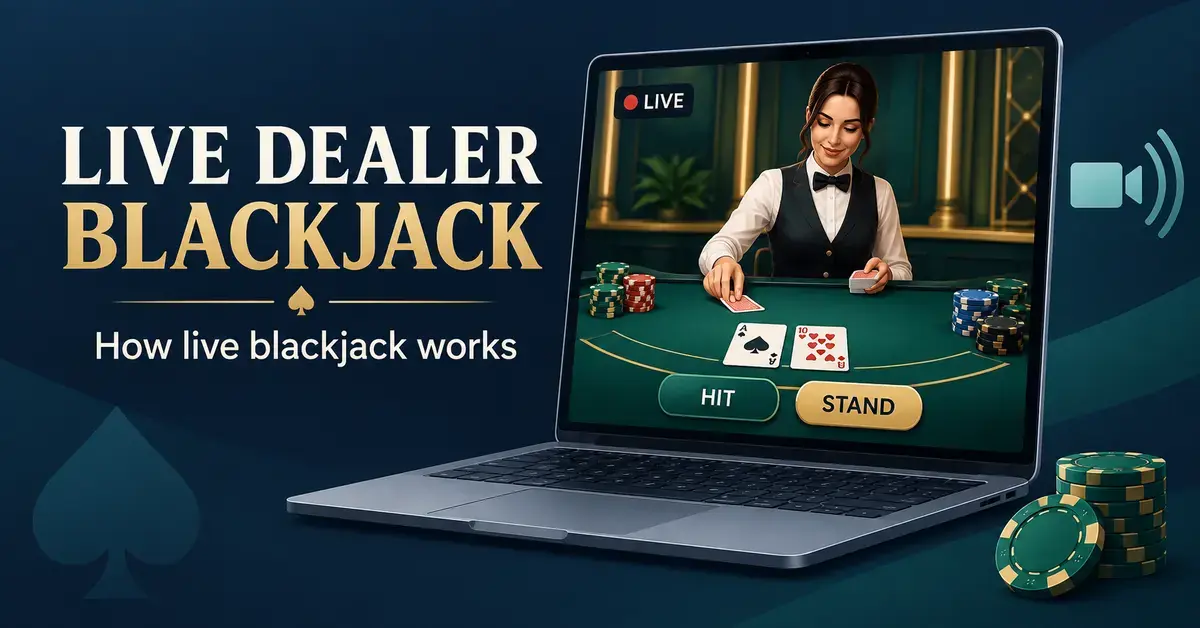
Live dealer blackjack is online blackjack played against a real human dealer who is filmed at a table and streamed to your screen in real time. Instead of a computer animation, you watch an actual croupier shuffle, deal physical cards and settle the hand, while you place bets and choose your moves through buttons on the video feed. It blends the pace and atmosphere of a land-based casino with the convenience of playing from home. This guide explains what live blackjack is, how the technology works behind the scenes, how a hand plays out, the main variants and side bets, and how it is regulated in Canada.
What is live dealer blackjack?
Live dealer blackjack (also called live blackjack) is a version of online blackjack where the game is run by a person, not by software alone. A dealer works from a professional studio or a real casino floor, using genuine cards on a real table. High-definition cameras capture every action and the video is streamed to your device, while an on-screen interface lets you bet and act on your hand.
The card game itself is the same blackjack you already know: you try to get a hand total closer to 21 than the dealer without going over. What changes is the delivery. You are watching a live broadcast rather than a random animation, you can often chat with the dealer, and rounds run at the natural speed of real dealing rather than instantly.
Key Facts
| What it is | Online blackjack streamed from a studio with a real human dealer and real cards |
|---|---|
| Main studios | Evolution, Pragmatic Play Live, Ezugi |
| Typical seats | Usually 7 (unlimited in Infinite Blackjack) |
| Blackjack payout | Usually 3:2 |
| Typical RTP | Around 99.3% with correct basic strategy (varies by table rules) |
| Common side bets | Perfect Pairs, 21+3 |
| Free demo play | Rarely available (a real dealer runs each table) |
| Canada availability | Regulated via iGaming Ontario / AGCO in Ontario; provincial platforms elsewhere |
How live dealer blackjack works
Turning a physical card table into an interactive online game takes three main pieces of technology working together: the studio and dealer, the camera and card-reading system, and the digital interface layered over the video.
The studio and the dealer
Most live games are filmed in a purpose-built studio designed like a television broadcast set, with professional lighting, sound and multiple tables. A trained dealer manages the cards and the game flow, greets players and often responds to messages typed into a live chat window. Some operators also stream from tables located inside real casinos.
Cameras and card reading (OCR)
Each table has several high-definition cameras providing wide, over-the-shoulder and close-up angles. Modern studios typically broadcast in 1080p, and the value of every card is captured the moment it is dealt. To convert the physical cards into on-screen information, studios use optical character recognition (OCR) — software that scans the camera image, identifies each card’s rank and suit, and sends that data to the game platform. This is why your screen instantly shows your hand total updating as cards land on the felt.
The interface and latency
Over the live video, the platform overlays a digital interface: your balance, the betting spots, the timer for each decision and the action buttons. When you click a button, your choice is transmitted back and reflected in the game. Well-run studios keep the delay (latency) low so the video and your actions stay in sync, which is what makes the experience feel like sitting at a real table.
How a hand of live blackjack plays out
Gameplay follows standard blackjack rules. You place a bet within a time limit, the dealer deals two cards to each active betting position and one or two cards to themselves, and then you decide how to play your hand.
The core decisions are the same five blackjack player actions: hit, stand, double down, split and (where offered) surrender. A two-card total of 21 is a natural blackjack, which normally pays 3:2. If the dealer shows an ace you may be offered insurance, a side bet that basic strategy usually advises skipping. Because outcomes depend on real cards and fixed rules, you can apply the same basic strategy you would use anywhere else — the live format changes the presentation, not the math.
One practical difference: live tables run on the dealer’s clock. Each decision has a countdown, and if the timer runs out the interface makes a default choice (usually stand). New players should get comfortable with the pace before playing at higher stakes.
Seats, Bet Behind and Infinite Blackjack
A classic blackjack table has a limited number of seats — commonly seven. During busy periods those seats fill up, so studios use two features to let more people play at once.
Bet Behind
Bet Behind lets you wager on the hand of a seated player without taking a seat yourself. If that player’s hand wins, your Bet Behind wager wins too; the seated player makes all the decisions. This means many people can back the same seat, so a table can accommodate far more players than there are chairs.
Infinite Blackjack
Infinite Blackjack removes the seat limit entirely. Every player at the table is dealt the same starting two-card hand, and from that shared start each person makes their own independent decisions — hit, stand, double, split — on their own copy of the hand. This lets an unlimited number of players join one table at the same time, and it typically comes with extra side bets and a Six Card Charlie rule (a hand of six cards without busting wins automatically).
Live blackjack variants and side bets
Beyond the classic game, studios offer several rule variants. Common examples include:
- Free Bet Blackjack — the house pays for certain double downs (hard 9, 10 or 11) and most splits, though a dealer total of 22 pushes rather than busts.
- Power Blackjack — lets you double, triple or quadruple your bet on your first two cards, with some tens removed from the shoe.
- Speed and party tables — faster dealing or a livelier, entertainment-focused presentation, often with lower minimum bets.
Optional side bets are also popular. Two of the most common are:
- Perfect Pairs — pays if your first two cards form a pair, with bigger payouts for a matched colour or an identical (perfect) pair.
- 21+3 — combines your two cards with the dealer’s up-card to form a three-card poker hand, paying for combinations such as a flush, straight or three of a kind.
Side bets add excitement but carry a much higher house edge than the main game — often several percent — so they cost more over time. Treat them as entertainment, not a way to improve your odds.
Live dealer vs. digital (RNG) blackjack
Standard online blackjack uses a random number generator (RNG) — software that produces card outcomes instantly. Live dealer blackjack uses real cards read from a video stream. Both are legitimate; they simply suit different players. The table below compares them.
Live vs. Digital Blackjack
| Feature | Live dealer blackjack | Digital (RNG) blackjack |
|---|---|---|
| Dealer | Real human, streamed live | Software / animation |
| Card outcomes | Physical cards read by OCR | Random number generator |
| Pace | Real-time dealing with a decision timer | Instant; play at your own speed |
| Table minimums | Often higher | Often very low |
| Social interaction | Live chat and other players | None |
| Free / demo play | Rarely available | Usually available |
Is live dealer blackjack legal in Canada?
Online gambling in Canada is regulated at the provincial level. In Ontario, a private, regulated iGaming market opened in April 2022: operators must be registered with the Alcohol and Gaming Commission of Ontario (AGCO) and hold an agreement with iGaming Ontario (iGO) to legally offer real-money games, including live dealer blackjack, to residents. Studios such as Evolution, Pragmatic Play Live and Ezugi supply live tables to these licensed sites.
Outside Ontario, most provinces offer legal online play through their own government-run platforms (for example provincial lottery and gaming corporations), which also feature live dealer tables. You can read more about the wider picture in our overview of blackjack in Canada. Wherever you play, choosing a provincially licensed or regulated site means the games are audited and you have consumer protections if something goes wrong.
How to get started
Trying live blackjack is straightforward once you are on a licensed platform:
- Register an account and complete identity verification, which regulated operators require.
- Deposit funds and open the live casino lobby.
- Pick a table that matches your budget — check the minimum and maximum bet before you sit down.
- Place your bet within the timer, then use the on-screen buttons to hit, stand, double or split.
If you are completely new to the game, review the basics in our guide to how to play blackjack first. Note that live tables rarely offer free or demo play, because a real dealer is running the game — so practise the rules and strategy on an RNG table before betting real money live.
Common mistakes to avoid
- Ignoring the timer. Decide your move early so you are not rushed into a default action.
- Chasing side bets. Perfect Pairs and 21+3 are fun but expensive over the long run.
- Playing above your budget. Live minimums are often higher than RNG tables; pick limits you can comfortably afford.
- Skipping basic strategy. The advantage of blackjack over other casino games disappears if you play on instinct.
- Assuming you can beat the house. Card counting does not work online: shoes are shuffled frequently and you cannot control the deck.
Responsible gambling
Blackjack, including live dealer blackjack, is a form of gambling with a built-in house edge. No strategy, side bet or system can guarantee a profit, and results are meant to be entertainment, not income. Only play with money you can afford to lose, set deposit and time limits, and never chase losses. You must be of legal gambling age in your province to play, and you should only use provincially licensed or regulated platforms.
If gambling is affecting you or someone you know, free confidential help is available across Canada. In Ontario, ConnexOntario offers 24/7 support at 1-866-531-2600. Other provinces run their own problem-gambling helplines. See our responsible gambling page for tools and resources.
Sources
- Evolution — Live Blackjack game information
- iGaming Ontario — Player help and regulated play
- Alcohol and Gaming Commission of Ontario (AGCO) — Gaming
- PokerNews — Blackjack side bets, odds and house edge
- Responsible Gambling Council — Help for Canadians
- ConnexOntario — Mental health, addictions and gambling support
Frequently asked questions (FAQ)
Is live dealer blackjack rigged?
No. On licensed, regulated platforms the game uses real physical cards dealt by a human and read by card-recognition software, and the studios are independently tested. Playing on a provincially licensed or regulated site is the best way to ensure fairness.
Can I use basic strategy in live blackjack?
Yes. Live blackjack follows the same rules as any other blackjack game, so basic strategy applies exactly the same way. It reduces the house edge but does not eliminate it, and it cannot guarantee a win on any single hand.
Does card counting work in live dealer blackjack?
Not in practice. Online live tables reshuffle frequently and you have no control over the shoe, which removes the conditions counting relies on. Treat live blackjack as entertainment rather than a way to gain an edge.
Is there a free version of live dealer blackjack?
Rarely. Because a real dealer runs each table, live blackjack is almost always real-money only. To practise for free, use a standard RNG blackjack game in demo mode first.
What is Bet Behind in live blackjack?
Bet Behind lets you wager on a seated player’s hand when the table’s seats are full. You win or lose based on how that player’s hand finishes, but they make all the playing decisions.
