
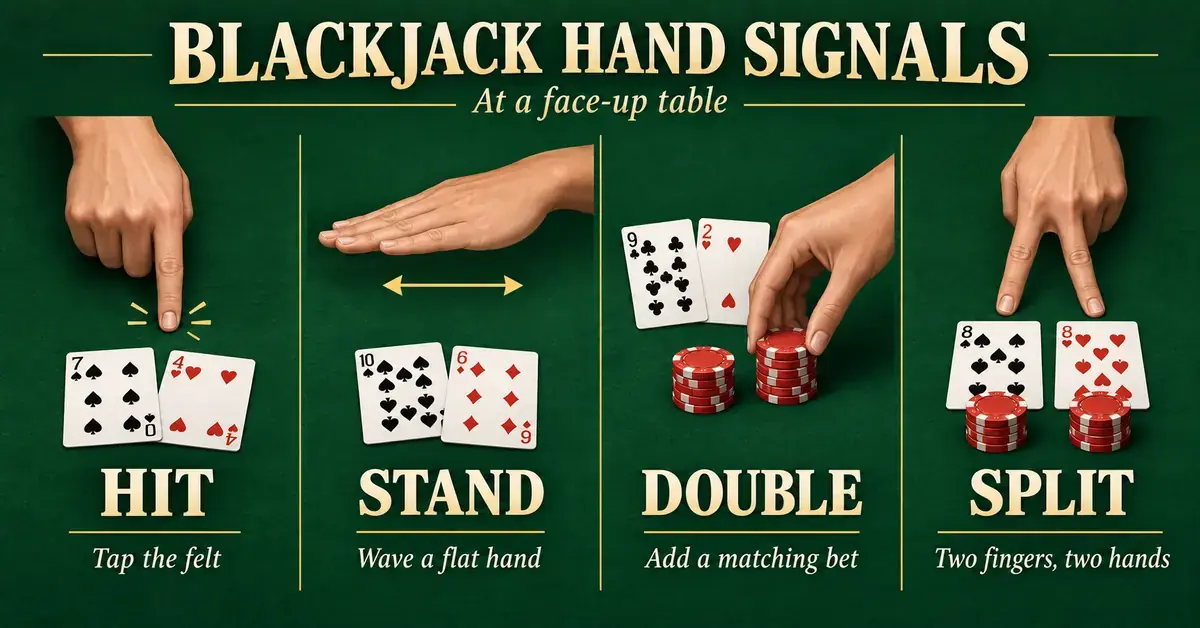
In a land-based casino, blackjack is a surprisingly quiet game. You rarely need to say a word to the dealer, because every decision is made with a small hand gesture. These movements — called hand signals — tell the dealer whether you want another card, want to stop, or want to double or split your bet. Learning them takes a couple of minutes and saves you from the one thing every new player dreads: holding up the table because nobody knows what you meant.
This guide covers exactly how to make each signal, how the gestures change between the two main table types, and the etiquette that keeps the game running smoothly. If you want the reasoning behind each decision instead — such as when to hit or stand — see our strategy guides, which focus on the maths rather than the mechanics.
Key Points
- Hit: tap or scratch the felt near your cards.
- Stand: wave a flat hand horizontally over your cards.
- Double down: add matching chips beside your bet (one finger optional).
- Split: add a matching bet and hold up two fingers in a V.
- Surrender: draw a line behind your bet and say “surrender.”
- Signals give the surveillance cameras a clear record of every decision.
- Online and live dealer games use on-screen buttons, not gestures.
Why blackjack uses hand signals
Casinos insist on hand signals for one main reason: a visual record. Above every table sits the surveillance system players nickname the “eye in the sky.” Cameras can see a gesture but cannot reliably hear a spoken request, so dealers are trained to act on what they can see, not what they hear. If a dispute ever arises about what a player asked for, the recording settles it.
There are practical reasons too. A busy floor is noisy, and a dealer managing several players cannot afford to mishear “hit” as “split.” A clear gesture removes the ambiguity, keeps the pace up, and protects both sides. Many dealers will ask you to confirm a borderline call with the matching signal even if you also say it out loud.
The two table types: face-up and face-down
The exact signal you use depends on how the cards are dealt, and there are two common formats:
- Face-up (shoe) games: Your cards are dealt face-up from a shoe (a box holding several decks). You never touch the cards at all — signals are made with your hand near the cards or the betting circle.
- Face-down (pitch) games: Usually single- or double-deck games dealt by hand. Here you are allowed to pick up your two cards with one hand, and some signals are made using the cards themselves.
Most modern blackjack in Canada is dealt face-up from a shoe, so if you learn only one set of signals, learn those. The sections below cover both.
How to signal each action in a face-up (shoe) game
These are the gestures you will use at the vast majority of tables. Keep them deliberate and visible to the camera.
Hit
To ask for another card, lightly tap or scratch the felt with one or two fingers, just behind your cards or bet. A gentle, repeatable motion is clearest. You can hit as many times as you like until you stand or go over 21.
Stand
To end your turn with no more cards, wave your flat hand horizontally over your cards, palm down, as if smoothing the air above them. This is the universal “no more” gesture and the single most important signal to get right.
Double down
To double your bet and take exactly one more card, place a second stack of chips next to — not on top of — your original bet. Do not touch the chips already in the circle. Many players also hold up one finger to show they expect a single card. Because you receive only one card, the double is a commitment; our guide on when to double down explains which hands justify it.
Split
When your first two cards are a pair, you can split them into two separate hands. Signal it by placing a matching second bet beside your original chips and holding up two fingers in a V shape. The dealer then separates the cards and deals a new card to each. See when to split pairs for which pairs are worth it.
Surrender
Where it is offered, surrender lets you fold a weak hand and reclaim half your bet. The signal is to draw an imaginary horizontal line on the felt behind your bet with your index finger, and — because this gesture is easy to confuse with a hit — you should also say “surrender” clearly. Not every table offers it, so check the felt or ask the dealer first.
Signal Cheat Sheet
| Action | Face-up (shoe) game | Face-down (pitch) game |
|---|---|---|
| Hit | Tap or scratch the felt behind your bet | Scrape your cards toward you on the felt |
| Stand | Wave a flat hand horizontally over the cards | Slide your cards face-down under your chips |
| Double down | Place matching chips beside your bet; one finger up | Lay cards face-up and add matching chips |
| Split | Place a matching bet; two fingers in a V | Lay cards face-up and add matching chips |
| Surrender | Draw a horizontal line behind the bet and say “surrender” | Ask the dealer; procedures vary by table |
Hand signals in face-down (pitch) games
In a hand-held game you hold your two cards, so several signals use the cards instead of your fingers:
- Hit: lightly scrape the edges of your cards toward you across the felt.
- Stand: slide your cards face-down under the chips in your betting circle, tucking them beneath the bet.
- Double down or split: turn your cards face-up on the table and place the additional chips beside your original bet, exactly as in a shoe game.
A few rules of handling apply in pitch games: use only one hand, keep the cards over the table at all times, and never remove them from the dealer’s view. If you are unsure, ask — dealers would far rather explain than reset a hand.
Table etiquette: the do’s and don’ts
Signals are only part of smooth play. A few habits keep you on the right side of the dealer and the pit:
- Place your bet before the deal. Once cards are out, do not add to or touch your wager except to double or split, and even then you add chips beside it rather than moving the original.
- Do not touch your cards in a face-up game. The dealer handles everything; your hands stay near, not on, the cards.
- Make one clear signal. Hesitant half-gestures confuse the dealer and the camera. Decide, then signal.
- Keep chips and cards in your own space. Learning the common blackjack terms also helps you follow the dealer’s calls.
- Ask if you are stuck. There is no penalty for asking the dealer to confirm the right signal.
Hand signals online and in live dealer games
When you play blackjack online against a computer, there are no hand signals at all — you simply click on-screen buttons labelled Hit, Stand, Double and Split. The same is true of live dealer blackjack, where a real dealer streams to your screen but you still make decisions with buttons rather than gestures, because the dealer cannot see you. Physical hand signals only matter when you are sitting at a real table in a casino.
Putting it together
Hand signals look like insider knowledge, but they are just a short, practical vocabulary: tap to hit, wave to stand, add chips to double or split, and a line behind the bet to surrender. Once the gestures are automatic, you can focus on the decisions themselves. For the full picture of what each move does, read our overview of the core blackjack player actions, then let strategy — not guesswork — guide which signal you make.
Responsible gambling
Blackjack is a form of gambling, not a way to make money. The house keeps a mathematical edge over the long run, and no hand signal, system or betting pattern changes that. Play only with money you can afford to lose, set limits before you start, and treat any winnings as entertainment rather than income.
The legal gambling age in Canada is 19 in most provinces and 18 in Alberta, Manitoba and Quebec. If gambling is affecting you or someone you know, free and confidential help is available through the Responsible Gambling Council, ConnexOntario (1-866-531-2600, available 24/7), and provincial programs such as GameSense and PlaySmart. This article is informational only and is not gambling advice.
Sources
Frequently asked questions
Why do I have to use hand signals in blackjack?
Casinos require hand signals so the overhead surveillance cameras have a clear visual record of every decision. Cameras can see a gesture but cannot reliably capture spoken words, so a signal protects both you and the casino if there is ever a dispute about what you asked for.
How do I signal that I want to stand?
Wave your flat hand horizontally over your cards, palm facing down, as if smoothing the air above them. In a face-down game you instead slide your cards under the chips in your betting circle. This tells the dealer you want no more cards.
What is the hand signal for doubling down?
Place a second stack of chips next to your original bet without touching the chips already down; many players also hold up one finger. The dealer then gives you exactly one more card and your turn ends.
Do I use hand signals when playing blackjack online?
No. Online games and live dealer tables both use on-screen buttons for hit, stand, double and split, because the dealer or software cannot see your hands. Physical signals are only used at a real table in a land-based casino.
What happens if I use the wrong signal?
The dealer acts on the gesture they see, so an unclear or wrong signal can lead to a card you did not want. If that happens, stay calm and tell the dealer and floor supervisor straight away — the camera footage can usually confirm what you intended. When in doubt, make one clear gesture and confirm it out loud.
