
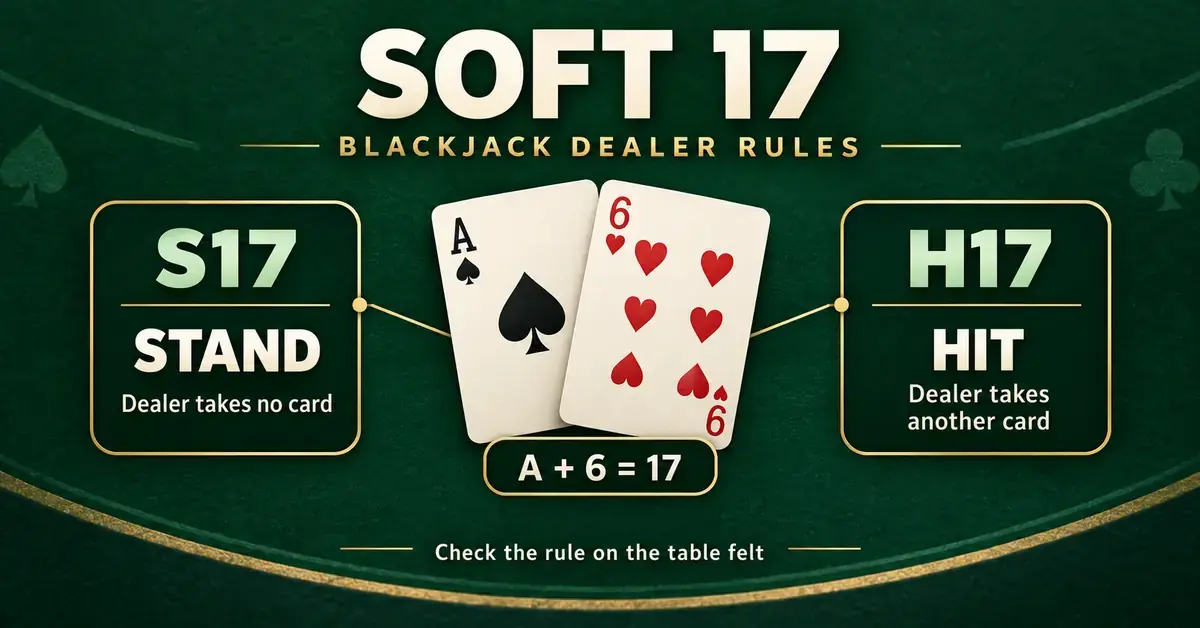
One small line printed on the blackjack table decides thousands of hands over your playing lifetime: what the dealer does when they hold a soft 17. At some tables the dealer must stop; at others the dealer takes another card. That single difference changes the odds in the casino’s favour, yet most players never notice it. This guide explains what a soft 17 is, the two dealer rules you will meet, exactly how much each one costs you, and how to tell them apart before you place a bet.
Key Points
- Soft 17 is any 17 that includes an ace counted as 11 — most often Ace-6.
- Tables use one of two dealer rules: S17 (dealer stands on soft 17) or H17 (dealer hits soft 17).
- H17 is worse for the player, adding about 0.22% to the house edge.
- The rule is printed on the table felt — always read it before you sit down.
- In Canada the rule varies by casino and even by table, so check each game individually.
What is a soft 17?
A hand is called soft when it contains an ace being counted as 11. Because an ace can be worth either 1 or 11, a soft hand can never bust on the next card — if a big card arrives, the ace simply drops to 1. A soft 17 is therefore any 17 that includes an ace counted as 11.
The most common example is Ace-6 (11 + 6 = 17), but Ace-2-4 and Ace-3-3 are soft 17s too. Compare that with a hard 17, such as 10-7 or 9-8, where there is no flexible ace. A hard 17 is fragile because one more card can easily push it past 21, while a soft 17 can be drawn to safely. If the distinction between soft and hard hands is new to you, our guide to blackjack card values breaks down how the ace works in detail.
The two dealer rules: stand or hit on soft 17
Unlike you, the dealer has no choices. They follow a fixed set of rules printed on the felt, and every table uses one of two versions when the dealer reaches a soft 17:
- S17 — dealer stands on soft 17. The dealer treats a soft 17 the same as any other 17 and stops. This is the more player-friendly rule.
- H17 — dealer hits soft 17. The dealer must draw one more card on a soft 17 and keep going until they reach a hard 17 or higher (or bust). This rule quietly favours the house.
In both versions the dealer always stands on a hard 17, so the rule only ever affects hands where the dealer’s 17 contains an ace as 11. That sounds like a rare edge case, but soft 17s come up often enough to matter over time.
H17 vs S17 Comparison
| Feature | S17 (stands on soft 17) | H17 (hits soft 17) |
|---|---|---|
| What the dealer does | Stops on any soft 17 | Draws another card on soft 17 |
| Effect on house edge | Baseline (more player-friendly) | About +0.22% for the house |
| Dealer bust rate | Slightly lower | Slightly higher, but offset by stronger final hands |
| Better for | The player | The casino |
| Printed on the felt as | “Dealer must stand on all 17s” | “Dealer must hit soft 17” |
Why does hitting soft 17 help the casino?
At first glance, forcing the dealer to hit a made 17 looks like it should help the player — surely the dealer will bust more often? They do bust slightly more. But that is not the whole story.
When the dealer hits a soft 17, roughly half the time the hand improves to 18, 19, 20 or 21. A standing 17 loses to, or pushes with, many of the hands players hold onto; an 18, 19 or 20 beats them. The extra winning hands the dealer picks up more than cancel out the small rise in dealer busts. Because the ace protects the dealer from going over 21 on that first draw, H17 is a low-risk, high-reward move for the casino — and that is precisely why so many tables use it.
How much does the soft 17 rule cost you?
The impact is small per hand but consistent. According to the rule-variations data published by gambling-maths resource Wizard of Odds, switching a table from S17 to H17 adds about 0.22% to the house edge — all other rules being equal.
To put that in perspective, a typical multi-deck game where the dealer stands on soft 17 and blackjack pays 3:2 has a house edge of well under 1% with correct play. Adding H17 pushes that edge up by roughly a fifth of a percent. On its own it will not empty your wallet, but combined with other unfavourable rules — such as 6:5 blackjack payouts — it adds up. Given a free choice between two otherwise identical tables, an S17 table is always the better seat.
How the soft 17 rule changes your play
Because H17 makes the dealer marginally stronger, a handful of basic blackjack strategy decisions shift when you sit at an H17 table. The differences are few, but they are worth knowing:
- Double a hard 11 against a dealer ace (instead of just hitting).
- Double a soft 18 (Ace-7) against a dealer 2, in addition to the usual 3 through 6.
- Double a soft 19 (Ace-8) against a dealer 6.
- Surrender more against a dealer ace where the option exists — for example hard 15 and hard 17 versus an ace.
Every other decision stays the same as it would under S17. If you already play a solid strategy, these small tweaks are all you need to adjust for. New to the game overall? Start with the fundamentals in our guide on how to play blackjack before layering in rule-specific adjustments.
How to tell which rule your table uses
You never have to guess. Casinos are required to print the dealer’s rule directly on the table layout, usually in a short phrase near the betting circles:
- “Dealer must stand on all 17s” means S17 — the friendlier rule.
- “Dealer must hit soft 17” (or “Dealer hits soft 17”) means H17.
Read that line before you sit down. In online and live-dealer blackjack the same information appears in the game’s rules or information panel. The rule can differ from table to table within the same room, so a quick look can quietly save you money.
The soft 17 rule in Canada
There is no single national standard — the soft 17 rule varies by operator, by property and sometimes by table. Some Canadian casinos deal S17, while many higher-limit or busy tables use H17, and provincial gaming rules in places like Ontario explicitly allow the dealer to draw on soft 17. Because it changes from one table to the next, the printed rule on the felt (or in the online game’s info panel) is always your source of truth. For a broader look at where and how the game is offered across the country, see our overview of blackjack in Canada.
Common mistakes to avoid
- Ignoring the felt. Sitting down without reading the dealer rule is the most common oversight — and the easiest to fix.
- Assuming H17 helps you. More dealer busts feel good, but the maths shows H17 favours the house overall.
- Confusing soft and hard 17. The rule only affects soft 17s; the dealer always stands on a hard 17.
- Playing S17 strategy at an H17 table. A few decisions change under H17 — skipping them gives back part of your edge.
Friskrivning: This article is for information and entertainment only and is not betting or financial advice. Blackjack is a game of chance; no rule knowledge, strategy or system can guarantee a win, and the house always keeps a mathematical edge. Only ever wager money you can afford to lose, and you must be of legal gambling age in your province or territory to play. If gambling is causing you or someone you know harm, free, confidential help is available in Canada through ConnexOntario (1-866-531-2600) and the Responsible Gambling Council, and you can read more on our responsible gambling page.
Sources
Frequently asked questions (FAQ)
What does “dealer stands on soft 17” mean?
It means the dealer must stop and take no more cards whenever their hand totals 17 and includes an ace counted as 11, such as Ace-6. This rule is known as S17 and is slightly better for the player than the alternative.
Is it better when the dealer hits or stands on soft 17?
It is better for you when the dealer stands (S17). Forcing the dealer to hit soft 17 (H17) makes the dealer’s average hand stronger and adds roughly 0.22% to the house edge, so an S17 table is the better choice whenever you have one.
Why is it called a “soft” 17?
It is soft because it contains an ace being counted as 11. That ace gives the hand flexibility: if another card would push the total over 21, the ace simply switches to a value of 1, so a soft hand cannot bust on the next card.
How can I tell if a table hits or stands on soft 17?
Look at the words printed on the table layout. “Dealer must stand on all 17s” is S17, while “Dealer must hit soft 17” is H17. In online or live-dealer games the same detail appears in the rules or information panel before you play.
Does hitting soft 17 change my basic strategy?
Only slightly. A few plays shift under H17 — for example doubling a hard 11 against a dealer ace, doubling Ace-7 against a 2, and taking a couple of extra surrenders against an ace. Every other decision stays the same as under S17.
