
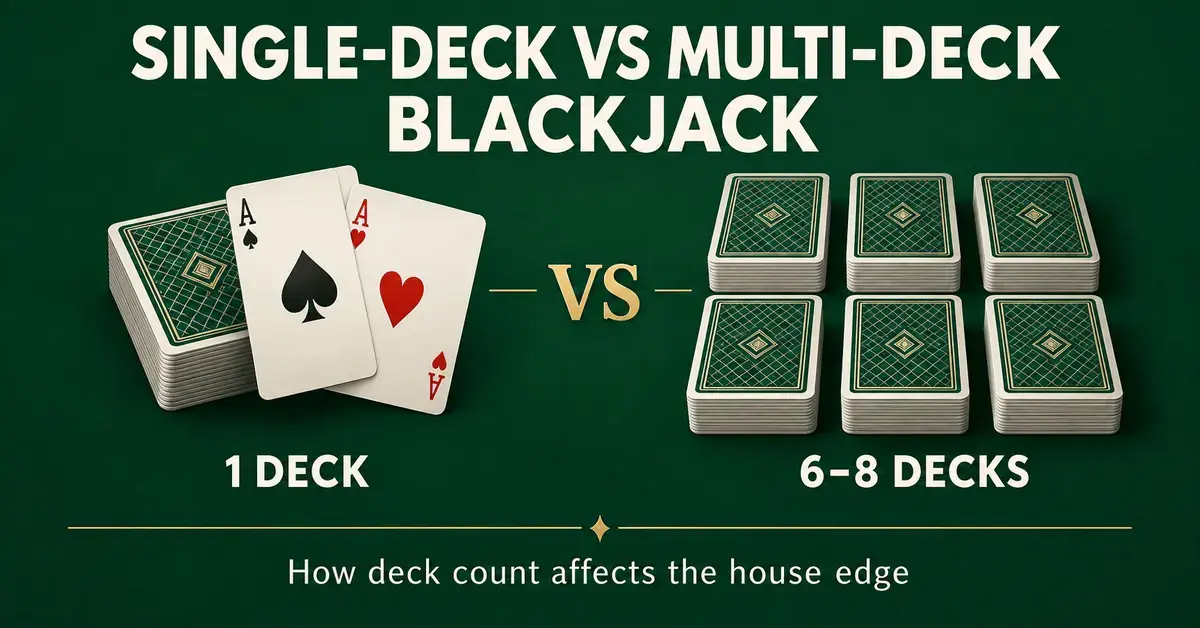
If you have ever wondered whether a single-deck blackjack table really gives you better odds than a six- or eight-deck shoe, the short answer is yes — but the gap is smaller than most players think, and it is easy to hand back. This guide puts single-deck and multi-deck blackjack side by side: how the number of decks changes the house edge (the casino’s built-in long-run advantage), why fewer decks help you, the catch that cancels out the benefit, and which format makes sense for a Canadian player.
Key Points
- Fewer decks help the player — one deck versus eight is worth about 0.48% in lower house edge under identical rules.
- The benefit is front-loaded: most of the gain is in the drop from eight decks to one or two; six and eight decks are nearly the same.
- The 6:5 trap cancels it out: a 6:5 payout adds about 1.39% to the house edge — far more than a single deck saves.
- Rule of thumb: a 3:2 six-deck table beats a 6:5 single-deck table every time.
- In Canada, six- and eight-deck shoes are the norm; genuine 3:2 single-deck games are rare.
What “deck count” actually means
Blackjack can be dealt from anywhere between one and eight standard 52-card decks. A single-deck game is dealt from one deck, usually by hand. Multi-deck games combine several decks in a shoe — a boxed card holder the dealer slides cards from — most often with four, six or eight decks. The cards and the basic goal never change: beat the dealer’s hand without going over 21. What changes is the probability of the cards you still need, and that small shift is enough to move the odds.
The reason is card removal. In a single deck, every card that has already been dealt is gone from the pack, so the composition of what remains swings sharply. Add more decks and each individual card matters less, which smooths the odds back toward the house. For a full breakdown of the underlying math, see our guide on how deck count affects blackjack odds.
How the number of decks changes the house edge
Under otherwise identical rules, fewer decks always favour the player. Using the widely cited figures from blackjack probability analysis (measured against a standard eight-deck game where the dealer stands on soft 17), the number of decks is worth roughly:
- Single deck: about 0.48% better for the player than eight decks
- Double deck: about 0.19% better than eight decks
- Four decks: about 0.06% better than eight decks
- Six decks: about 0.02% better than eight decks
- Eight decks: the baseline
In plain terms, going from one deck to eight adds roughly half a percentage point to the house edge. A liberal single-deck game that pays 3:2 can carry a house edge as low as about 0.15% with perfect basic strategy, while a comparable six- or eight-deck game sits closer to 0.5%–0.65%. Notice how the gain shrinks fast: most of the benefit is in the jump from eight decks down to one or two, and there is almost no practical difference between six and eight decks. For the big picture of how all these numbers fit together, our blackjack odds and house edge overview puts deck count in context with the other rules that move your edge.
Comparison
| Feature | Single-Deck Blackjack | Multi-Deck Blackjack (6–8 decks) |
|---|---|---|
| Decks in play | 1 (often hand-dealt) | 6 or 8, dealt from a shoe |
| Base house edge (3:2, good rules) | ~0.15% | ~0.5%–0.65% |
| Typical blackjack payout offered | Often 6:5 (worse) | Usually 3:2 (better) |
| Reshuffle frequency | Frequent | Infrequent (more hands per hour) |
| Card-counting difficulty | Easier | Harder (true-count conversion needed) |
| Availability in Canada | Rare | Standard, online and in person |
Why fewer decks help the player
Two effects drive the advantage. First, a natural blackjack (an ace plus a ten-value card, which normally pays 3:2) happens slightly more often with fewer decks, because once you hold an ace there are proportionally more ten-value cards left to pair it with. Second, doubling down and splitting pay off a little more reliably when card removal is strong, because you can better “use up” the cards you need. Added together, these edges are real but modest — which is exactly why the payout rule discussed next matters so much.
Single-deck blackjack: the catch
Here is where many players get caught. Because casinos know single-deck games favour the player, most modern single-deck tables — on casino floors and online — pay only 6:5 on a natural blackjack instead of the traditional 3:2. That one change is devastating: it adds about 1.39% to the house edge, nearly three times the roughly 0.5% you saved by dropping to a single deck.
Put simply, a single-deck 6:5 table is a worse bet than a six-deck 3:2 table, even though the single deck “sounds” better. The payout swamps the deck benefit many times over. Always check the felt and the screen for the payout before you sit down; our comparison of 3:2 vs 6:5 payouts shows exactly what the difference costs you per hour. A good rule of thumb: a 3:2 multi-deck game beats a 6:5 single-deck game every time.
Multi-deck blackjack: why casinos prefer it
Six- and eight-deck shoes are the default in most casinos, and there are practical reasons beyond the slightly higher edge. A shoe holds hundreds of cards, so the dealer reshuffles far less often, keeping more hands in play per hour. It also makes card counting much harder, since the running count must be divided across many decks to mean anything. For the casino, multi-deck games are faster, steadier and safer against advantage players — which is why they dominate the floor and nearly every online and live-dealer table.
How deck count changes basic strategy
The correct play on most hands is identical whether you face one deck or eight. A handful of borderline decisions do shift, almost all involving soft hands (a hand with an ace counted as 11) and some doubling plays. For example, in single-deck games basic strategy is slightly more aggressive with certain soft doubles — such as doubling a soft 18 (ace-7) against a dealer 2, or doubling ace-8 against a 6 — moves that a multi-deck chart tells you to skip.
For almost every recreational player the practical advice is simple: learn the standard multi-deck basic strategy and use it everywhere. The cost of applying multi-deck strategy at a single-deck table is tiny — a fraction of a percent — and far smaller than the mistakes you avoid by knowing one chart cold. If you want to go deeper, see how deck count interacts with the moves in our guides to common blackjack mistakes.
Deck count and card counting
Deck count matters most to card counters. Fewer decks make counting easier and more powerful because each card has a larger effect on the odds, and the count translates more directly into an edge. With a multi-deck shoe, counters must convert their running count into a true count by dividing by the number of decks left — and deep penetration (how far into the shoe the dealer deals before shuffling) matters more than the raw deck count. If you are curious how this works, our explainer on the Hi-Lo card counting system walks through running counts and true-count conversion. For the average player who is not counting, none of this changes the basic-strategy odds described above.
Single-deck vs multi-deck in Canadian casinos
In Canada, multi-deck is overwhelmingly the norm. Brick-and-mortar rooms such as Casino Niagara, River Rock and Casino de Montréal deal six- or eight-deck shoes, and Canadian online and live-dealer tables almost always use six or eight decks as well. Genuine hand-dealt single-deck games with a 3:2 payout are rare; where you do find a single deck, it usually carries the 6:5 catch. The practical takeaway for most Canadian players is to focus less on the deck count and more on the payout and dealer rules at the table in front of you.
Which should you play?
If you can find a single-deck or double-deck table that still pays 3:2 with reasonable rules, it offers the lowest house edge available — take it. In practice those games are scarce, so the realistic choice is a 3:2 six- or eight-deck game, which gives up only a fraction of a percent and is widely available. The one table to avoid is any game paying 6:5, regardless of deck count. Deck count is a real factor, but it ranks well below the blackjack payout and the dealer’s soft-17 rule when you are sizing up a table’s true cost.
Responsible Gambling
This article is for information and education only; it is not betting advice and does not promise winnings. Blackjack always keeps a house edge over the long run, and no choice of deck count or strategy changes the fact that the game is designed for the casino to profit. The legal gambling age in Canada is 19 in most provinces and 18 in Alberta, Manitoba and Quebec. If gambling is no longer fun or is affecting your finances or wellbeing, free, confidential help is available — in Ontario through ConnexOntario (1-866-531-2600), and through your own province’s problem-gambling service. See our responsible gambling resources for more support options.
Sources
- Wizard of Odds — Blackjack Rule Variations (effect of number of decks and payouts on house edge)
- Las Vegas Advisor / Gambling With an Edge — Calculating the House Edge for Any Number of Decks and Rules
- Las Vegas Advisor — What’s So Bad about 6-5 Blackjack?
- ConnexOntario — Free, confidential problem-gambling support
Frequently Asked Questions
Is single-deck blackjack better than multi-deck?
Under identical rules, yes — a single deck lowers the house edge by roughly half a percent compared with eight decks, mainly because naturals and doubles pay off a little more often. But the advantage is small and only holds if the single-deck table pays 3:2. Most single-deck games today pay 6:5, which makes them worse than a standard six-deck 3:2 game.
How much does each extra deck add to the house edge?
The effect is front-loaded. Moving from one deck to two gives back most of the benefit, and going from six decks to eight barely changes anything. In total, one deck versus eight is worth about 0.48% to the player under the same rules — a meaningful but modest gap.
Why do single-deck tables pay 6:5 instead of 3:2?
Casinos use the 6:5 payout to claw back the advantage that fewer decks give the player, and then some. Paying 6:5 on a natural instead of 3:2 adds about 1.39% to the house edge — far more than the roughly 0.5% a single deck saves you — so a 6:5 single-deck game is a poor bet despite the appealing deck count.
How many decks do Canadian casinos and online tables use?
Most Canadian live casinos and online and live-dealer tables deal from six- or eight-deck shoes. True single-deck games are uncommon, and when they appear they usually come with the 6:5 payout. For most players in Canada, checking the payout and dealer rules matters more than hunting for a low deck count.
Does the number of decks change basic strategy?
Only slightly. Most hands play the same regardless of deck count; a few soft-hand and doubling decisions become more aggressive in single-deck games. For practical purposes, learn the standard multi-deck basic strategy and apply it everywhere — the cost of doing so at a single-deck table is negligible.
