
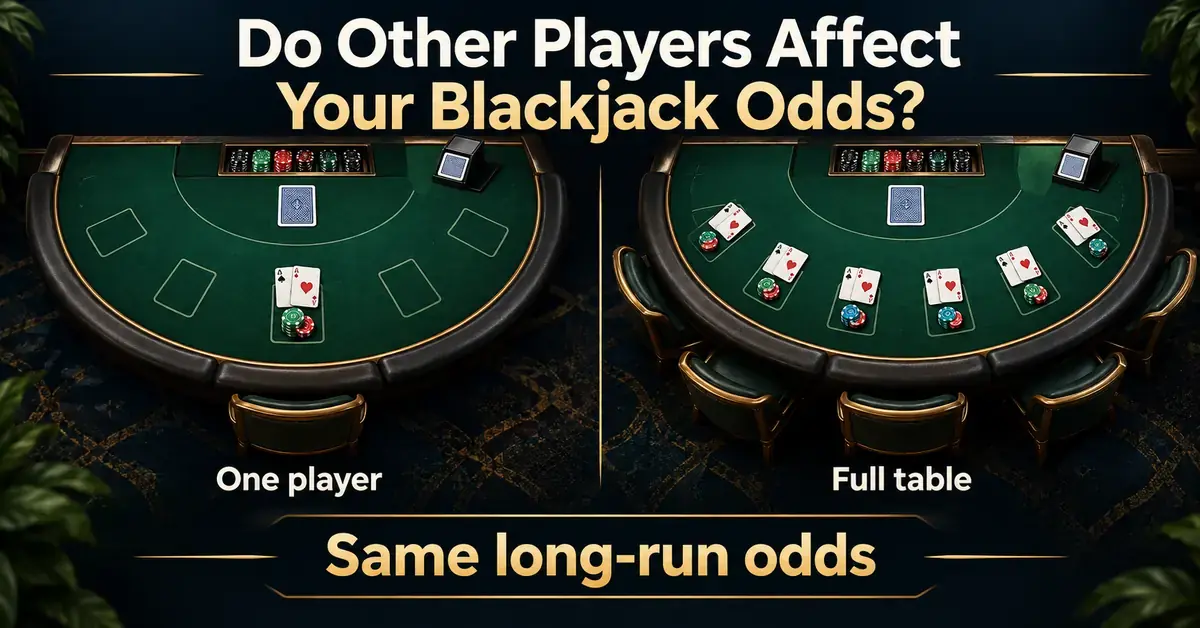
Sit down at a busy blackjack table and you will eventually hear it: someone groans that a “bad” player just cost everyone the hand, or swears the table runs hot when every seat is full. It raises a fair question — does the number of players actually change your blackjack odds? The short answer is no, at least not in the way most people think. Over the long run, the maths of the game does not care how many seats are filled. But a crowded table does change a few real things, and it helps to know which is which.
The short answer
The number of other players at the table has no effect on your long-run odds. Your chance of winning any given hand, and the house edge you face over thousands of hands, stay the same whether you play alone against the dealer or share the felt with six other people. What they do, how they bet, and whether they play well or badly does not shift the expected value of your own hand.
That surprises people, because a full table feels different. The cards land in a different order, the mood swings with each win and loss, and one memorable hand can convince you that a stranger “ruined” your night. Those are real experiences — they are just not changes to the odds.
Key Points
- Your long-run odds don’t change with the number of players — the house edge is the same alone or at a full table.
- The “third-base player stole the bust card” claim is a myth. Over time, their good and bad plays cancel out for you.
- A full table is slower: roughly 55–60 hands an hour versus 200+ heads-up, so your bankroll lasts longer at the same bet.
- Variance rises, expectation doesn’t. More players change the short-term swings, not the average.
- What really moves the edge: the 3:2 vs 6:5 payout, deck count, soft-17 rule and double/split rules — not seat count.
Why player count doesn’t change the maths
Blackjack is built on a shuffled shoe in which the order of the cards is already fixed before the first one is dealt. Nobody at the table knows that order. From your seat, the next card you receive is effectively random, and so is the dealer’s. Because the cards are random, every possible card is just as likely to help you as to hurt you.
Here is a simple way to see it. Imagine a table with five players. Across a session it will be dealt roughly five times as many natural blackjacks as a one-player table. But you only occupy one seat, so you collect about a fifth of those blackjacks — the same number you would get playing head-to-head with the dealer. More players spreads more cards around the table, but your personal slice of the good and bad outcomes stays proportional. The averages do not move.
The one thing that genuinely improves your results is the quality of your own decisions. Playing correct basic strategy shrinks the house edge to roughly half a percent; guessing instead of following the chart gives it back. That is in your control. The other seats are not.
The “he took the dealer’s bust card” myth
The most common complaint at a crowded table is aimed at third base — the last seat to act before the dealer. When a player there hits a hand they “should” have stood on, draws a low card, and the dealer then makes a strong total, it looks obvious: that player stole the card that would have busted the dealer.
It is a myth. Over the long run, the hands a stranger’s misplay costs you are exactly cancelled out by the hands their misplay saves you. For every time a loose hit hands the dealer a winner, there is another time that same extra card busts the dealer or changes the draw in your favour. Because the cards are random, those two outcomes are equally likely — but human memory only files away the painful one.
The player at third base is simply the most visible link in the chain, because their card is the last event before the dealer turns over the hole card. Visibility is not the same as cause. Mathematical studies of the game consistently find that the combined skill level of everyone else at the table makes no difference to your expectation. If you want to understand where the dealer’s busting actually comes from, it is driven by the upcard, not the seating chart — see our breakdown of the dealer’s bust odds.
Blaming other players is one of the more stubborn common blackjack mistakes, and it tends to lead to worse play — tilting, over-betting, or abandoning strategy out of frustration.
What a full table actually changes
So if the odds are fixed, why does a full table feel so different? Because it changes several things that are real but are not the house edge.
Hands per hour and your bankroll
This is the biggest practical difference. Playing one-on-one with the dealer, you can see well over 200 rounds an hour. At a full seven-seat table, the pace drops to roughly 55–60 rounds an hour. The house edge per hand is identical, but you are exposed to it far fewer times per hour at a crowded table.
In practice that means a busy table bleeds your bankroll more slowly for the same average bet, because you simply play fewer hands. If your goal is to stretch a set amount of money across a longer evening, a full table does that — not by improving your odds, but by slowing the clock.
Short-term variance and the cards you see
More players means more cards come out of the shoe each round, so the deck composition in front of the dealer looks different from hand to hand. This does not change your long-run expectation, but it does add short-term swings — the ups and downs that make one session feel lucky and another feel cursed. Variance is noise around the average; it is not a change to the average itself.
What it means for card counters
For the small minority who use card counting, table population cuts both ways. Seeing more cards per round gives a counter more information about what remains in the shoe. But a full table also deals fewer rounds per hour, so there are fewer chances to bet big when the count is favourable, and the extra cards per round raise variance. For an ordinary player who is not tracking the count, none of this applies — the information from other players’ cards is only useful if you are actually using it.
What really moves the house edge
If you want to improve your odds, ignore how many people are at the table and look at the rules posted on it. A handful of specific conditions do change the house edge, sometimes by a lot:
- The payout for a natural. A table that pays 3:2 on blackjack is far better than one paying 6:5; the worse payout can add well over a percent to the house edge.
- The number of decks. Fewer decks favour the player, all else equal — explained in detail in our guide to how deck count affects the odds.
- Whether the dealer hits or stands on soft 17. A dealer who stands on all 17s is better for you.
- Doubling and splitting rules. Being allowed to double after a split, or to double on any two cards, lowers the edge against you.
Those are the levers that matter. The seat you choose and the strangers beside you are not on the list.
Comparison
| Factor | Changes your odds? | Why |
|---|---|---|
| Number of other players | No | You still get your proportional share of good and bad cards. |
| Your seat position | No | First base, third base and the middle all share the same expectation. |
| How other players play | No | Their mistakes help and hurt you equally over the long run. |
| Number of decks in the shoe | Yes | Fewer decks slightly favour the player. |
| Blackjack payout (3:2 vs 6:5) | Yes | 6:5 adds well over a percent to the house edge. |
| Dealer hits or stands on soft 17 | Yes | A dealer standing on all 17s is better for you. |
| Double and split rules | Yes | More generous doubling and splitting lowers the edge. |
| Your own basic-strategy decisions | Yes | Correct play cuts the house edge to about 0.5%. |
Choosing a seat and a table
Because seat position does not change your odds, you can sit wherever you are comfortable. First base (first to act) and third base (last to act) carry no mathematical advantage or penalty for a basic-strategy player; the only difference at third base is social pressure, since your decision is the last one the table sees before the dealer draws.
When you pick a table, judge it on the rules and the minimum bet, not on how many seats are taken. A quiet 3:2 table with good doubling rules beats a packed 6:5 table every time. And if a crowded table helps you play more slowly and stick to your strategy, that is a genuine benefit — just not one that shows up in the odds.
Responsible Gambling
This article is for information only and is not betting advice. Blackjack is a casino game with a built-in house edge: understanding the maths can help you make better decisions, but no seat, table or table size changes the fact that the house holds a long-run advantage, and no strategy guarantees a win. In Canada the legal gambling age is 19 in most provinces (18 in Alberta, Manitoba and Quebec). Only gamble with money you can afford to lose, set limits before you play, and treat any losses as the cost of entertainment. If gambling stops being fun or feels hard to control, free, confidential help is available — see our responsible gambling resources for Canadian support services.
Sources
Frequently Asked Questions
Does the number of players change the house edge?
No. The house edge is set by the rules and payouts of the game, not by how many seats are filled. Whether you play alone or at a full table, your long-run expectation per hand is the same.
Did the player at third base really take the dealer’s bust card?
No. It only looks that way because their card is the last one before the dealer draws. Over many hands, the times another player’s bad decision costs you are exactly offset by the times it helps you, because the cards are random.
Is it better to play at a full table or heads-up with the dealer?
Neither is better for your odds. A full table deals far fewer hands per hour, so your bankroll lasts longer for the same average bet, while heads-up play is faster. Choose based on the pace and atmosphere you prefer, not on any hope of better odds.
Do more players help card counters?
It is mixed. More players mean more cards are revealed each round, which gives a counter extra information, but a full table also deals fewer rounds per hour and raises variance. For a player who is not counting, other players’ cards make no difference.
Does my seat position affect my odds?
No. First base, third base and every seat in between carry the same mathematical expectation for a basic-strategy player. The only real difference is that third base acts last, which can feel like more pressure.
