
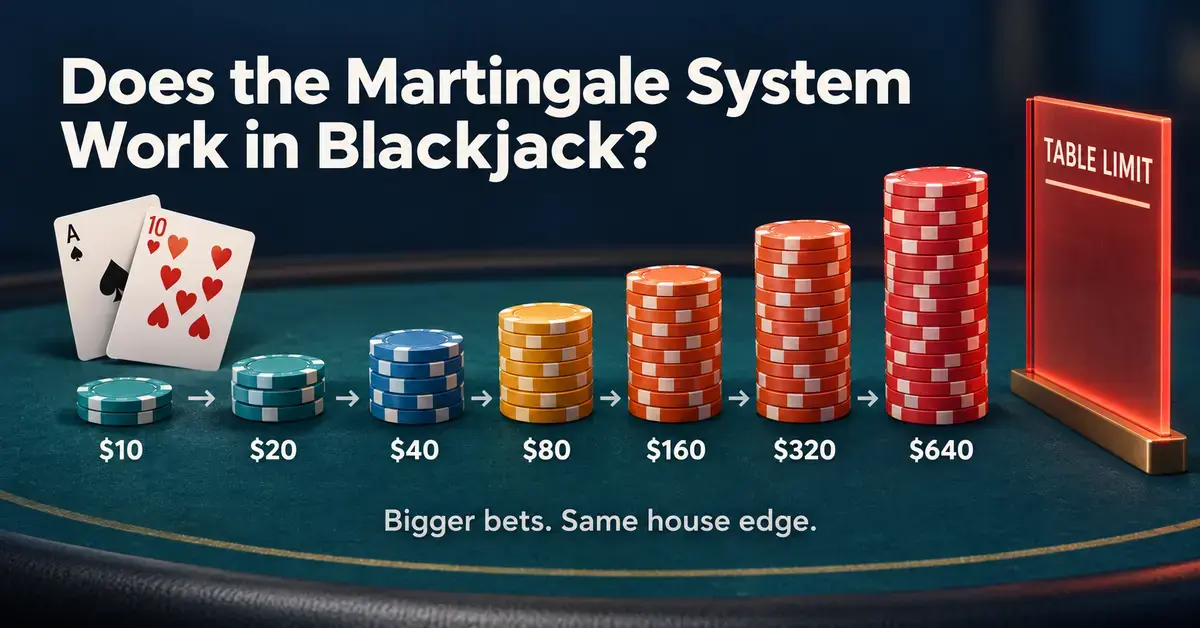
The Martingale is the most famous betting system in gambling: after every losing hand you double your next bet, so a single win claws back everything you lost plus a small profit. On paper it looks unbeatable. In practice, table limits, the house edge and a few quirks unique to blackjack turn it into one of the fastest ways to empty a bankroll. This guide explains how the Martingale works, walks through the math with a real doubling sequence, and shows why every betting progression runs into the same wall.
Key Points
- The Martingale means doubling your bet after every loss and resetting after a win, so one win recovers the whole losing run plus a small profit.
- It does not change the odds of any hand or remove the casino’s house edge — it only reshapes your pattern of wins and losses.
- Table limits stop the doubling fast: from a $10 start, the 7th bet in a losing run is already $640.
- Under basic strategy you lose about 49% of hands, so a six- or seven-loss streak is close to inevitable over a session.
- 3:2 blackjack payouts, doubles, splits and pushes all break the clean doubling math, making the system shakier than in roulette.
- No betting progression — Martingale, Paroli, D’Alembert, Fibonacci or Labouchere — beats a negative-expectation game.
What is the Martingale system?
The Martingale is a negative progression betting method. “Negative progression” simply means you raise your stake after a loss rather than after a win. The idea dates back to 18th-century France and is most often attached to even-money casino bets such as red or black in roulette, but players apply it to blackjack too.
The whole system fits in one sentence: double your bet every time you lose, and drop back to your starting bet the moment you win. The appeal is a neat piece of arithmetic — a win is always one unit larger than the sum of all the losses before it, so a single winning hand is supposed to wipe the slate clean and leave you ahead by your original stake.
How the Martingale works in blackjack
Imagine you sit down at a table with a $10 minimum bet and decide to run a Martingale:
- You bet $10 and lose. You are down $10.
- You double to $20 and lose again. You are down $30.
- You double to $40 and win. You collect $40, which covers the $30 you were down and leaves you $10 ahead.
That $10 profit equals your original bet. You then reset to $10 and start over. As long as every losing run eventually ends in a win, the theory says you grind out a steady stream of small profits.
The problem is what happens when a losing run keeps going. The bet required to recover doubles each time while the profit you are chasing stays frozen at $10. The table below shows how fast the numbers escalate from a $10 start.
Martingale Doubling Sequence
| Loss number | Bet required | Total staked if all lost | Profit if this bet wins |
|---|---|---|---|
| 1 | $10 | $10 | $10 |
| 2 | $20 | $30 | $10 |
| 3 | $40 | $70 | $10 |
| 4 | $80 | $150 | $10 |
| 5 | $160 | $310 | $10 |
| 6 | $320 | $630 | $10 |
| 7 | $640 | $1,270 | $10 |
| 8 | $1,280 | $2,550 | $10 |
By the seventh loss you must stake $640 to win back $10, and by the eighth you need $1,280. Few players bring that kind of money to a $10 table, and as the next section shows, most tables would not even let you place the bet.
Why the Martingale fails
The Martingale does not fail because of bad luck on any single night. It fails for structural reasons that no amount of discipline can fix.
Table limits cap the progression
Every casino table has a maximum bet, and it is usually only 50 to 100 times the minimum — a $10 table often caps out at $500 or $1,000. Doubling blows through that ceiling fast. Starting at $10, your seventh bet in a losing run would be $640 and your eighth $1,280. On a $500-max table you simply cannot place the recovery bet, so the moment you hit the wall the progression is dead and you are stuck with the full accumulated loss. The limit exists precisely so that no staking pattern can be used to guarantee a win.
The house edge never goes away
A betting system only decides how much you stake on each hand; it does nothing to the odds of the hand itself. Blackjack keeps a built-in advantage for the casino on every bet, and rearranging your stake sizes cannot turn a string of negative-expectation bets into a positive one. Mathematically, the Martingale has the same long-run expected result as flat betting the same total — it just repackages that outcome into many small wins and the occasional catastrophic loss. If you want the full picture of how that advantage is built, see our guide to blackjack odds and the house edge.
A long losing streak is a question of when, not if
Under basic strategy a blackjack player wins roughly 42% of hands, loses about 49% and pushes the rest. Because you lose nearly half of all hands, a run of six, seven or eight losses in a row is not a freak event — over a few hundred hands it is close to inevitable. A seven-loss streak turns up on average about once in every 150 starting hands. When it lands, you either run out of money or run out of table, and one such streak can erase dozens of the small $10 wins you banked earlier.
Blackjack complicates the doubling math
The clean “double to recover” arithmetic assumes every bet is a simple even-money win or loss. Blackjack breaks that assumption in several ways:
- Naturals pay 3:2. A winning blackjack pays more than even money, and a losing hand costs your full stake — so your wins and losses are not the symmetrical units the system relies on. Our 3:2 vs 6:5 payouts explainer shows why that payout matters.
- Doubles and splits need extra chips. Correct play often requires you to put more money on the table mid-hand, which breaks the tidy doubling schedule and inflates your exposure even faster.
- Pushes stall the run. A tie neither wins nor loses, so you cannot advance or recover — the progression simply freezes while your risk stays parked at its current level.
These wrinkles make the Martingale even shakier in blackjack than in a cleaner even-money game like roulette.
Other betting progressions fail the same way
The Martingale is the most aggressive progression, but it is not the only one, and none of them beats the house edge. They only reshape the pattern of wins and losses:
- Paroli (reverse Martingale): you double after a win instead of a loss, chasing a hot streak. It limits the damage of a bad run but needs a long winning streak to pay off — and streaks end without warning.
- D’Alembert: you raise your bet by one unit after a loss and lower it by one after a win. Gentler than the Martingale, but still powerless against a negative-expectation game.
- Fibonacci: you step bets up along the Fibonacci sequence after losses. It climbs more slowly than doubling, yet it still runs into table limits and bankroll limits during a long slide.
- Labouchere: you cross numbers off a list to reach a target profit. It is more intricate, not more effective, and a bad run can leave the list — and your bets — spiralling.
Every one of these systems is a way of distributing the same expected loss across time. Some trade frequent small wins for rare big losses, others do the reverse, but the long-run math is identical. Treating any of them as a route to guaranteed profit is one of the most common blackjack mistakes.
What actually affects your results
If staking systems cannot help, what can? The honest answer is that nothing a casual player does removes the house edge entirely — but the right habits shrink it to its smallest possible size:
- Play perfect basic strategy. Making the mathematically correct decision on every hand pushes the house edge down toward roughly 0.5% in a typical game. No betting pattern comes close to that improvement.
- Choose good rules. Tables that pay 3:2 on blackjack, use fewer decks and let you double after splitting all tilt the odds slightly in your favour.
- Manage your bankroll. Flat betting an amount you can afford to lose keeps you in the game far longer than any progression and removes the risk of a single streak wiping you out.
The only widely known method that can flip the edge to the player is card counting with the Hi-Lo system, and even that demands skill, a big bankroll and tolerance for casino counter-measures. For a grounded look at the limits of all of this, read whether you can win at blackjack over the long run.
Responsible gambling
Blackjack is a game of chance with a built-in advantage for the casino, and no betting system — the Martingale included — changes that. The information here is educational and is not financial or gambling advice. Only ever wager money you can afford to lose, and treat any system that promises guaranteed profit with scepticism. If gambling is causing you or someone you know harm, free and confidential help is available in Canada through the Responsible Gambling Council and the ConnexOntario helpline (1-866-531-2600, available 24/7). You can also read our responsible gambling page for more support options.
Sources
Frequently asked questions
Does the Martingale system work in blackjack?
No. It can produce a run of small wins, but it does not change the odds of any hand or remove the house edge. Table limits and the certainty of an eventual long losing streak mean that over time it loses money just like any other staking pattern, only with far bigger swings.
What is the Martingale betting system?
It is a negative-progression system in which you double your bet after every loss and return to your starting bet after a win. The aim is for one win to recover all previous losses plus a profit equal to your first stake.
How many losses in a row can the Martingale survive?
Not many. Starting from a $10 bet, the seventh bet in a losing run is $640 and the eighth is $1,280. Most tables with a $10 minimum cap bets at $500 or $1,000, so a run of six or seven losses is usually enough to hit the ceiling or exhaust a modest bankroll.
Is the Martingale banned in casinos?
No, using it is perfectly legal and casinos do not stop you. They do not need to — the standard maximum bet on every table neutralises the system on its own by preventing the bet from doubling indefinitely.
What is a better alternative to the Martingale?
Flat betting an amount you can afford, combined with correct basic strategy and good table rules, keeps the house edge as low as possible and lets you play far longer. These habits do far more for your results than any betting progression.
