
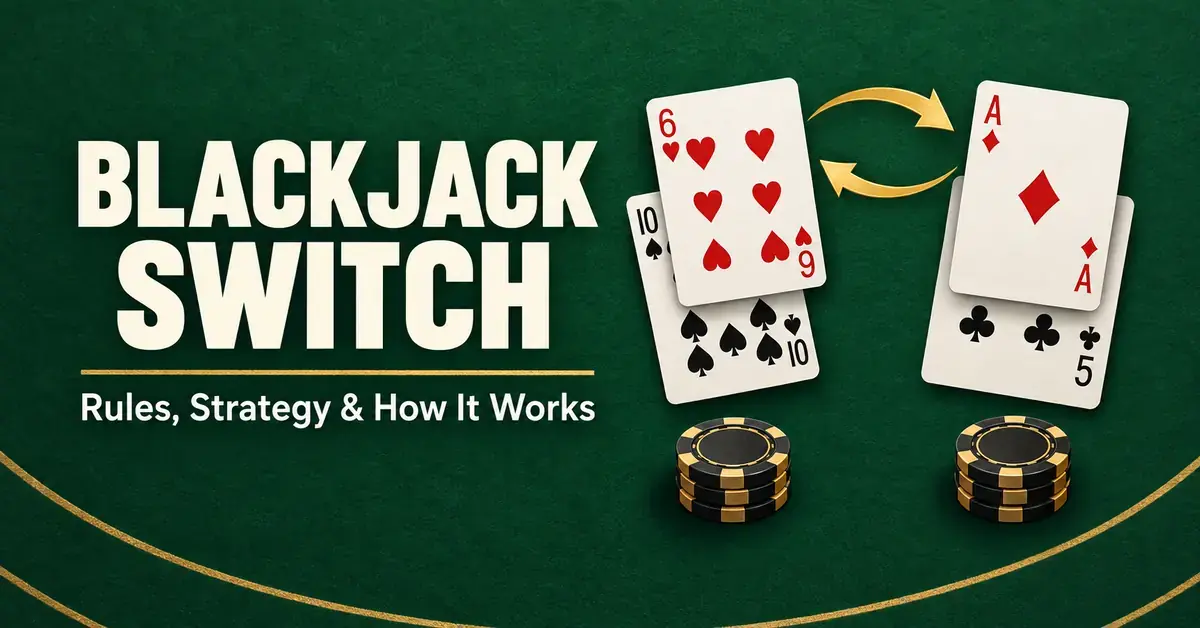
Blackjack Switch is a popular variant of blackjack in which you play two hands at once and are allowed to swap the second card dealt to each hand. That single twist — trading cards between your two hands to build stronger totals — is where the game gets its name. In return for this player-friendly option, the casino changes two important rules elsewhere. This guide explains exactly how Blackjack Switch works, what those rule trade-offs mean for your odds, and how it differs from the classic game.
Key Points
- You play two hands at once with two equal bets and may swap the top card between them.
- A dealer 22 pushes against any player total of 21 or less — but loses to a natural blackjack.
- Blackjack pays even money (1:1), not the usual 3:2.
- A blackjack made by switching counts as an ordinary 21.
- Typically 6 or 8 decks; dealer usually hits soft 17; double and re-split allowed.
- House edge is about 0.58% with optimal play.
- Invented by Geoff Hall; first installed in 2001, with the Push-22 rule added in 2003.
What Is Blackjack Switch?
Blackjack Switch was invented by Geoff Hall, who exhibited it at the Global Gaming Expo in Las Vegas in 2000 and saw the first table installed at a casino in Iowa in 2001. Hall came up with the idea out of frustration at being dealt two weak hands that could be dramatically improved if only he could swap a couple of cards between them. The signature “dealer pushes on 22” rule was added in 2003, and the game was patented in 2009.
The core of the game is standard blackjack: you try to build a hand that beats the dealer without going over 21. If you are new to the game, our guide to blackjack card values explains what each card is worth, including how an ace can count as 1 or 11. Where Blackjack Switch departs from the norm is that you always play two hands side by side, and after the deal you get one chance to switch cards between them.
How the Switch Works
To play, you place two bets of equal size, one for each of two hand positions. The dealer then gives each hand two cards, all face up. Before you do anything else, you may swap the second (top) card of one hand with the second card of the other hand. You cannot switch the first cards, and you are never forced to switch — you take the swap only if it improves your position.
A quick example
Suppose you are dealt a 10 and a 6 in the first hand, and a 10 and a 5 in the second. On their own, those are two awkward stiff hands (16 and 15). By switching the second cards, you can turn them into 10 + 5 = 15 and 10 + 6 = 16 — not much help there — but the same mechanic often lets you convert, say, a 10 + ace and a 9 + 10 into a blackjack (ace + 10) plus a strong 19. The freedom to reorganise your cards is the main advantage of the variant.
Playing out the hands
After you decide whether to switch, each hand is played separately using the usual options — you can hit, stand, double down or split. If you are unsure when to use each move, see our explainer on blackjack player actions. Typical Blackjack Switch tables use six or eight decks, let you double on any two cards, allow doubling after a split, and let you re-split up to four hands. The dealer usually hits a soft 17 (a total of 17 that includes an ace counted as 11). Surrender is generally not offered.
The Two Big Rule Changes
The switching option is powerful, so the casino balances it with two rules that work in its favour. Understanding both is essential before you sit down.
The dealer pushes on 22
In classic blackjack, a dealer who draws to 22 has busted and every remaining player wins. In Blackjack Switch, a dealer total of 22 is a push (a tie) against any player total of 21 or less. Your bet is simply returned rather than paid. The one exception: a player blackjack still beats a dealer 22. This “Push 22” rule is the single biggest cost to the player, because it removes a large share of the hands you would otherwise win outright.
Blackjack pays even money
A natural blackjack — an ace with a ten-value card on your first two cards — normally pays 3:2. In Blackjack Switch it pays only even money (1:1). And if you create a blackjack by switching cards, it counts as an ordinary 21 rather than a natural, so it can be tied by a dealer 21. These changes reduce the reward on your strongest hands.
The Super Match Side Bet
Most Blackjack Switch tables offer an optional side bet called Super Match. It pays out based on pairs and other combinations among the four initial cards across your two hands, regardless of how the main hands finish. In a six-deck game the typical payouts are:
- One pair: 1:1
- Three of a kind: 5:1
- Two pairs: 8:1
- Four of a kind: 40:1
The catch is the house edge: Super Match carries roughly a 2.55% edge for the casino, far higher than the main game. Like most blackjack side bets — including insurance — it is best treated as occasional entertainment rather than a serious way to make money.
Comparison
| Feature | Classic Blackjack | Blackjack Switch |
|---|---|---|
| Hands played | One | Two (two equal bets) |
| Switching cards | Not allowed | Swap the top card between hands |
| Natural blackjack payout | 3:2 | Even money (1:1) |
| Dealer total of 22 | Dealer busts, player wins | Push vs 21 or less (loses to natural) |
| Decks | Usually 1–8 | Usually 6 or 8 |
| Side bet | Insurance and others vary | Super Match (pairs / combinations) |
| House edge (optimal) | ~0.5% (rules dependent) | ~0.58% |
House Edge and Odds
Despite the two unfavourable rules, Blackjack Switch remains one of the lower-edge blackjack variants when played correctly. Under common Las Vegas rules (six decks, dealer hits soft 17, switched blackjack counts as 21), the house edge is about 0.58% with optimal strategy. Rule variations move that figure up or down — an eight-deck shoe adds roughly 0.02%, while more generous rule sets can push the edge lower still. In practice that translates to an return-to-player (RTP) of around 99.4%, competitive with well-played classic blackjack.
Basic Strategy Adjustments
Blackjack Switch asks you to make two decisions: first whether to switch, then how to play each hand. Because the dealer pushes on 22, the correct basic strategy is close to the classic game but with some tweaks:
- Switching: aim to build one strong hand and avoid leaving two stiff totals. Prioritise making a hand of 20 or 21, or turning a bust-prone pair of cards into one solid hand.
- Hitting: hit slightly more often on stiff hands (12–16), because a dealer 22 no longer rescues you the way a bust would in classic blackjack.
- Doubling: double down a little less aggressively than in the classic game, since the push-22 rule lowers the value of pressing your bet.
Common Mistakes to Avoid
- Forgetting the push on 22. Players used to classic blackjack often expect to win against a busted dealer and misjudge how many hands end in a push.
- Chasing the Super Match. The high payouts are tempting, but the 2.55% house edge makes it a costly habit over time.
- Making a lazy switch. Always compare both arrangements; the wrong switch can weaken a hand you should have left alone.
- Playing classic strategy unchanged. The rule differences require the adjustments above, so a standard chart is only a starting point.
Who Blackjack Switch Suits
The variant appeals to players who enjoy extra decision-making and the puzzle of arranging two hands, and who are comfortable managing double the stake since two equal bets are required. Beginners may prefer to master the standard game first. In Canada, Blackjack Switch appears at some online casinos regulated by iGaming Ontario and registered with the Alcohol and Gaming Commission of Ontario (AGCO), though it is offered less widely than mainstream blackjack tables. Because it is a variant, availability and exact rules differ from one provider to another — always check the specific table rules before betting.
Responsible Gambling
Blackjack Switch is a game of chance with a built-in house edge, and no strategy can guarantee a profit over time. This article is informational only and is not betting or financial advice. Only ever play with money you can afford to lose, set time and deposit limits, and treat any winnings as entertainment rather than income. In Canada, free and confidential support is available through ConnexOntario (1-866-531-2600) and the Responsible Gambling Council. You can read more general guidance on our responsible gambling page. You must be of legal gambling age in your province or territory to play.
Sources
Frequently Asked Questions (FAQ)
What is the main rule that makes Blackjack Switch different?
You play two hands at the same time and may swap the second card between them once after the deal. In exchange, a dealer total of 22 pushes against player totals of 21 or lower, and a natural blackjack pays even money instead of 3:2.
Does a player blackjack still beat a dealer 22?
Yes. Although a dealer 22 ties (pushes) against player totals of 21 or less, a natural blackjack on your first two cards still wins against a dealer 22. A blackjack created by switching cards, however, counts only as a 21.
What is the house edge in Blackjack Switch?
Under common rules — six decks and a dealer who hits soft 17 — the house edge is about 0.58% with optimal strategy, giving a return to player of roughly 99.4%. The exact figure varies with the specific table rules.
Is the Super Match side bet worth playing?
Super Match pays for pairs and other card combinations among your four starting cards, from 1:1 for a pair up to 40:1 for four of a kind. Its house edge is around 2.55%, much higher than the main game, so it is best played sparingly for fun.
Can I use my normal blackjack strategy?
Mostly, but with adjustments. Because the dealer pushes on 22, you should hit stiff hands a little more often and double down slightly less than in classic blackjack, in addition to deciding when to switch cards.
