
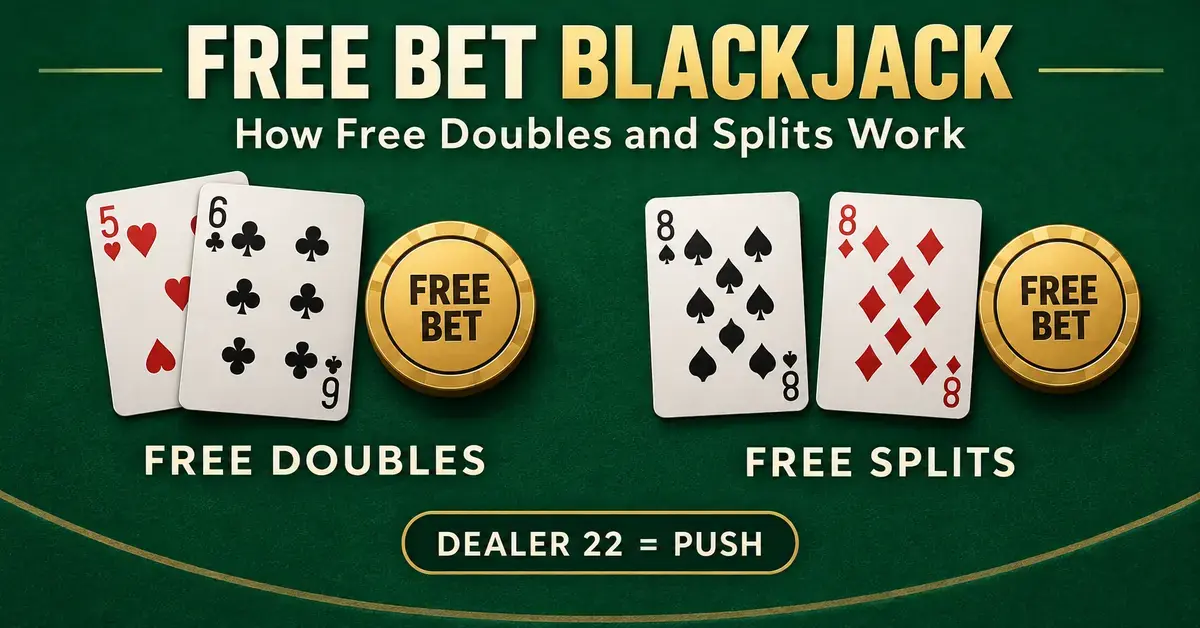
Free Bet Blackjack is a popular casino variant that lets you double down and split pairs without risking any extra money of your own — the house puts up the additional bet for you. It sounds like a gift, and in many hands it is, but the game balances those freebies with one important rule: when the dealer busts with a total of 22, the hand is a push instead of a win. This guide explains how the free doubles and free splits work, what the “free-bet button” actually means, and how the Push 22 rule keeps the casino ahead over the long run.
What Is Free Bet Blackjack?
Free Bet Blackjack is a table-game version of 21 invented by game designer Geoff Hall, who also created Blackjack Switch. It first appeared at the Golden Nugget in Las Vegas in 2012 and is distributed to casinos by AGS (formerly Shuffle Master). Today you can also find it online as a live-dealer game, where Evolution runs the best-known streamed version.
The core goal is identical to classic blackjack: build a hand closer to 21 than the dealer without going over. Cards are counted the same way, blackjack still pays 3:2, and the dealer still plays a fixed set of rules. What changes is who pays for your doubles and splits — and what happens on a dealer 22.
Key Facts
Game type: Blackjack rule variant
Inventor: Geoff Hall (also created Blackjack Switch)
Debut: 2012, Golden Nugget, Las Vegas
Distributed by: AGS (land-based); Evolution runs the online live version
Decks: 6
Dealer: Hits on soft 17
Blackjack payout: 3:2
Free doubles: Hard two-card totals of 9, 10 or 11
Free splits: Any pair except ten-value cards; re-split to four hands
Signature rule: Dealer total of 22 is a push against hands of 21 or less
House edge: About 1.04% (standard rules); online live RTP about 98.45%
How the Free Bets Work
The headline feature is right there in the name: certain doubles and splits are “free,” meaning the casino covers the extra wager. You do not hand over more chips. Instead, the dealer places a marker — the free-bet button — next to your hand to show that a casino-funded bet is riding on it.
Free doubles
You get a free double down whenever your first two cards make a hard total of 9, 10 or 11. A hard total is one without an ace counted as 11. So a 6-3, a 7-3 or a 5-6 all qualify. You take one more card, exactly as in a normal double, but you did not have to match your original bet to do it. If the hand wins, you are paid as though you had doubled for real money. Higher or lower totals, and soft totals that include an ace, do not get the free double.
Free splits
You get a free split on any pair except 10-value cards (two tens, or any mix of tens and face cards). When you split, your original wager stays with the first card and a free-bet button is placed on the second. You then play each hand in turn, and each one can earn its own free double or free split — so a lucky run of pairs can open several free bets at once. Pairs can be re-split up to four hands, including aces, and doubling after a split is allowed (and free when the new total is a hard 9, 10 or 11). As in most blackjack games, split aces normally receive just one card each.
The free-bet button explained
Think of the free-bet button as a placeholder chip the casino owns:
- If the free-bet hand wins, the dealer removes the button and pays you real chips equal to that bet — so a free double on a $10 hand wins you an extra $10.
- If the free-bet hand loses, the button is simply taken away. You lose none of your own money on the free portion; only your original stake is ever at risk.
- If the free-bet hand pushes (ties the dealer), the button is removed with no payout — you neither win nor lose on it.
Because the downside of a free double or split is removed, you take them far more often than you would in the classic game — and that is exactly what the casino is counting on.
The Push 22 Rule: the catch
All those free bets have to be paid for somehow, and the Push 22 rule is how. In Free Bet Blackjack, if the dealer draws to a hard total of 22, the dealer does not bust in the usual sense. Instead, every player hand still in play that totals 21 or less is treated as a push — a tie — so you get your stake back but win nothing.
There are two things worth underlining here:
- A player blackjack still wins. A natural 21 (an ace plus a ten-value card on your first two cards) is paid 3:2 even if the dealer lands on 22.
- A busted player hand still loses. If you went over 21 earlier in the hand, Push 22 does not rescue you — the dealer 22 only helps hands that were still live.
In ordinary blackjack a dealer 22 is a bust and you win. Turning roughly one in twelve dealer-bust hands into a tie is what pays for all the free doubles and splits, and it is the single biggest reason the house edge is higher than in the standard game.
House Edge and Payouts
Under the common table rules — six decks, dealer hits on soft 17, blackjack pays 3:2 — the house edge of Free Bet Blackjack is about 1.04%, as calculated by gambling mathematician Michael Shackleford. Evolution’s online live version publishes a return to player (RTP) of 98.45%, which is an edge of roughly 1.55%; small rule differences between venues move the number a little either way.
For context, a well-run classic six-deck game runs closer to 0.5%, so Free Bet Blackjack costs you roughly twice as much per dollar wagered over time. That said, it is still far better value than a 6:5 blackjack table, where the shortened natural payout alone pushes the edge up to around 2%. The free bets also keep more of your own money on the table, which many players enjoy even knowing the edge is a touch higher.
Basic Strategy Changes
Free Bet Blackjack rewards a more aggressive style than the classic game, for two reasons: the free doubles and splits cost you nothing, and a push counts as a non-win, so you want to keep pressing when you have an edge. The broad guidelines:
- Take every free double and free split that is offered. Because your own money is never at stake on them, accepting them is almost always correct, even against a strong dealer upcard.
- Adjust for Push 22. Against dealer upcards that often make 22 (notably when the dealer shows a face card or a strong total), you lean toward hitting more marginal hands rather than standing and hoping the dealer busts.
- Do not buy insurance. As in every blackjack game, the insurance side bet is a poor-value wager and basic strategy skips it.
A full Free Bet strategy card differs from the standard chart in several spots, so it is worth consulting a variant-specific chart before you sit down rather than relying on classic basic strategy alone.
How Free Bet Blackjack Compares to Other Variants
Free Bet Blackjack is one of several rule twists on the classic game. The table below shows where it sits among the other blackjack variants you are likely to meet in Canadian and online casinos. House-edge figures assume reasonable rules and correct basic strategy; actual numbers vary by table.
Variant Comparison
| Variant | Defining feature | Blackjack pays | Dealer 22 pushes? | Approx. house edge |
|---|---|---|---|---|
| Free Bet Blackjack | Free doubles (hard 9–11) and free splits | 3:2 | Yes | ~1.04% |
| Classic blackjack (6 decks) | You fund your own doubles and splits | 3:2 | No | ~0.5% |
| 6:5 blackjack | Standard play, shortened natural payout | 6:5 | No | ~2% |
| Spanish 21 | All tens removed, bonus payouts | 3:2 | No | ~0.4–0.8% |
| Blackjack Switch | Swap cards between two hands | 1:1 | Yes | ~0.6% |
Who It Suits
Free Bet Blackjack is a good fit for players who like action and enjoy splitting and doubling often without dipping deeper into their bankroll. The free bets make for an exciting, swingy session and the rules are easy to pick up. It is a weaker choice for players focused purely on the lowest possible house edge — a classic 3:2 table with standard rules will stretch a bankroll further. Common mistakes to avoid are declining the free bets, forgetting that a dealer 22 is only a push (so you should not over-celebrate or over-fold on it), and assuming classic basic strategy is optimal here.
Responsible Gambling
Free Bet Blackjack is a game of chance with a built-in house edge, and no rule, system or strategy can turn it into a long-term profit. The free doubles and splits improve the entertainment, not your odds of beating the casino. In Canada the legal gambling age is 19 in most provinces and 18 in Alberta, Manitoba and Quebec. Set a budget before you play, treat any losses as the cost of entertainment, and never gamble money you cannot afford to lose. If gambling stops being fun, free and confidential help is available from the responsible gambling resources listed below, including ConnexOntario (1-866-531-2600) and the Responsible Gambling Council.
Sources
Frequently Asked Questions
Is Free Bet Blackjack actually free to play?
No. You still place a normal bet on each hand. What is “free” is the extra wager for qualifying doubles and splits — the casino covers that portion, so you do not add chips of your own. Your original stake is always at risk.
What hands can I double or split for free?
You get a free double on any two-card hard total of 9, 10 or 11, and a free split on any pair except two ten-value cards. Each resulting hand can earn its own further free double or split, and pairs can be re-split up to four hands.
What is the Push 22 rule?
If the dealer busts with a total of exactly 22, every player hand of 21 or less that is still in play becomes a push (a tie) rather than a win. A player blackjack is the exception — it is still paid 3:2. This rule is how the casino pays for the free bets.
What is the house edge in Free Bet Blackjack?
Around 1.04% under common rules (six decks, dealer hits soft 17, blackjack pays 3:2). That is higher than a standard 3:2 game at roughly 0.5%, but lower than a 6:5 table at about 2%. Online live versions publish an RTP near 98.45%.
Does blackjack still pay 3:2?
Yes. A natural blackjack pays 3:2 in Free Bet Blackjack, and it wins even if the dealer later reaches 22. Always check the felt before playing, as a few tables shorten the payout to 6:5, which costs you more.
