
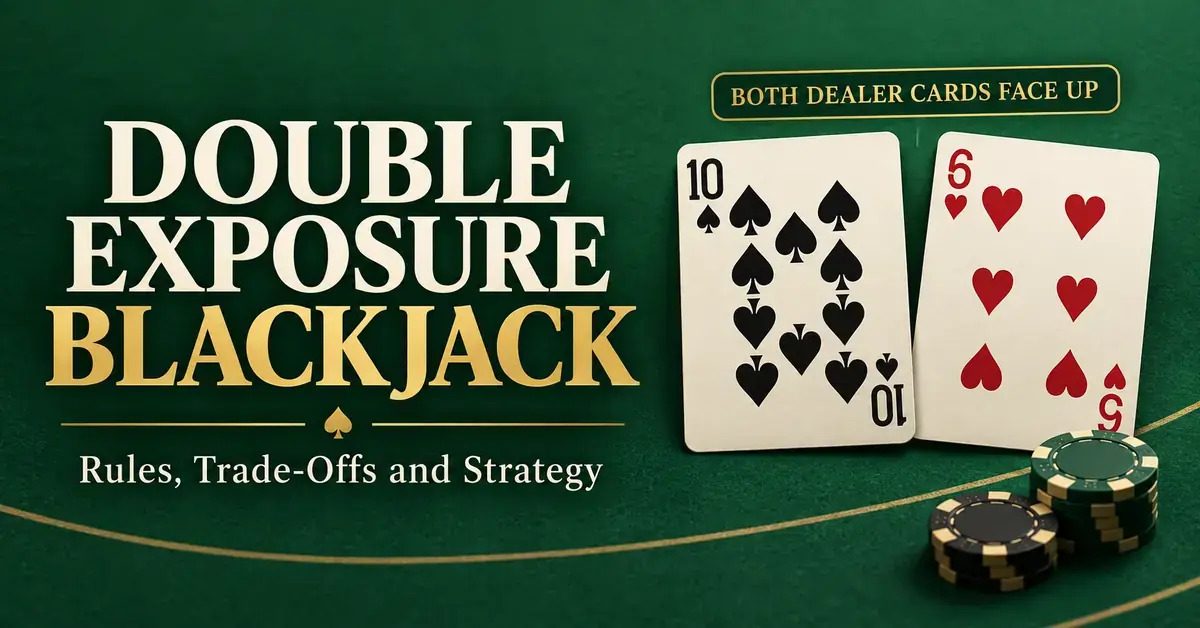
Double Exposure Blackjack is a variant with one striking twist: both of the dealer’s cards are dealt face up from the very start. In classic blackjack you only ever see one dealer card (the upcard) until it is your turn to act, so being handed the full dealer hand sounds like a gift. It is — but the game quietly claws that advantage back through a set of rule changes most newcomers overlook. This guide explains exactly how Double Exposure works, the trade-offs built into it, what the house edge really is, and how your strategy has to change when you can see everything.
Key Points
- Both of the dealer’s cards are dealt face up from the start.
- To compensate, blackjack pays only even money (1:1) instead of 3:2.
- The dealer wins all ties, except a tied natural blackjack (which pushes or wins for the player, depending on the table).
- There is no insurance and no surrender, and doubling/splitting are often restricted.
- The house edge is typically about 0.3%-0.7% — similar to, or worse than, a good classic table.
- Basic strategy changes sharply because you play against the dealer’s known total.
What is Double Exposure Blackjack?
Double Exposure is a blackjack variant in which the dealer’s first two cards are both exposed before you decide how to play your hand. The core goal is unchanged from the classic game: build a hand closer to 21 than the dealer’s without going over (busting). The difference is purely in information — you know the dealer’s starting total, not just a single upcard.
The idea was proposed by mathematician Richard A. Epstein in 1977 and first reached a casino floor at Vegas World in Las Vegas in 1979, where the operator added rule changes that tilted the maths back toward the house. Those compensating rules are the heart of the game and the reason it has survived. Online, the same concept is often sold under the name Face Up 21 or Face Up Blackjack. If you are new to the wider family of games, our overview of blackjack variants shows where Double Exposure sits among the alternatives.
Quick Facts
| Game type | Blackjack variant |
|---|---|
| Also known as | Face Up 21 / Face Up Blackjack (online) |
| Origin | Proposed by Richard A. Epstein (1977); debuted at Vegas World, Las Vegas (1979) |
| Dealer cards | Both dealt face up |
| Blackjack payout | Even money (1:1) |
| Ties | Dealer wins all ties except blackjack |
| Insurance / surrender | Not offered |
| Typical house edge | ~0.3%-0.7% depending on rules |
The trade-off: how the rules change
Seeing both dealer cards is a large edge in your favour, so the casino balances the books with several rules that favour the dealer. Understanding these is the whole point of the game, because they are where your “advantage” disappears.
- Blackjack pays even money (1:1), not 3:2. In a standard game a natural blackjack pays 3:2 — a $10 bet returns $15 in winnings. In Double Exposure it pays only $10. This single change is the biggest cost to the player.
- The dealer wins all ties. In classic blackjack a tie is a push and you keep your bet. Here, if your total equals the dealer’s, you lose — with one exception below.
- A tied blackjack is the exception. If both you and the dealer have a natural, most tables either push or pay the player; the exact treatment varies by house, so it is worth checking the table rules.
- No insurance and no surrender. Both options rely on uncertainty about the dealer’s hand, and that uncertainty is gone, so neither is offered. If you want to understand what you are giving up, see our guides to blackjack insurance and the full set of player actions.
- Restricted doubling and splitting. Many tables let you double only on a hard total of 9 to 11, limit how often you can split, and do not allow doubling after a split.
Taken together, these changes more than offset the information you gain. The even-money payout and dealer-wins-ties rules are each individually worth a large swing toward the house.
The house edge: is seeing both cards worth it?
Because the exact rules vary from table to table, so does the house edge. With typical rules — even-money blackjacks and the dealer winning all non-blackjack ties — a six-deck game runs an edge of roughly 0.67% to 0.69% against a player using correct strategy. Some older land-based versions with more generous side rules have been measured as low as about 0.26%, while stricter tables sit higher.
For context, a good classic blackjack game with 3:2 payouts and sensible rules can be around 0.5% or lower. In other words, Double Exposure’s eye-catching gimmick usually lands you at a house edge that is similar to, or slightly worse than, a well-chosen traditional table. One detail that matters a lot: whether a tied blackjack is a push or a win for the player. Letting the player win tied blackjacks is worth roughly +0.22% to you, so it is one of the better rules to look for.
Double Exposure vs classic blackjack
The table below summarises the main rule differences so you can see the trade-off at a glance.
| Rule | Classic blackjack | Double Exposure |
|---|---|---|
| Dealer cards visible | One (upcard only) | Both, face up |
| Blackjack payout | 3:2 (sometimes 6:5) | Even money (1:1) |
| Ties (equal totals) | Push — bet returned | Dealer wins |
| Tied blackjacks | Push | Push or player wins (house-dependent) |
| Insurance | Offered | Not offered |
| Surrender | Often offered | Not offered |
| Doubling | Usually any first two cards | Often hard 9-11 only |
| Typical house edge | ~0.5% or lower | ~0.3%-0.7% |
How basic strategy changes
Knowing the dealer’s exact total rewrites the decision chart. You are no longer guessing against a single upcard; you are playing against a finished dealer hand you can read. That leads to plays that would look reckless or bizarre in a classic game.
Play to the dealer’s real total
If the dealer already shows a made hand of 17 to 20, you must keep hitting until you beat it or bust, because standing on a lower total is a guaranteed loss (remember, ties lose). For example, a hard 19 should be hit when the dealer shows 20 — in classic blackjack you would never hit a 19.
Chase the dealer’s weak hands
When the dealer holds a total of 12 to 16, they are likely to bust if they draw, so you can often stand on low totals and play more aggressively. This is also where unusual splits appear: two ten-value cards are split when the dealer is showing 13 to 16, a move that is almost never correct in standard play. Our guide to reading a basic strategy chart explains the underlying logic you are adapting here.
Ties lose, so near-misses matter
Because an exact tie costs you your bet, there is extra value in edging just past the dealer rather than matching them. Correct Double Exposure strategy is published in dedicated charts; the broad principle is to use the dealer’s visible total to decide, and to accept more risk against weak dealer hands and more hitting against strong ones.
Who Double Exposure suits
Double Exposure appeals to players who enjoy the puzzle of playing with full information and dislike the uncertainty of insurance decisions. It is widely available online, where it tends to be fast and straightforward. It is not, however, an easy-money game: the house edge is comparable to classic blackjack, the strategy is different enough to trip up players running on autopilot, and the even-money blackjack rule stings every time you draw a natural. If you mostly value a low edge, a 3:2 classic table played with correct strategy is usually the stronger choice.
Common mistakes to avoid
- Assuming the exposed cards are a free win. The compensating rules are designed precisely to erase that edge.
- Using classic basic strategy. The correct plays genuinely differ; standing on 19 against a dealer 20, for instance, is an automatic loss.
- Ignoring the tie rule. Forgetting that pushes lose leads to passive play that bleeds money.
- Not checking the tied-blackjack and payout rules. These vary by table and materially change the edge.
Responsible gambling
Double Exposure Blackjack is a game of chance with a built-in house edge, and no strategy removes that edge or guarantees a profit. Seeing both dealer cards does not make the game beatable over the long run. Treat any money staked as the cost of entertainment, set limits before you play, and never gamble to recover losses. In Canada you must be of legal gambling age in your province or territory. If gambling is affecting you or someone you know, free, confidential help is available through the Responsible Gambling Council and provincial support lines. You can also read our responsible gambling resources for more information.
Sources
Frequently Asked Questions (FAQ)
Does seeing both dealer cards give you an advantage in Double Exposure Blackjack?
It gives you useful information, but the casino offsets it with rules that favour the house — blackjacks pay only even money, the dealer wins all ties except blackjacks, and there is no insurance or surrender. The net result is a house edge broadly similar to a good classic table, so the game is not easier to beat.
Why does blackjack pay even money in Double Exposure?
The reduced payout is one of the main ways the game compensates for letting you see both dealer cards. Instead of the usual 3:2, a natural pays 1:1, which is the single biggest cost to the player and a key reason the house keeps its edge.
What happens on a tie in Double Exposure Blackjack?
Unlike classic blackjack, where a tie is a push and your bet is returned, the dealer wins all ties. The one common exception is a tied natural blackjack, which depending on the table either pushes or is paid to the player.
What is the house edge in Double Exposure Blackjack?
It depends on the exact table rules. With typical rules on a six-deck game the edge is roughly 0.67% to 0.69%, though some generous versions have been measured near 0.26%. That is comparable to, and often slightly worse than, a well-chosen 3:2 classic blackjack table.
Is basic strategy different in Double Exposure Blackjack?
Yes, significantly. Because you can see the dealer’s full total, you play against their actual hand: you hit low totals hard when the dealer already has 17-20, play aggressively when the dealer is weak, and make unusual moves such as splitting two tens against a dealer 13-16. Standard blackjack charts do not apply.
