
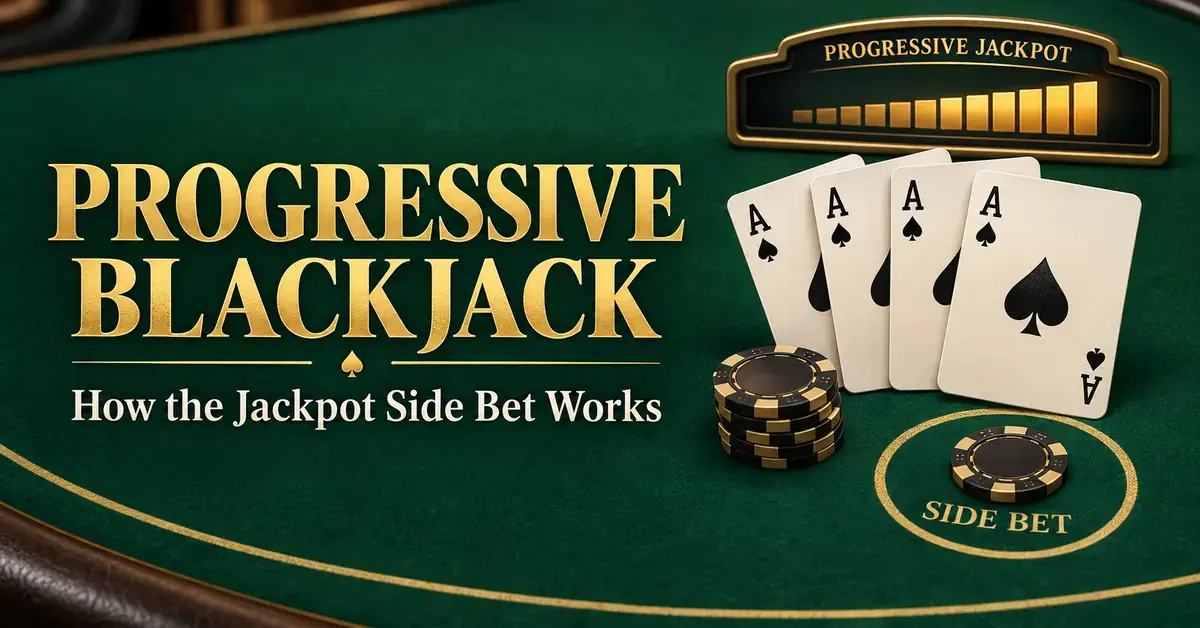
Progressive blackjack is not a separate game so much as a standard blackjack table with one extra feature bolted on: an optional jackpot side bet whose top prize keeps climbing until somebody wins it. You play the normal hand as always, but for a small additional stake you also get a shot at a pooled jackpot that can reach into the hundreds of thousands of dollars. It sounds thrilling, and occasionally it is — but the way the bet is priced makes it one of the most expensive wagers on the casino floor. This guide explains exactly how the jackpot side bet works, what a typical pay table looks like, the odds behind it, and where you are likely to run into it.
Key Facts
| What it is | An optional jackpot side bet added to a normal blackjack table |
|---|---|
| Typical stake | Fixed, usually $1 per hand |
| What it pays on | Aces in your own opening cards, on a fixed ladder of prizes |
| Jackpot trigger | Usually four aces of the same colour or suit (needs a multi-deck shoe) |
| Jackpot seed | Often around $25,000, then grows from a slice of each bet |
| House edge | Very high — commonly 15% to 40%+, far above the ~0.5% base game |
| Where found | Land-based pits plus many online and live dealer tables |
What progressive blackjack actually is
The word “progressive” refers to the jackpot, not to the blackjack. A progressive jackpot is a prize pool that grows a little every time a player makes the qualifying bet. A small slice of each wager is skimmed off and added to a shared meter, so the number on the display ticks upward hand after hand until one lucky player triggers the top combination and takes the whole pot. The meter then resets to a starting “seed” amount — often around $25,000 — and begins climbing again.
Crucially, the progressive feature sits alongside the main game. Your regular blackjack hand still plays out under whatever house rules the table uses, and your main bet wins, loses or pushes exactly as it normally would. The progressive side bet is a completely separate wager with its own outcome. If you want to understand how the core game is priced, our guide to blackjack odds and the house edge covers that in detail; this article is only about the jackpot bet layered on top.
How the jackpot side bet works
Placing the bet
To be eligible for the jackpot you must place the side bet — usually a fixed amount such as $1 — in a marked circle before the cards are dealt. It is entirely optional. You can play the base game all night without ever touching it, but if you skip it you are not in the running for the pot, even if you happen to be dealt the magic cards.
The most common form of the bet pays out based on the aces in your own opening cards. The more aces you are dealt, and the better they match by suit or colour, the higher you climb on a fixed ladder of prizes. The very top rung — typically four aces of the same colour or the same suit — wins the full progressive jackpot.
How the jackpot grows and pays
Every qualifying $1 side bet contributes a few cents to the meter. Because the top combination is extraordinarily rare, the pot can grow for weeks or months between hits, which is how progressive displays reach eye-catching figures. When someone finally lands the winning hand, they collect the displayed amount, the meter seeds back to its starting value, and the cycle restarts.
The fixed lower prizes on the ladder (for one, two or three aces) are paid straight from the casino and do not touch the jackpot. Only the top tier empties the pooled meter. Note that the side bet is settled on your dealt cards alone — whether you go on to win, lose or make a natural blackjack with those cards has no effect on the side-bet payout.
A typical progressive pay table
Pay tables vary by game and operator, so always read the layout in front of you before betting. The table below shows one well-documented classic version (as recorded at the New York New York casino in Las Vegas) based on a $1 bet. It is representative of how the ladder is usually structured, not a universal standard.
| Your cards | Payout (on a $1 bet) |
|---|---|
| First card is an ace | $3 |
| Two aces, mixed suits | $15 |
| Two aces, same suit | $50 |
| Three aces, mixed suits | $200 |
| Three aces, same suit | $1,000 |
| Four aces, mixed | $2,000 |
| Four aces, same colour | Progressive jackpot |
Several points are worth highlighting. Getting three or four aces at all requires a multi-deck shoe (a single deck holds only four aces, and the dealer and other players are competing for them), which is part of why the top prizes are so scarce. Some versions reward four suited aces for the jackpot rather than four same-colour aces, and the exact dollar figures on the lower rungs differ from casino to casino. The principle is always the same: tiny odds of the big prize, modest fixed prizes below it.
Key Points
- The progressive bet is separate from your main hand and is settled on your dealt cards alone.
- You must place the side bet before the deal to be eligible for the jackpot.
- Lower prizes (one to three aces) are paid by the casino; only the top combination empties the growing meter.
- The house edge is far steeper than the base game, so treat it as paid entertainment, not strategy.
- Pay tables and jackpot triggers differ by casino — always read the layout before betting.
The odds and the house edge
The house edge is the slice of every wager the casino keeps on average over the long run. On the main blackjack game with good rules and basic strategy, that edge is around 0.5%. The progressive side bet is in another universe entirely.
Because the jackpot is a fixed pool rather than a fixed multiple of your bet, the value of the bet changes as the meter grows. When the jackpot is near its seed level, the analysis published by Wizard of Odds puts the house edge on the classic version at roughly 44% — meaning the casino expects to keep about 44 cents of every dollar bet. Other published pay tables land lower, often quoted in the 15%-plus range, but every one of them is far worse than the base game. The return creeps upward as the jackpot climbs, and in theory the bet can even tip in the player’s favour, but only at astronomical, rarely seen jackpot sizes: one eight-deck online version was calculated to need a pot of roughly $2.6 million before it broke even.
In practice that means the side bet is an entertainment wager, not a strategy play. No amount of skill changes the odds, and the fixed $1 stake keeps the ladder prizes small relative to how rarely they land. Treating it as a cheap lottery ticket is a fair way to think about it; treating it as a way to make money is not. For a wider look at wagers that eat into your bankroll, see our rundown of common blackjack mistakes.
Where you will find progressive blackjack
Progressive jackpot blackjack appears in two main settings:
- Land-based casinos. The four-aces style bet has been a fixture on physical tables for decades, usually with a single shared meter above the table or linked across several tables in the pit.
- Online and live dealer tables. Many live dealer blackjack studios offer a progressive option, sometimes using the classic ace ladder and sometimes a poker-style side bet (built from your cards and the dealer’s up-card) with a jackpot tier on top. Online networks can pool the jackpot across thousands of players, which is why online progressives often display the largest figures.
Whatever the setting, the mechanics are the same: an optional stake, a fixed ladder of prizes, and a growing pooled jackpot for the rarest hand.
How it compares to other side bets
Progressive blackjack is just one of several optional wagers you may be offered. Each carries its own high house edge, and none of them is part of sound blackjack strategy — they are all added for extra excitement. The quick comparison below sets the jackpot bet against the other common options.
| Side bet | What it rewards | Typical house edge |
|---|---|---|
| Progressive jackpot | Multiple aces in your hand; top hand wins a growing pot | Very high (often 15%–40%+) |
| 21+3 | A poker hand from your two cards plus the dealer’s up-card | Around 3%–7% |
| Perfect Pairs | Your first two cards forming a pair | Around 4%–11% |
| Insurance | The dealer’s hole card being a ten-value card | Around 6%–7% |
For the full breakdown of the first two, see our guide to blackjack side bets, and for why the fourth is almost always a pass, read about blackjack insurance. Progressive blackjack is also one entry among many in the wider family of blackjack variants.
Who the progressive bet suits
The honest answer is that the progressive side bet suits players who understand they are paying a premium for the small thrill of chasing a life-changing prize, and who budget for it accordingly. If you enjoy the idea of a big long-shot payout and you are happy to lose the extra dollar most hands, a single small progressive stake can add some fun. If your goal is to make your bankroll last or to play the mathematically soundest game, the progressive bet works against both aims, and you are better off putting that money on the main hand.
Responsible gambling
This article is for information only and is not betting advice. Blackjack and its side bets are games of chance in which the house holds a mathematical edge over the long run; progressive jackpots do not change that, and no side bet or system can turn the odds in your favour. In Canada the legal gambling age is 19 in most provinces (18 in Alberta, Manitoba and Quebec). Set a budget before you play, never bet money you cannot afford to lose, and never chase losses. If gambling is causing you or someone you know harm, free, confidential help is available — contact the Responsible Gambling Council or, in Ontario, ConnexOntario at 1-866-531-2600, and see your provincial gambling support service. You can also read our responsible gambling page.
Sources
- Wizard of Odds — Progressive Blackjack side bet analysis and pay tables
- Nevada Gaming Control Board — TriLux Blackjack Progressive rules of play
- Washington State Gambling Commission — Super 4 Progressive Blackjack rules
- Responsible Gambling Council (Canada)
- ConnexOntario — free, confidential gambling support
Vanliga frågor (FAQ)
Is progressive blackjack a different game from regular blackjack?
No. It is ordinary blackjack with an optional jackpot side bet added. Your main hand follows the normal rules; the progressive bet is a separate wager that pays based on the aces you are dealt, with the top combination winning a growing pooled jackpot.
How much does the progressive side bet cost?
It is usually a fixed amount, most often $1, placed in a separate spot before the deal. It is optional and does not change the size of your main blackjack bet.
Do I have to win my blackjack hand to win the jackpot?
No. The side bet is settled purely on your dealt cards. You can lose the main hand and still collect a progressive prize if your cards hit the pay table, and vice versa.
What are the odds of hitting the progressive jackpot?
Extremely small. The top prize usually needs four matching aces, which is why jackpots grow for a long time between wins. The side bet carries a very high house edge — commonly from around 15% up to 40% or more — so it is far costlier than the base game.
Is the progressive bet ever worth placing?
Mathematically it is a poor-value wager and only approaches break-even at enormous, rarely seen jackpot sizes. Most players treat it as a small-stakes, lottery-style flutter for fun rather than a serious strategy.
