
Card counting is a method some blackjack players use to track whether the cards still to be dealt favour the player or the dealer. It does not involve memorising which exact cards have appeared — that would be impossible over several decks. Instead, a counter keeps one small running number in their head. The most widely taught method is the Hi-Lo system, prized because it is accurate yet simple enough to learn. This guide explains how to count cards in blackjack with Hi-Lo step by step, what the running count and true count mean, and — just as important — the practical limits that make it far harder than films suggest.
Key Points
- What it is: tracking whether the remaining cards favour the player, using one running number — not memorising every card.
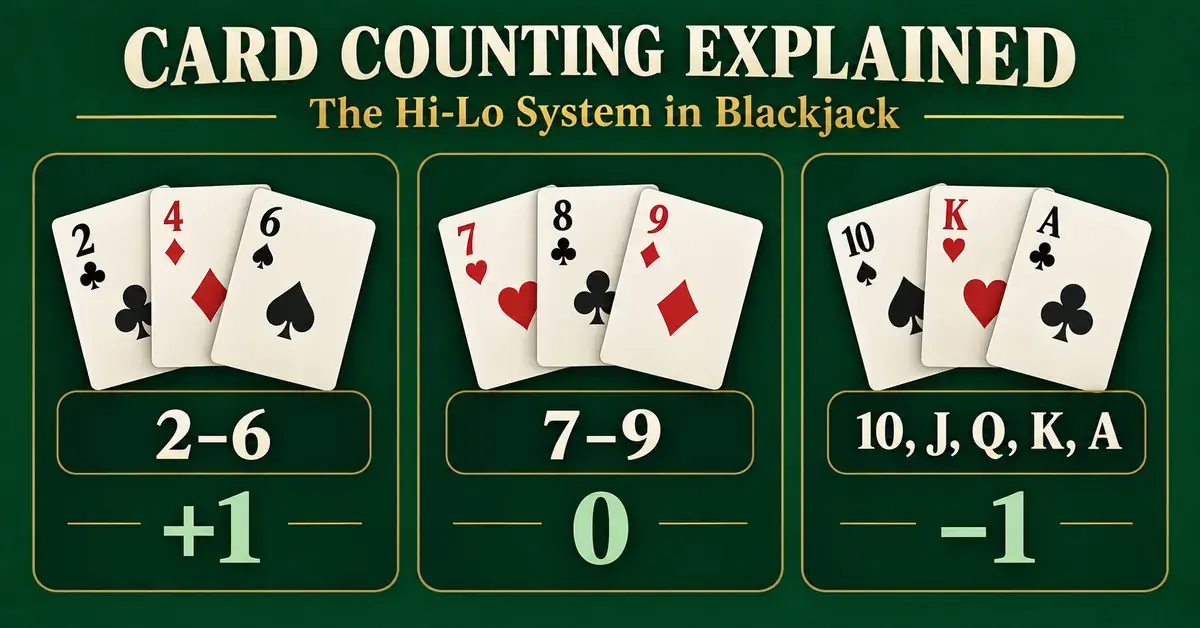
- Hi-Lo values: 2–6 = +1, 7–9 = 0, 10 through Ace = −1. A full deck sums to zero (a “balanced” system).
- Running count: the cumulative total as cards are dealt; positive favours the player.
- True count: running count ÷ decks remaining — the figure that reflects your real edge.
- Use: raise bets at high true counts, keep them minimal at low counts.
- Reality check: legal in Canada but casinos may ban you; countermeasures, variance and speed keep the real edge small.
What card counting actually is
Every hand of blackjack is dealt from a fixed set of cards — typically six or eight 52-card decks shuffled together in a “shoe”. As cards leave the shoe, the mix of what remains changes. Card counting is simply a way of estimating whether the remaining cards are rich in high cards or low cards.
Why does that matter? High cards (tens and aces) help the player. They make natural blackjacks more likely, and a natural pays extra — see what a blackjack is and how naturals pay. High cards also make the dealer bust more often when forced to draw on a stiff hand. Low cards do the opposite; they help the dealer complete weak hands safely. So when the leftover cards lean toward tens and aces, the player has a small edge; when they lean toward low cards, the house edge grows.
Counting does not predict the next card. It only measures a shift in probability across many hands. That distinction explains why counting is a long-run tool, not a way to win any single hand.
The Hi-Lo values: how the system works
Hi-Lo assigns each card one of three tags. You add these tags together as cards are exposed.
- Low cards (2, 3, 4, 5, 6) each count as +1. When they leave the shoe, the remaining deck improves for the player, so the count goes up.
- Neutral cards (7, 8, 9) count as 0 and are ignored.
- High cards (10, Jack, Queen, King, Ace) each count as −1. When they leave the shoe, conditions get worse for the player, so the count goes down.
Because there are exactly the same number of high cards as low cards, a full deck counted from start to finish sums to zero. A system with that property is called balanced, and it is what makes the true-count conversion below work cleanly. If you are still learning what each card is worth in the first place, review the blackjack card values before going further.
Hi-Lo Card Values
| Cards | Hi-Lo value | What it means |
|---|---|---|
| 2, 3, 4, 5, 6 | +1 | Low cards; their removal helps the player |
| 7, 8, 9 | 0 | Neutral; ignored in the count |
| 10, J, Q, K, A | −1 | High cards; their removal helps the dealer |
Keeping the running count
The running count is the total you carry as cards appear. You start at zero the moment a fresh shoe is dealt, then add or subtract as each card shows — your own cards, other players’ cards and the dealer’s cards all count.
Here is a short worked example. Imagine these cards come out over a couple of hands:
- 5 (+1) → running count is +1
- King (−1) → back to 0
- 3 (+1) → +1
- 2 (+1) → +2
- 8 (0) → still +2
- 6 (+1) → +3
- Ace (−1) → +2
A positive running count means more low cards have been removed than high cards, so the shoe now leans in the player’s favour. A negative count means the opposite. Experienced counters speed this up by “cancelling” a +1 card against a −1 card they see at the same time, and by counting cards in pairs, so they only ever adjust the total by the leftover.
From running count to true count
A running count of +5 means something very different with six decks left than with one deck left. With lots of cards remaining, that +5 is thinly spread; with a single deck remaining, it is concentrated and much more powerful. To account for this, Hi-Lo converts the running count into a true count:
True count = running count ÷ decks still remaining in the shoe
For example, a running count of +10 with five decks left gives a true count of +2 (10 ÷ 5). The same +10 with only two decks left gives a true count of +5 — a far stronger signal. Players estimate the decks remaining by glancing at the discard tray and rounding to the nearest half-deck or full deck.
Why the true count is the number that matters
The true count is what actually maps onto your edge. As a rule of thumb, each point of positive true count shifts the odds by roughly half a percent in the player’s favour. Because a typical game starts with a house edge of a few tenths of a percent, it usually takes a true count of around +1 or +2 before a skilled player is even at break-even, and higher counts before there is a genuine advantage. That is why the running count on its own is not enough — only the true count tells you how strong the situation really is.
Turning the count into decisions
Knowing the true count is useless unless it changes what you do. Counters act on it in two ways.
Adjusting the bet size
The main lever is the size of your wager. Counters bet the table minimum (or sit out where allowed) when the true count is low, and increase their bet as the true count climbs, because their edge only appears at higher counts. The ratio between the smallest and largest bet is called the bet spread — a “1-to-8” spread means the top bet is eight times the minimum. This bet variation supplies the large majority of a counter’s theoretical advantage. It is also the behaviour casinos watch for most closely.
Changing a few playing decisions
A smaller part of the edge comes from occasionally deviating from basic strategy when the count is extreme. The best-known example is the insurance bet: normally a poor bet, it becomes worthwhile at a high positive count because tens are more likely. A handful of other decisions — when to stand, double or split — also flip at certain counts. Counting sits on top of, and never replaces, a solid grasp of the core player actions such as hit, stand, double and split.
A short history of Hi-Lo
Card counting entered public awareness with mathematician Edward O. Thorp, whose 1962 book Beat the Dealer proved that blackjack could be beaten with a system. Thorp’s original method was cumbersome to use at the table. The Hi-Lo system was developed by engineer Harvey Dubner, who used an IBM computer to simplify counting into the +1 / 0 / −1 scheme still used today, and presented it at the 1963 Fall Joint Computer Conference. It was later refined by researcher Julian Braun and popularised in the revised 1966 edition of Beat the Dealer. Its balance of accuracy and simplicity is why Hi-Lo remains the most taught system decades later.
Is card counting legal in Canada?
Counting cards using only your own mind is legal in Canada. Canadian courts have treated cheating as involving unlawful devices or interference with the game, and keeping a mental count does neither, so it is not a criminal offence. Using a phone, app or any device to help count is a different matter and can cross into illegal territory.
Being legal is not the same as being welcome. Casinos are private businesses and, in most provinces, may refuse service to suspected counters — asking them to leave, barring them from the blackjack tables, or banning them from the property. Counters are not arrested for counting, but they can be shown the door.
Why it is much harder than it looks
Films make counting look glamorous and easy. In practice, several factors keep the real-world edge small and fragile:
- Countermeasures. Casinos use continuous shuffling machines that reshuffle after almost every hand, deal from more decks, shuffle earlier in the shoe, and limit how far players can spread their bets — all of which blunt or eliminate counting.
- Speed and stamina. The count must be kept perfectly, in a noisy room, for hours, while also playing correct basic strategy, sizing bets and appearing casual.
- Bankroll and variance. Even with a genuine edge, results swing wildly over the short term. Long losing stretches are normal, and a small edge only pays off over a very large number of hands.
- Common mistakes. Forgetting to reset to zero at a new shoe, converting to the true count incorrectly, raising bets too obviously, or letting the count distract from correct play all erase the advantage.
- Online play. Standard online blackjack and most live-dealer tables reshuffle frequently or use a fresh virtual shoe each hand, so counting does not work there.
Who the Hi-Lo system suits
Hi-Lo is best understood as an educational and mathematical topic. It suits players who already know basic strategy cold, enjoy mental arithmetic, and are curious about the maths of the game rather than chasing profit. For the vast majority of players, it is far more valuable as a way to understand why high and low cards matter than as a practical money-making method. Casual players are better served by mastering basic strategy and treating blackjack as entertainment with a fixed budget.
Responsible Gambling
This article is educational and does not encourage gambling or claim that card counting guarantees a profit. Blackjack is a game of chance with a built-in house edge, and no system removes the risk of losing money. Only play with money you can afford to lose, set limits before you start, and never chase losses. If gambling is causing you or someone you know harm, free and confidential help is available across Canada — you can reach ConnexOntario at 1-866-531-2600, contact your provincial problem-gambling helpline, or visit the responsible gambling resources page. You must be of legal gambling age in your province or territory to play.
Sources
- Overview of card counting concepts and true-count conversion
- Blackjack Apprenticeship — Hi-Lo system guide
- Wizard of Odds — Introduction to card counting
- Blackjack Review — Harvey Dubner and the development of Hi-Lo
- Legal status of card counting in Canada
- ConnexOntario — problem gambling support
- Responsible Gambling Council — help for Canadians
Frequently Asked Questions
Is the Hi-Lo card counting system hard to learn?
The rules are simple: add +1 for low cards, subtract 1 for high cards, ignore sevens through nines. Learning the values takes minutes. Doing it flawlessly at real speed, while playing correct strategy and staying inconspicuous, is what takes practice.
What is the difference between the running count and the true count?
The running count is the raw total you keep as cards appear. The true count adjusts that total for how many decks are still to be dealt, by dividing the running count by the decks remaining. The true count is the number that reflects your actual edge.
Does card counting guarantee that I will win?
No. At best it turns a small house edge into a small player edge that only shows up over a very large number of hands. Short-term swings are large, and losing sessions are common even for skilled counters.
Can I count cards playing blackjack online?
Generally no. Standard online blackjack shuffles a fresh virtual shoe for every hand, and most live-dealer games reshuffle frequently, so there is no ongoing count to track.
Will I get in trouble for counting cards in Canada?
Counting in your head is legal and is not a criminal offence in Canada. However, casinos are private venues and can refuse service, ask you to leave, or ban you if they suspect you are counting. Using a device to help count is not legal.
