
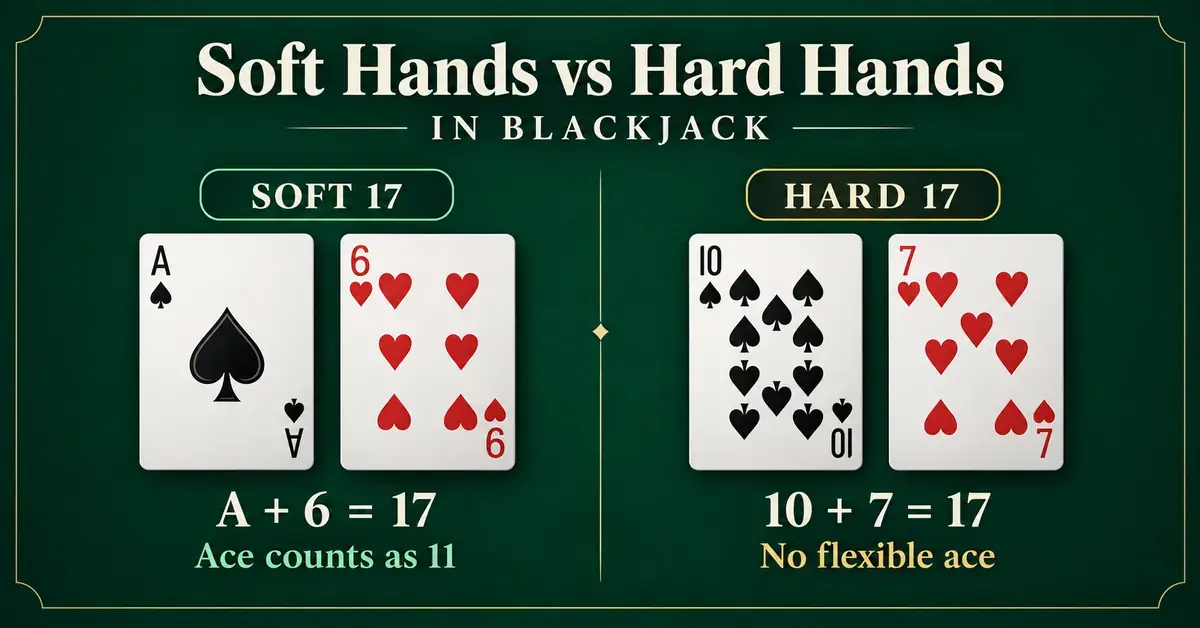
Two blackjack hands can add up to the same number and still need to be played in completely different ways. The reason is the ace, the only card that can be worth either 1 or 11. When an ace is in your hand, its flexibility turns an ordinary total into a “soft” hand that behaves differently from a “hard” one. Understanding soft hands versus hard hands — and the special case of a soft 17 — is one of the biggest steps a beginner can take toward playing blackjack correctly.
This guide explains exactly what each type of hand is, gives clear examples, and shows why the same total is sometimes a stand and sometimes a hit depending on whether it is soft or hard.
Key Points
- Hard hand: no ace, or an ace forced to count as 1 — the total is fixed and can bust.
- Soft hand: contains an ace counted as 11 — it can never bust on the next card.
- Soft 17 is an ace-plus-six (or any 17 using an ace as 11).
- The H17 rule (dealer hits soft 17) adds about 0.22% to the house edge versus S17 (dealer stands).
- Play soft hands aggressively (hit or double); play hard “stiff” totals of 12–16 cautiously.
The Ace: Why Two Totals Exist
Before comparing hand types, it helps to remember how the cards are counted. Number cards are worth their face value, and jacks, queens, kings and tens are all worth 10. The ace is unique: it can count as either 1 or 11, whichever helps the hand more at that moment. If you want a full refresher on this, see our guide to blackjack card values.
Because an ace has two possible values, a hand that contains one can often be read two ways. That single fact is what separates soft hands from hard hands.
What Is a Hard Hand?
A hard hand is any hand that does not contain an ace being counted as 11. In practice, that means one of two things:
- The hand has no ace at all — for example, 10 + 6 = hard 16, or 9 + 8 = hard 17.
- The hand has an ace, but counting it as 11 would push the total over 21, so the ace is forced to count as 1 — for example, 10 + 7 + Ace = hard 18.
The defining feature of a hard hand is that its total is fixed. There is no flexibility, and if you draw another card there is a real risk of going over 21 (busting). A hard 16 against a strong dealer card is one of the toughest spots in the game precisely because you cannot improve it safely.
What Is a Soft Hand?
A soft hand is any hand that contains an ace counted as 11 without the total going over 21. It is called “soft” because it cannot bust on the next card — if a big card arrives, the ace simply drops from 11 to 1 and the hand keeps a legal total.
Some clear examples:
- Ace + 6 = soft 17 (the ace is 11). Draw a 10 and it becomes 17 as a hard hand — the ace turns into a 1.
- Ace + 7 = soft 18, the most misplayed soft hand in the game.
- Ace + 2 = soft 13, a weak-looking hand that is actually a good doubling opportunity against certain dealer cards.
The key advantage of a soft hand is safety: you can take a card in search of a better total with zero chance of busting on that draw. This is why correct strategy is far more aggressive with soft hands than with hard ones.
Soft vs Hard Hands Compared
| Feature | Soft hand | Hard hand |
|---|---|---|
| Contains an ace as 11? | Yes | No (no ace, or ace = 1) |
| Can bust on next card? | No | Yes |
| Example | Ace + 6 = soft 17 | 10 + 7 = hard 17 |
| Total is fixed? | No — flexible | Yes |
| Typical strategy | Aggressive: hit or double | Cautious: stand or hit |
Soft 17: The Hand That Can Change the Rules
Of all the soft totals, soft 17 (an ace plus a six, or any combination using an ace as 11 that totals 17) gets special attention because of a casino rule that directly affects your odds.
Dealer Hits vs Stands on Soft 17 (H17 vs S17)
The dealer has no choices — they follow a fixed rule. Every blackjack table states one of two versions on the felt:
- S17 — “Dealer stands on all 17s.” The dealer stops on a soft 17 (like Ace-6) and does not draw.
- H17 — “Dealer must hit soft 17.” The dealer draws another card on a soft 17, trying to improve the hand.
H17 is worse for the player. When the dealer hits a soft 17, their chance of busting goes up a little, but their chance of finishing with 18 or more goes up roughly twice as much — so the rule favors the house overall. Analysts at authorities such as the Wizard of Odds put the cost at about 0.22% added to the house edge. That may sound tiny, but blackjack is a game of small margins, and the H17 rule is now the more common version in modern casinos, so it is worth checking before you sit down.
Your own soft 17 is played to your advantage: because it can never bust on one card, basic strategy tells you to hit or double it rather than stand — a stand on soft 17 is almost always a wasted hand.
Why Soft and Hard Hands Are Played Differently
The same total is not the same decision. A hard 17 is a firm stand — hitting it risks a bust and there is no upside. A soft 17 cannot bust on the next card, so standing throws away a free chance to improve. This is the core reason a basic strategy chart lists soft hands in a separate section from hard hands.
In general, soft hands invite the more aggressive player actions — hitting and, when the dealer is weak, doubling down. Hard hands are more cautious, especially the awkward “stiff” totals of 12 through 16.
Basic Strategy for Soft Hands
The table below shows the standard basic-strategy plays for soft hands in a common multi-deck game where the dealer stands on soft 17 and doubling after a hit is allowed. Where a double is recommended but the rules do not allow it (for example, on a three-card hand), you hit instead — unless the entry says otherwise.
| Your soft hand | Double down against | Otherwise |
|---|---|---|
| Soft 13 (A-2) | Dealer 5–6 | Hit |
| Soft 14 (A-3) | Dealer 5–6 | Hit |
| Soft 15 (A-4) | Dealer 4–6 | Hit |
| Soft 16 (A-5) | Dealer 4–6 | Hit |
| Soft 17 (A-6) | Dealer 3–6 | Hit |
| Soft 18 (A-7) | Dealer 3–6 | Stand vs 2, 7, 8; Hit vs 9, 10, Ace |
| Soft 19 (A-8) | — | Stand |
| Soft 20 (A-9) | — | Stand |
Soft 18 is the one most players get wrong. It looks like a strong hand, but 18 is not good enough to beat a dealer showing a 9, 10 or ace, so basic strategy has you hit it against those cards. Because it is a soft hand, that extra card can never bust you. Note that exact soft-18 and soft-19 plays shift slightly under the H17 rule, so always match your chart to the table you are playing.
Basic Strategy for Hard Hands (In Brief)
Hard hands follow simpler, more defensive logic:
- Hard 8 or lower: always hit — you cannot bust and you need a bigger total.
- Hard 9 to 11: strong doubling range against weaker dealer cards; otherwise hit.
- Hard 12 to 16 (“stiff” hands): stand when the dealer shows 2–6 (they are likely to bust) and hit when the dealer shows 7 through ace.
- Hard 17 or higher: always stand — the bust risk outweighs any gain.
If you are still learning the flow of a round, our guide on how to play blackjack walks through the sequence of a hand from bet to payout.
Common Mistakes With Soft Hands
- Standing on soft 17 or soft 18 too early. These hands beg to be hit or doubled in the right spots; standing wastes their risk-free upside.
- Not noticing the ace is flexible. Beginners sometimes treat Ace-6 as a fixed 7 or a fixed 17. It is both, depending on the next card.
- Forgetting a soft hand can become hard. Once a big card forces the ace to count as 1, you are playing a hard total and the cautious rules apply.
- Ignoring the table rule. H17 versus S17 changes a few plays and the overall edge — read the felt before you bet. If a dealer’s soft-17 draw beats a hand you would otherwise have won, that is the H17 rule at work, not bad luck. You can read more about the naturals that pay a premium in our explainer on what a blackjack is.
Which Hand Type Suits Which Player?
Neither hand type is something you choose — you play whatever the cards deal you. But knowing the difference matters most for newer players, because soft hands are where instinct and correct strategy diverge the most. If you can train yourself to be braver on soft totals and more disciplined on hard “stiff” totals, you have absorbed the single most valuable habit in basic strategy.
Responsible gambling notice. This article is educational and explains the rules and mathematics of blackjack; it is not betting advice and does not improve the long-term house edge, which always favors the casino. No strategy guarantees a win, and outcomes are determined by chance. Set a budget, treat any losses as the cost of entertainment, and never chase them. In Canada you must be of legal gambling age in your province or territory (18 or 19). If gambling is causing harm, free, confidential help is available through the Responsible Gambling Council. See our responsible gambling resources for more.
Sources
Frequently Asked Questions (FAQ)
What is the difference between a soft hand and a hard hand in blackjack?
A soft hand contains an ace counted as 11 without going over 21, so it can never bust on the next card. A hard hand has no ace, or an ace that must count as 1, which means its total is fixed and drawing another card can bust it.
What is a soft 17 in blackjack?
A soft 17 is a hand worth 17 that uses an ace as 11, most commonly an ace and a six. The ace can drop to 1 if you draw a big card, so a soft 17 can never bust on the next card.
Why does it matter if the dealer hits or stands on soft 17?
When the dealer hits soft 17 (the H17 rule), they get an extra chance to improve a weak hand. This adds roughly 0.22% to the house edge compared with a table where the dealer stands on all 17s (S17), so S17 tables are slightly better for players.
Can a soft hand turn into a hard hand?
Yes. If you draw a card that would make an 11-value ace bust the hand, the ace automatically counts as 1 instead. From that point the hand has a fixed total and is played like any other hard hand.
Should you ever stand on a soft 17?
No. Basic strategy never has a player stand on soft 17, because the hand cannot bust on one card and can only improve. Depending on the dealer’s upcard you either hit it or double down, but you do not stand.
