
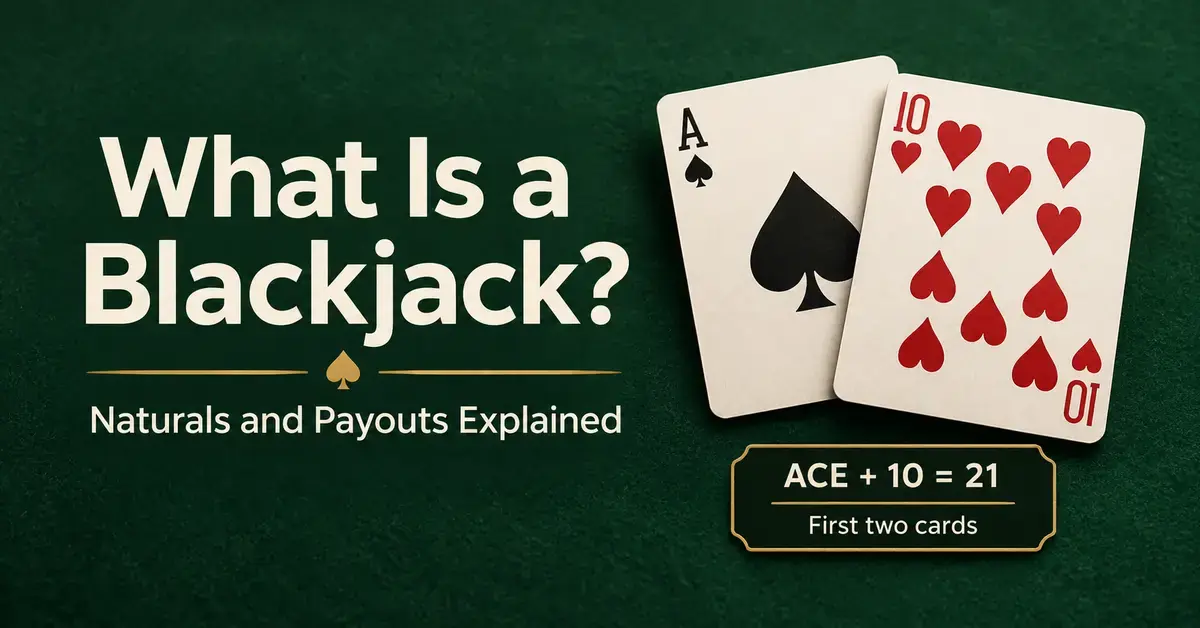
In blackjack, the word “blackjack” has a very specific meaning that goes beyond the name of the game. A “blackjack” — also called a “natural” — is the single best hand you can be dealt, and it is paid more generously than any ordinary winning hand. Knowing exactly what counts as a natural, and how the casino pays it, is one of the most useful things a new player can learn, because the payout attached to this one hand affects your odds more than almost any other rule at the table.
What a Natural Blackjack Actually Is
A natural blackjack is a two-card hand worth exactly 21, made up of an ace paired with any ten-value card. Because it is formed by the first two cards you receive, it is the strongest possible start: the dealer can tie it but never beat it. The ace counts as 11 here, and the ten-value card supplies the other 10. If you are new to the game, our guide on how to play blackjack walks through the full sequence of a hand.
Which Cards Make a Natural
Any combination of one ace and one ten-value card counts as a natural. The ten-value cards are:
- The 10 of any suit
- The Jack (J)
- The Queen (Q)
- The King (K)
Suits do not matter — a natural is about value, not colour or symbol. An ace of spades with a king of hearts is exactly as good as an ace of clubs with a 10 of diamonds.
Hands That Look Like a Natural but Are Not
A total of 21 is not always a natural, and the distinction matters because only a genuine two-card natural earns the premium payout. In particular:
- Three or more cards reaching 21 (for example 7 + 4 + a ten-value card) is a regular 21, not a blackjack.
- An ace and ten drawn after splitting — if you split a pair of aces and then draw a ten-value card, most casinos score the hand as an ordinary 21 rather than a natural, so it pays even money instead of the higher blackjack rate.
How Blackjack Payouts Work
When you are dealt a natural and the dealer is not, you are paid at a fixed ratio rather than the even-money (1:1) return of a normal winning hand. Three payout rules are common, and the difference between them is money straight out of your pocket.
Payout Comparison
| Payout rule | You win on a natural | Effect on the house edge |
|---|---|---|
| 3:2 (1.5:1) | Baseline and best for players (about 0.5% edge under common rules) | |
| 6:5 (1.2:1) | Adds roughly 1.4% | |
| Even money (1:1) | Adds roughly 2.3% |
The 3:2 Payout (the Standard)
The traditional and most player-friendly payout is 3:2, sometimes written as 1.5:1. It means you win $3 for every $2 wagered on the natural. A $10 bet returns $15 in winnings (plus your original $10 back), and a $20 bet returns $30. This is the payout you should look for before sitting down.
The 6:5 Payout
Many newer tables — especially single-deck games marketed as a bargain — pay only 6:5. Here a natural pays $6 for every $5 bet, so a $10 wager returns just $12 instead of $15. That $3 difference on a single hand looks small, but it repeats every time you draw a natural and adds up sharply over a session.
Even Money and Insurance
When the dealer’s up-card is an ace and you hold a natural, the dealer may offer you “even money”: a guaranteed 1:1 payout instead of risking a push if the dealer also has blackjack. It sounds safe, but taking even money is mathematically the same as buying insurance, and over the long run it returns less than simply letting the 3:2 hand stand.
How Often Do You Get a Natural?
Naturals are rare enough to feel special but common enough to matter. From a freshly shuffled single deck the probability of being dealt one is about 4.83%, or roughly once every 21 hands. In a typical six-deck shoe it is slightly lower, at around 4.75%. Because the hand appears so regularly, the payout rule attached to it compounds quickly.
Natural vs. a Regular 21
A common point of confusion is what happens when both you and the dealer reach 21. The rules are consistent at almost every casino:
- Your natural beats any dealer hand that is not also a natural — including a dealer’s three-card 21.
- If both you and the dealer are dealt naturals, the hand is a push (a tie): your bet is returned and nobody wins.
- A dealer’s natural beats your non-natural 21.
In short, a two-card blackjack always outranks a 21 built from three or more cards.
Key Points
- A natural (blackjack) is an ace plus any ten-value card — 10, J, Q or K — in your first two cards.
- Suits are irrelevant; only the total value matters.
- The standard payout is 3:2; avoid 6:5 and even-money tables where you can.
- A natural beats every hand except another natural, which is a push.
- You are dealt one roughly once every 21 hands (about 4.8%).
- An ace-plus-ten formed after splitting aces usually counts as a plain 21, not a natural.
Why the Payout Rule Matters More Than It Looks
The payout on naturals is the single biggest rule-based factor in your expected return. Under common rules, a 3:2 game carries a house edge of roughly 0.5%. Switching that same table to 6:5 adds about 1.4% to the house edge, and accepting even money adds around 2.3%. For perspective, most other rule changes — whether the dealer hits or stands on soft 17, or whether you can double after splitting — move the edge by only about 0.1% to 0.2%. Pairing a good payout with sound basic blackjack strategy is the most reliable way to keep the house edge low.
What This Means for Players in Canada
Blackjack is offered at licensed land-based and provincial online casinos across the country, and payout rules vary from table to table just as they do elsewhere. Always check the felt or the game information screen for the natural payout before you place a bet. For more on where and how the game is regulated, see our overview of blackjack in Canada. The legal gambling age is 19 in most provinces and territories, and 18 in Alberta, Manitoba and Quebec.
Responsible Gambling Disclaimer
This article is for informational and educational purposes only. It explains how blackjack naturals and payouts work; it is not gambling advice or an inducement to gamble. No strategy, payout rule or bet removes the casino’s built-in mathematical edge, and results over any short period are unpredictable. You must meet your province’s legal gambling age — 19 in most of Canada, 18 in Alberta, Manitoba and Quebec. If gambling is affecting you or someone you know, free and confidential help is available through the Responsible Gambling Council, and you can review our responsible gambling resources for further support.
Sources
Frequently Asked Questions (FAQ)
Is a blackjack always an ace and a ten?
Yes. A natural blackjack is specifically an ace combined with any ten-value card (a 10, Jack, Queen or King) dealt as your first two cards. Any other total of 21, or a 21 built from three or more cards, is a regular 21 rather than a blackjack.
What is the difference between a 3:2 and a 6:5 payout?
At 3:2 a natural pays $3 for every $2 wagered, so a $10 bet wins $15. At 6:5 the same natural pays only $6 for every $5, so a $10 bet wins just $12. The 6:5 rule keeps more money for the casino and raises the house edge by about 1.4%.
Does a two-card 21 beat a three-card 21?
Yes. A natural (two-card 21) beats a 21 made from three or more cards, including the dealer’s. The only time a natural does not win outright is when both the player and the dealer have a natural, which is a push.
Is taking even money on a blackjack a good idea?
Generally no. Even money guarantees a 1:1 return when the dealer shows an ace, but it is mathematically equivalent to insurance and returns less over time than allowing the 3:2 payout to stand. Most players are better off declining it.
What are the odds of being dealt a blackjack?
From a single freshly shuffled deck the chance is about 4.83%, or roughly one hand in every 21. In a six-deck shoe it is slightly lower, at about 4.75%. It is an uncommon but regular occurrence over a session of play.
