
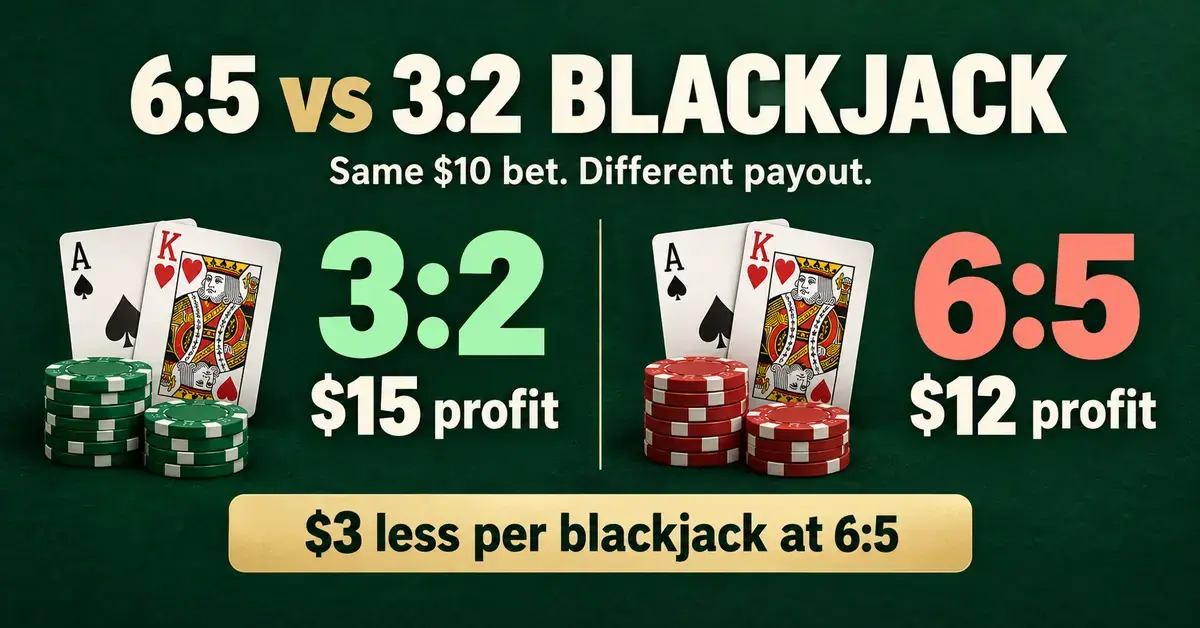
Two blackjack tables can look identical — same felt, same dealer, same rules — yet one quietly charges you several times more to play. The difference is a single line printed on the table: whether a natural blackjack pays 3:2 or 6:5. It sounds like a tiny change, and the casino counts on it feeling that way. In real money, it is one of the most expensive rules you can sit down to. This guide skips the theory and shows you exactly what the 6:5 payout costs — per blackjack, per hour, and over a night of play.
Key Takeaways
- 3:2 pays $15 on a $10 blackjack; 6:5 pays only $12 — a $3 shortfall per natural.
- Switching a table to 6:5 adds about 1.39% to the house edge, pushing a typical 0.5% game up to roughly 1.9%.
- A natural lands on about 4.8% of hands (1 in 21), so the short-pay hits often.
- Real cost scales with bet size and hands played: a $25 player gives up roughly $24 an hour to the rule alone.
- No strategy, system or deck count removes it — the only fix is to play a 3:2 table.
What the two payouts actually pay
A “natural” or blackjack is an ace plus any ten-value card dealt as your first two cards. Because it is the strongest possible start, it pays a bonus instead of the even money (1:1) you get on an ordinary winning hand. The payout ratio tells you how big that bonus is.
- 3:2 — you win $3 for every $2 staked. On a $10 bet, a blackjack pays $15.
- 6:5 — you win $6 for every $5 staked. On the same $10 bet, a blackjack pays only $12.
That is a $3 gap on a single $10 hand. It looks trivial, but a natural shows up often — on roughly 4.8% of hands, or about one in every 21. Over a session you are dealt a lot of blackjacks, and the 6:5 table short-pays every one of them. For the mechanics of each payout side by side, see our full breakdown of 3:2 vs 6:5 blackjack payouts.
The real cost: turning 1.39% into dollars
Switching a table from 3:2 to 6:5 adds about 1.39% to the house edge. The house edge is the share of every dollar wagered that the casino expects to keep over the long run. On a good 3:2 game played with correct basic strategy, that edge is around 0.5%. Add the 6:5 penalty and it climbs to roughly 1.9% — nearly four times as much — before you have made a single mistake.
Where does 1.39% come from? It is simple arithmetic: a natural pays 1.5 units at 3:2 but only 1.2 units at 6:5, a shortfall of 0.3 units. Multiply that by how often you actually get paid for a blackjack (about 4.75% of hands, after the rare pushes where the dealer also has one) and you get roughly 1.4% of every wager handed back to the house. That cost is baked into the table — no strategy, card counting or betting system removes it.
The practical way to feel the damage is to stop thinking in percentages and start thinking in dollars. House edge is a percentage of everything you bet, so the faster you play and the bigger you bet, the faster the 6:5 penalty drains your bankroll.
Cost by bet size and session length
The table below shows two things: the money you lose on each individual blackjack, and the extra expected loss per hour that the 6:5 rule adds on top of a normal game. The hourly figures assume a brisk full table of about 70 hands per hour; a quieter table deals fewer, a near-empty one more.
Cost by Bet Size
| Bet per hand | Blackjack pays (3:2) | Blackjack pays (6:5) | Lost per blackjack | Extra cost per hour (~70 hands) |
|---|---|---|---|---|
| $10 | $15 | $12 | $3.00 | ~$10 |
| $25 | $37.50 | $30 | $7.50 | ~$24 |
| $50 | $75 | $60 | $15.00 | ~$49 |
| $100 | $150 | $120 | $30.00 | ~$97 |
A few things jump out. A $25 player at a 6:5 table gives up roughly $24 an hour purely to the payout rule — the price of a decent meal, every hour, for nothing in return. Stretch that over a four-hour session and the 6:5 penalty alone has cost around $95. Play once a week for a year and you are looking at several thousand dollars that a 3:2 table two steps away would have let you keep.
These are averages, not guarantees — on any given night you might run hot or cold. But the edge is relentless: the more hands you play, the closer your results drift toward the math, and the math at 6:5 is simply worse. Rushing to add more decks or bigger bets only speeds up the loss; for how other table conditions move your odds, see our guide to how deck count affects blackjack odds.
The hidden rounding trap
There is a second cost that the 1.39% figure understates. A 6:5 payout only divides cleanly when your bet is a multiple of $5. Bet an odd amount — say $7.50 — and many casinos round down, sometimes paying a fraction of the hand at plain even money. The result is that a $7.50 natural might pay $8.50 instead of the correct $9. Those shaved pennies mean the real-world cost of a 6:5 table often runs slightly higher than the quoted penalty, especially for players who bet in small or uneven amounts. The lesson: at a 6:5 table, betting below the clean $5 increments quietly makes a bad deal worse.
Who 6:5 hurts the most
Counter-intuitively, the rule punishes low-stakes and recreational players hardest — the very people most likely to sit at these tables.
- Low rollers. 6:5 tables usually carry the lowest table minimums in the room (often under $25), which is exactly why they exist: they lure budget players with a low buy-in and quietly take it back through the payout.
- Long-session players. Because the cost scales with hands played, someone grinding a $10 table for hours loses far more than a visitor who plays ten hands and leaves.
- Players who think they are getting a deal. The table may advertise “single deck” or a low minimum as a perk. A single-deck game normally lowers the house edge, but a 6:5 payout more than cancels that benefit, turning an apparent bargain into one of the worst bets on the floor.
Sitting down at a 6:5 table is one of the most common blackjack mistakes, precisely because it is invisible if you do not know to look for it.
How to protect your bankroll
You cannot out-play a bad payout, but you can refuse to pay it. A few habits keep the 6:5 tax off your bankroll:
- Read the felt before you sit. The payout is printed on the layout: look for “Blackjack pays 3 to 2” versus “Blackjack pays 6 to 5.” If you cannot find it, ask the dealer — they will tell you.
- Treat the minimum as a warning sign. An unusually low minimum on a crowded floor is often a 6:5 game. The higher-minimum tables nearby are frequently the 3:2 ones.
- Walk to a 3:2 table. If a 3:2 game exists in the building — even at a higher minimum — the lower edge usually makes it the cheaper place to play per hour, not the more expensive one.
- If only 6:5 is available, play less. Fewer hands and shorter sessions directly shrink the dollar cost, because the penalty only applies to money you actually wager.
For the bigger picture on how payouts, rules and decks combine into the overall numbers, see our overview of blackjack odds and house edge.
Disclaimer
This article is for information and education only. It explains how a payout rule affects the mathematical cost of a game; it is not betting advice, and no payout, strategy or system makes blackjack a long-term winning proposition — the house keeps an edge on every version described here. Gambling can be harmful and should only ever involve money you can afford to lose. You must be of legal gambling age in your province or territory. If gambling is affecting you or someone you know, free, confidential help is available across Canada through the Responsible Gambling Council and provincial support lines. See our responsible gambling resources for more.
Sources
Frequently Asked Questions (FAQ)
How much does 6:5 blackjack really cost compared to 3:2?
The 6:5 payout adds about 1.39% to the house edge. In dollars, a natural that would pay $15 at a 3:2 table pays only $12 at 6:5 on a $10 bet. Over an hour of play at that stake you lose roughly $10 extra, and a $25 player loses around $24 an hour purely to the payout change.
Why do casinos offer 6:5 tables at all?
Because they are far more profitable. The lower payout can roughly quadruple the house edge, so casinos use 6:5 games — often with low table minimums to attract budget players — to earn much more from the same table without changing anything a casual player would notice.
Does a single-deck 6:5 game make up for the worse payout?
No. Fewer decks normally lower the house edge by a few tenths of a percent, but the 6:5 payout adds about 1.39% — far more than the deck reduction saves. A single-deck 6:5 game is still one of the worst blackjack bets on the floor.
How can I tell if a table is 6:5 or 3:2?
Look at the printed layout. It will say either “Blackjack pays 3 to 2” or “Blackjack pays 6 to 5.” If the text is unclear, ask the dealer before you buy in — the payout is fixed for that table and cannot be negotiated.
Can good strategy or card counting cancel out the 6:5 penalty?
No. Basic strategy and card counting reduce or shift the edge that comes from how you play, but the 6:5 penalty is built into the payout itself. It applies to every blackjack you are dealt regardless of skill, so the only way to avoid it is to play a 3:2 table.
