
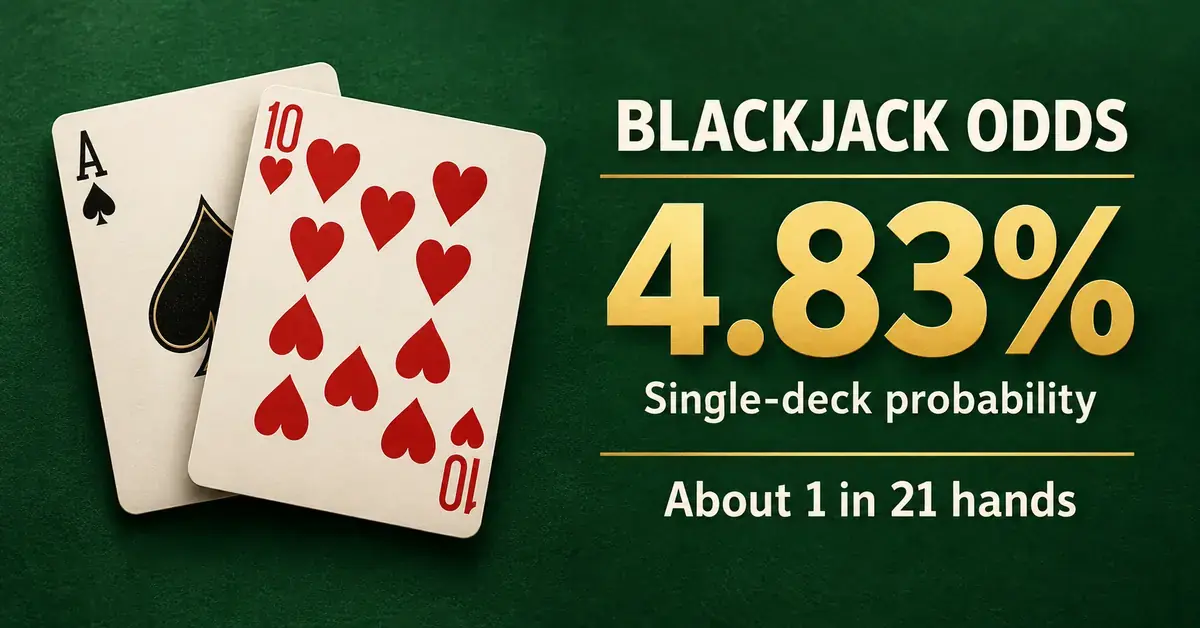
A natural blackjack — an ace next to a ten-value card on your first two cards — is the best hand in the game, yet it turns up far less often than most players expect. So what are the real odds of getting a blackjack? In a single-deck game the chance is about 4.83%, or roughly one hand in every 21. The figure shifts a little with the number of decks, but it never strays far from that one-in-twenty mark. Below is the exact math, a table by deck count, and what the number actually means when you are sitting at the table.
Key Facts
- Single deck: about 4.83% chance of a natural (64 of 1,326 two-card hands)
- Six decks: about 4.75% — roughly 1 in 21 hands
- What it needs: one ace plus one ten-value card (10, J, Q or K)
- More decks: slightly lower odds, converging toward about 4.73%
- Can’t be influenced: the deal is random; no strategy changes how often it appears
- If both hands tie: player and dealer naturals make a push (bet returned)
What counts as a blackjack
A blackjack — also called a natural — is a total of 21 made with exactly two cards: one ace (worth 11 here) and one card worth 10. The ten-value cards are the 10, Jack, Queen and King, so there are 16 of them in a standard 52-card deck against just 4 aces. Reaching 21 later by hitting several cards is still a winning total, but it is not a blackjack and does not earn the premium payout. If you want the full definition and how it pays, see our guide to what a blackjack is, and our note on blackjack card values explains why so many cards count as 10.
The odds of getting a blackjack in a single deck
With one freshly shuffled 52-card deck, a blackjack needs one ace and one ten-value card, in either order. There are two ways to think about the math, and both give the same answer.
The step-by-step calculation
Working through the draw card by card:
- Ace first, then a ten: 4/52 × 16/51
- Ten first, then an ace: 16/52 × 4/51
Adding the two routes together gives (4 × 16 + 16 × 4) ÷ (52 × 51) = 128 ÷ 2,652 = 0.0483, or about 4.83%. The same result drops out of counting two-card combinations: there are 4 × 16 = 64 ace-plus-ten pairs among the 1,326 possible two-card hands, and 64 ÷ 1,326 is again 4.83%. Turned into odds, that is close to 1 in 20.7 — so a little under one blackjack for every 21 hands you play.
How the number of decks changes the odds
Casinos usually deal from a shoe of four, six or eight decks rather than one. Adding decks lowers the chance of a natural slightly, because the ratio of aces to other cards stays the same but the “first card, then matching card” math is diluted. The effect is small — the probability slips from about 4.83% with one deck toward roughly 4.73% with a very large shoe — but it is one more reason single-deck tables favour the player. Our guide to how deck count affects blackjack odds covers the wider house-edge picture.
Blackjack Odds by Number of Decks
| Number of decks | Chance of a natural blackjack | Approximate odds |
|---|---|---|
| 1 deck | 4.83% | ~1 in 20.7 |
| 2 decks | 4.78% | ~1 in 20.9 |
| 4 decks | 4.76% | ~1 in 21.0 |
| 6 decks | 4.75% | ~1 in 21.1 |
| 8 decks | 4.75% | ~1 in 21.1 |
What the probability means at the table
A 4.75% chance per hand sounds low, and in practice it is. A few ways to picture it:
- About 1 in 21 of your own hands. Over a long session you will average roughly one natural every 20 to 21 rounds — not one every few hands, which is why a dry spell of 40 or 50 hands with no blackjack is perfectly normal.
- Roughly three an hour. At a brisk heads-up pace of about 70 hands per hour, the math works out to around three naturals for you in that time.
- The dealer has the same chance. The dealer is dealt from the same shoe and is just as likely to show a natural. Counting both hands, a blackjack appears somewhere in a heads-up round close to one time in ten.
Because both sides can draw one, a natural does not guarantee a win. If you and the dealer both have blackjack, the hand is a push (a tie) and your bet is returned. When only you have it, the standard payout is 3:2 — the single biggest reason a natural is worth celebrating. How much that is really worth, and why some tables quietly pay less, is explained in our comparison of 3:2 vs 6:5 payouts.
Common misconceptions about blackjack odds
- “I can play in a way that gets me more blackjacks.” No strategy changes the deal. Your first two cards are random, so basic strategy, bet size and seat position have no effect on how often a natural lands. Strategy improves what you do after the deal, not the deal itself.
- “A blackjack always wins.” It wins or pushes — it can never lose — but a matching dealer natural turns it into a tie.
- “The odds reset every hand, so I’m due one.” Each fresh shuffle is independent; cards are not “owed.” The 4.8% figure is a long-run average, not a promise about the next 20 hands.
- “More decks help me because there are more aces.” There are more aces, but also proportionally more of everything else, so the chance per hand actually dips slightly as decks are added.
Knowing the true frequency keeps expectations realistic. A natural is a lucky break, not something you can summon — and it is only one part of the wider picture covered in our overview of blackjack odds and the house edge and the companion piece on bust probability.
Responsible gambling
Blackjack is a game of chance with a built-in house edge, and no understanding of the odds removes it. The figures on this page are for information and education only; they are not betting advice and do not improve your chance of winning. Set a budget you can afford to lose and treat any losses as the cost of entertainment.
If gambling is causing you or someone you know harm, free, confidential help is available across Canada through ConnexOntario (1-866-531-2600), the responsible gambling resources we list, GameSense and the Responsible Gambling Council. You must be of legal gambling age in your province or territory to play.
Sources
Frequently asked questions (FAQ)
What are the odds of getting a blackjack?
About 4.83% with a single deck and roughly 4.75% with six decks — close to one hand in every 21. The chance dips slightly as more decks are added because the ace-to-ten ratio is diluted across the shoe.
Why is a blackjack more likely with one deck than with six?
In a single deck, once you draw an ace there is a relatively higher chance the matching ten-value card follows, because fewer cards are competing for that slot. Spreading the same ratio of cards across six or eight decks lowers that chance a little, which is one reason single-deck games favour the player.
Does a blackjack always win?
No. A natural can never lose, but if the dealer also has a two-card 21 the hand is a push and your original bet is returned. When only you hold the blackjack, it is paid at the table’s natural rate, usually 3:2.
Can I improve my chances of being dealt a blackjack?
No. The first two cards are dealt at random, so no betting pattern, seat or strategy changes how often a natural appears. Skill in blackjack lies in how you play the hand you are dealt, not in forcing a better deal.
How often will I get a blackjack in an hour of play?
At around 70 hands an hour, a roughly 4.75% chance per hand averages close to three naturals an hour for you. That is an average over the long run, so some hours bring several and others none.
