
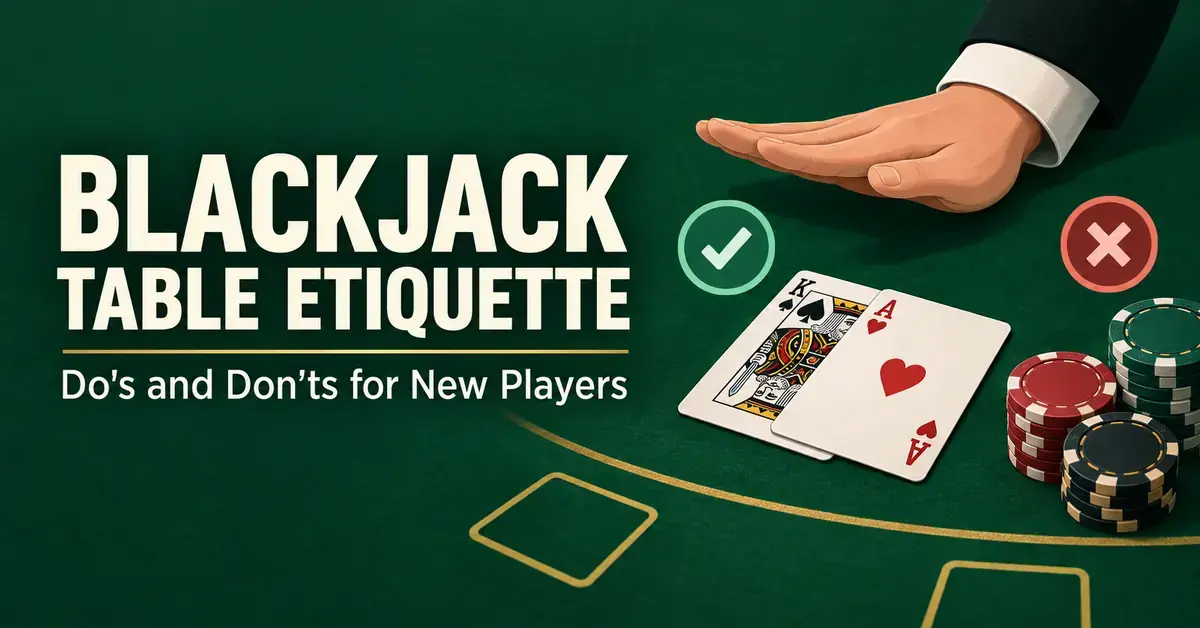
Sitting down at a blackjack table for the first time can feel intimidating — not because the game is hard, but because every table seems to run on a set of unwritten rules. Where do you put your money? Why does everyone wave their hands instead of talking? Can you pick up your cards? Blackjack etiquette is simply the shared set of manners and procedures that keep the game fair, fast and friendly for everyone. Most of it exists for a practical reason: casinos record every table on camera, so clear, consistent conduct protects you as much as it protects the house. This guide walks new players through the do’s and don’ts step by step, from buying in to tipping the dealer when you leave.
Why blackjack etiquette matters
Etiquette is not about being fancy. It keeps the game moving, prevents honest misunderstandings over bets and decisions, and keeps everyone at the table comfortable. A hand of blackjack is played against the dealer, but you share the table — and the dealer’s time — with other players, so slowing things down or breaking the routine affects everyone.
There is also a security reason. Every table is filmed by overhead cameras (dealers call it “the eye in the sky”). Standardised gestures and chip-handling rules create a clear visual record of what each player decided and wagered, which protects you if a dispute ever comes up. Once you understand that the rituals exist for clarity and fairness, they stop feeling like tests and start feeling like common sense.
Before you sit down
Scan the table before you take a seat. Look for the small placard that lists the table minimum and maximum bets, and check whether a natural blackjack pays 3:2 or the worse 6:5 — a detail that matters more for your wallet than any etiquette rule. If you are unsure which table suits a beginner, read our guide on how to play blackjack first so you arrive knowing the basics.
- Join between hands. Take an open seat when the current round has finished, not in the middle of a deal.
- Ask if it’s okay to jump into a shoe. A “shoe” is the box the dealer draws cards from. Some players are superstitious about new people joining mid-shoe; a quick, friendly “mind if I sit in?” smooths it over, though you are within your rights to play.
- Don’t reserve seats you aren’t using. Placing a jacket or chips on empty chairs to hold them for friends who are elsewhere is poor form when the floor is busy.
Buying in: getting your chips
You bet with chips, not cash, so your first move is to exchange money for chips — the “buy-in.” There is a specific, camera-friendly way to do it.
- Wait for the hand to end. Don’t interrupt a round in progress.
- Lay your cash flat on the felt. Place it in front of you, outside the betting circle — never hand money directly to the dealer. Dealers are not allowed to take cash from your hand; it must be laid down so the cameras can see the amount.
- Let the dealer spread and count it. The dealer will fan the bills out on camera, announce the total to the pit, and slide chips across to you.
- Stack your chips neatly in front of you, highest denominations at the bottom, and keep them organised throughout your session.
Key Points
- Buying in: wait for the hand to end, then lay cash flat on the felt — never hand it to the dealer.
- Hit: tap or scratch the felt (face-up games).
- Stand: wave a flat hand, palm down, over your cards.
- Double / split: place matching chips beside your bet, not on top of it.
- Touching cards: never in face-up games; one hand only, above the table, in face-down games.
- Locked bet: don’t touch your chips once the deal has started.
- Tipping: optional — hand in a chip or place a bet for the dealer.
Hand signals: let your hands do the talking
In a casino you communicate your decisions with hand signals, not words. The dealer may not act on a spoken “hit” alone, because the overhead camera cannot hear you — the gesture creates a visible record. The exact signal depends on whether the cards are dealt face up or face down. To learn what each decision actually means, see our breakdown of blackjack player actions.
Face-up (shoe) games
At most multi-deck tables the cards are dealt face up and you must not touch them.
- Hit (take another card): lightly tap or scratch the felt behind your cards with a finger.
- Stand (take no more cards): wave one flat hand, palm down, horizontally over your cards.
- Double down (double your bet for one more card): place a matching stack of chips next to — not on top of — your original bet, then hold up one finger.
- Split (separate a pair into two hands): place a second matching bet beside the first and hold up two fingers in a V.
- Surrender (give up half your bet): this is usually spoken, often with a finger drawn horizontally across the felt behind your bet, because not every table offers it.
Face-down (hand-held) games
At single- and double-deck tables the cards are often dealt face down and you may pick them up — but only with one hand, always above the table, and never bent or taken out of the dealer’s sight.
- Hit: lightly scratch the edge of your cards on the felt toward yourself.
- Stand: slide your cards face down under the chips in your betting circle.
The do’s and don’ts at the table
Most table friction comes down to a short list of habits. Keep these in mind and you will blend in from your first session.
Do
- Use clear hand signals for every decision.
- Keep your bets and chips tidy and inside your own betting circle.
- Learn basic strategy before you play so you decide quickly and keep the game moving.
- Be polite to the dealer and the other players, win or lose.
- Let the dealer know when you want to leave and ask to “colour up” — swap your small chips for larger ones — before heading to the cage to cash out.
Don’t
- Don’t touch your chips once the cards are dealt — your bet is locked for the round.
- Don’t touch the cards in a face-up game.
- Don’t hand cash directly to the dealer.
- Don’t use your phone at the table; many casinos prohibit it during play.
- Don’t give other players unsolicited advice or criticise how they play their hand.
- Don’t blame the player at “third base” (the last seat, which acts right before the dealer) when the dealer wins — their choices do not change your long-run odds.
Table Etiquette Checklist
| Do | Don’t |
|---|---|
| Signal every decision with your hand | Talk instead of signalling |
| Lay cash on the felt to buy in | Hand money straight to the dealer |
| Keep chips tidy in your own circle | Touch your bet after the deal starts |
| Decide quickly to keep play moving | Use your phone at the table |
| Stay courteous to dealer and players | Blame the “third base” seat for a loss |
| Ask to colour up before you leave | Give unsolicited advice on others’ hands |
Handling cards and chips
The handling rules all trace back to one idea: nothing should happen that the cameras cannot verify. In a face-up game the cards stay on the felt and you never touch them, so there is no suspicion of marking or switching. In a face-down game you may hold your cards, but with one hand only, kept above the table and never pressed against the table edge or hidden below it.
Chips follow the same logic. Once the dealer begins dealing, do not add to, remove from or straighten the chips in your betting circle — a settled wager must stay settled. If you want to make side decisions like doubling or splitting, place the extra chips beside your original bet and let the dealer arrange them. Keeping your hands away from a live bet is one of the quickest ways to mark yourself as a courteous, experienced-looking player.
Tipping the dealer
Tipping a blackjack dealer (known in the casino world as a “toke”) is appreciated but never required. Dealers are providing a service, and a tip is a normal way to acknowledge good, friendly service — but there is no fixed amount and no obligation. There are two common ways to do it:
- Hand in a chip. Simply slide a chip toward the dealer and say it’s for them. They will tap it on the table to signal the toke to the cameras before dropping it in their box.
- Place a bet for the dealer. Put a small chip at the front edge of your betting circle as a wager that rides with your hand. If the hand wins, the dealer wins the tip too — a popular approach because it gets the dealer rooting for you.
Many players tip a little when they’re winning or when they leave the table, but how much is entirely your call. Set it inside your gambling budget, not on top of it.
Etiquette at live online blackjack tables
If you play live dealer blackjack online — a real dealer streamed to your screen — the mechanics are handled for you, so there are no hand signals, no chip-handling and no buy-in ritual to learn. The social etiquette still applies, though. A live table usually has a chat box: keep comments friendly, don’t abuse the dealer, and respect the decision timer so you don’t stall the other players. Rude behaviour in the chat can get you muted or removed by the host.
Common etiquette mistakes new players make
Beyond the obvious, a few habits quietly mark someone as a beginner. Avoiding them — along with the strategic slip-ups in our guide to common blackjack mistakes — will make your sessions smoother:
- Talking instead of signalling. Always add the gesture; the camera needs to see your choice.
- Touching the bet mid-hand. Resting your fingers on your chips looks like you’re trying to change a wager.
- Playing too slowly. Decide before it’s your turn; agonising over every hand holds up the table.
- Taking losses out on others. The dealer doesn’t control the cards, and neither does the player beside you.
- Over-drinking. Free drinks are easy to accept, but they blur judgement and your sense of how much you’re spending.
Responsible gambling
This article is for information only and is not gambling advice. Blackjack is a game of chance and the casino keeps a long-run edge; no etiquette, strategy or tip improves your odds of winning. You must be of legal gambling age in your province or territory (18 or 19, depending on where you live). If gambling is affecting you or someone you know, free and confidential help is available in Canada from the responsible gambling resources we link to, from the Responsible Gambling Council, and from ConnexOntario at 1-866-531-2600, available 24/7.
Sources
Frequently asked questions (FAQ)
Can I touch the cards in blackjack?
It depends on the game. In face-up shoe games (most multi-deck tables), you must never touch the cards. In face-down hand-held games (often single or double deck), you may pick them up, but only with one hand, kept above the table and never bent or hidden from view.
Why do I have to use hand signals instead of just telling the dealer?
Overhead security cameras record the table but cannot hear you. A hand signal creates a clear, visible record of your decision, which keeps the game fair and protects you if there is ever a dispute. Many dealers will ask for the gesture even if you speak your choice.
How do I buy chips at a blackjack table?
Wait for the current hand to finish, then lay your cash flat on the felt in front of you — never hand it directly to the dealer. The dealer will count it on camera and slide your chips across. Stack them neatly in front of your betting circle.
Am I supposed to tip the blackjack dealer?
Tipping is appreciated but optional, with no set amount. You can hand the dealer a chip or place a small bet for them at the front of your betting circle so they win if your hand does. Only tip within your budget.
Is it rude to join a blackjack table in the middle of a shoe?
You are allowed to sit down between hands at any point, but some players are superstitious about newcomers joining mid-shoe. A quick, friendly acknowledgement before you jump in keeps the mood relaxed.
