
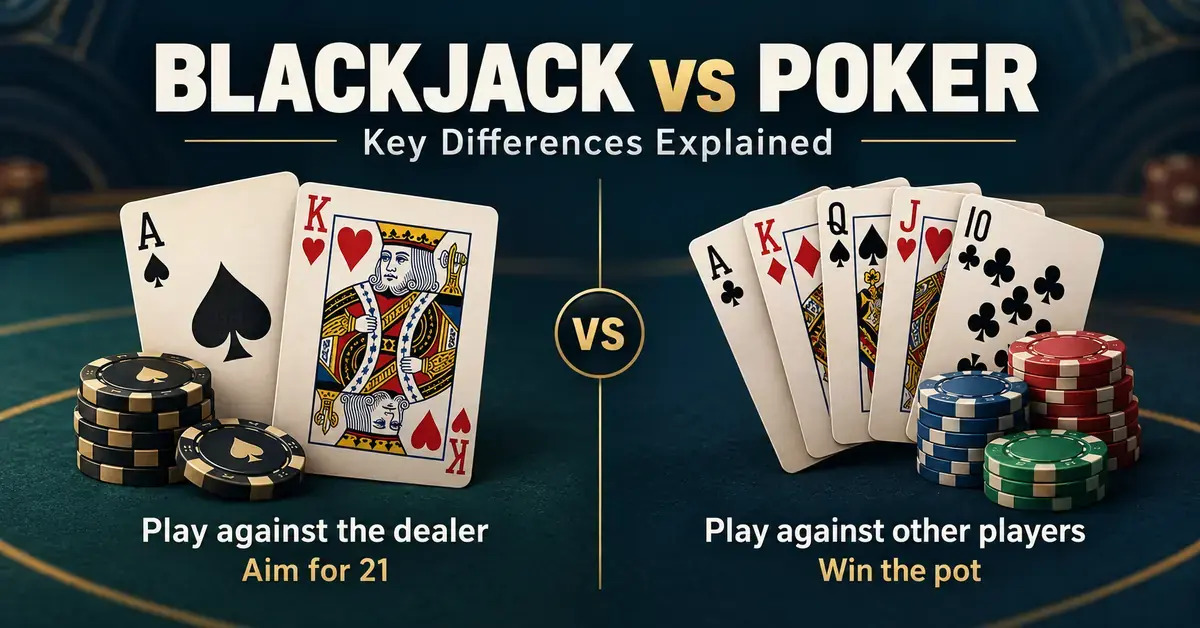
Blackjack and poker are the two most famous card games in any casino, and newcomers often lump them together. In practice they are almost opposites. Blackjack is a fast, maths-driven game you play against the house, while poker is a slower, psychological contest you play against other people. Understanding that single structural difference explains almost everything else — the rules, the skills that matter, how luck factors in, and how the casino actually makes its money. This guide breaks down how each game works and where they diverge, so you can decide which one fits how you like to play.
Key Points
- Opponent: Blackjack is played against the dealer (the house); traditional poker is played against other players.
- Goal: Blackjack — get closer to 21 than the dealer without busting. Poker — win the pot with the best hand or by making others fold.
- Skill vs luck: Blackjack has a fixed optimal strategy; poker rewards open-ended skill, psychology and reading opponents.
- How the casino profits: Blackjack uses a built-in house edge (about 0.5% with perfect play); poker rooms take a rake (roughly 3–5%, capped) or a seat charge.
- Watch out: Casino table games like Three Card Poker use poker hands but are played against the dealer, with their own house edge.
The core difference: who you play against
The most important distinction is your opponent. In blackjack, you play against the dealer, who represents the casino (the “house”). Every player at the table is trying to beat the same dealer hand, and the dealer follows fixed, published rules — typically drawing to 16 and standing on 17. Because the dealer cannot bluff, adapt or make judgement calls, blackjack is essentially you versus a rulebook.
In traditional poker, you play against the other players, not the house. The casino simply hosts the game and referees it. Your goal is to win the chips in the middle (the “pot”), either by holding the best hand at showdown or by betting in a way that convinces everyone else to fold. That means your real opponents are thinking humans who can deceive you — and whom you can deceive in return.
How blackjack works
Blackjack has a single, clear objective: build a hand worth as close to 21 as possible without going over. Cards 2 through 10 are worth their face value, face cards (jack, queen, king) are worth 10, and an ace counts as 1 or 11 — whichever helps more. If you go over 21 you “bust” and lose immediately, whatever the dealer holds.
Each round, you and the dealer receive two cards. You then choose from a short list of actions — hit (take a card), stand (keep your total), double down (double your bet for one more card) or split (turn a pair into two hands). Because every one of these decisions has a mathematically correct answer for any card combination, blackjack rewards discipline over instinct. If you want the full walkthrough, see our guide on how to play blackjack and the detail on each of the blackjack player actions.
How poker works
Poker is not one game but a family of games — Texas Hold’em, Omaha, Seven-Card Stud and more — that share a common idea: players wager over several betting rounds, and the pot goes to the last player standing or to the best five-card hand at showdown. Hands are ranked from a high card up to a royal flush, and knowing that ranking is only the starting point.
What makes poker fundamentally different is hidden information. You can see your own cards and the community cards, but never your opponents’ hole cards. Winning therefore depends on estimating what others hold, reading their betting patterns, controlling the size of the pot, and — crucially — sometimes winning with a weak hand by bluffing. There is no “correct” chart that tells you exactly what to do; the right play changes with every opponent and every situation.
Skill versus luck
Both games blend skill and chance, but in different proportions and in different ways.
- Blackjack: The skill ceiling is defined and reachable. A published basic strategy chart tells you the optimal move for every hand. Learn it and you play near-perfectly; there is little further edge to gain through cleverness (card counting aside, which casinos discourage). Short-term results still swing on the luck of the draw.
- Poker: The skill ceiling is effectively open-ended. Because you play against fallible humans rather than a fixed rulebook, better decision-making, discipline and reading of opponents can compound over thousands of hands. Luck dominates any single session, but skill dominates over the long run — which is why the same professionals keep reaching final tables.
Put simply: in blackjack you master a system; in poker you outplay people.
The maths: house edge versus rake
This is where the two games differ most for your bankroll. In blackjack, the casino builds in a house edge — a small, permanent statistical advantage. With good rules and perfect basic strategy, that edge can be as low as about 0.5%, meaning you would lose roughly 50 cents per $100 wagered over the long run. Casual players who guess their way through push it up toward 2–3%. You can read the full breakdown in our explainer on blackjack odds and house edge. The key point: the edge never disappears, so blackjack is a negative-expectation game for the player over time.
Traditional poker has no house edge on your hand at all, because you are not betting against the casino. Instead, the poker room earns money through the rake — a small cut of each pot, commonly around 3–5% up to a fixed cap (for example, 5% capped at $5), or sometimes a flat hourly seat charge at higher stakes. Many rooms also apply a “no flop, no drop” rule, taking no rake if the hand ends before the flop. Because you compete against other players rather than the house, a genuinely skilled player can overcome the rake and win money over time — something that is mathematically impossible in blackjack.
A key exception: casino “poker” table games
One point trips up a lot of beginners. Games such as Three Card Poker, Caribbean Stud and Ultimate Texas Hold’em use poker hand rankings but are played against the dealer, not other players. Structurally, these are house-banked games much closer to blackjack: they carry a built-in house edge (often in the 2–5% range depending on the game and side bets) and no amount of bluffing helps, because the dealer plays a fixed rulebook. So “poker” on a casino table-games list is not the same as the player-versus-player poker found in a dedicated poker room. If you enjoy comparing formats, our overview of blackjack variants shows how much a single ruleset can change the maths.
Pace, atmosphere and learning curve
Beyond the maths, the two games simply feel different to play:
- Speed: Blackjack is quick — a hand takes seconds and decisions are immediate. Poker hands unfold over multiple betting rounds and can take minutes, with long stretches of folding and waiting.
- Social element: Blackjack is cooperative in feel; everyone faces the dealer and chatting is welcome. Poker is directly competitive — the person beside you is trying to take your chips.
- Learning curve: Blackjack’s rules can be learned in minutes and near-optimal play in an afternoon. Poker’s rules are also quick to grasp, but true competence takes months or years because your opponents keep evolving.
Which game suits you?
Neither game is objectively “better” — they reward different temperaments. The comparison below sums up the practical trade-offs.
Comparison
| Feature | Blackjack | Poker (traditional) |
|---|---|---|
| You play against | The dealer / house | Other players |
| Objective | Beat the dealer, get near 21 | Win the pot |
| Role of skill | Fixed optimal strategy | Open-ended, long-term |
| Role of luck | High per hand | High per session, fades over time |
| Bluffing | Does nothing | Central skill |
| How the casino earns | House edge (~0.5% with perfect play) | Rake (~3–5%, capped) or seat charge |
| Can a skilled player profit long term? | No — edge always remains | Yes — against weaker players, after rake |
| Pace | Fast (seconds per hand) | Slower (minutes per hand) |
| Best for | Quick, maths-based play | Strategy, psychology, competition |
Choose blackjack if you like fast rounds, clear correct decisions, and a game you can play well quickly without reading anyone’s mind. Choose poker if you enjoy long-term strategy, psychology, and the idea that patient study can turn you into a consistent winner against other players rather than a fixed house edge.
Common misconceptions
- “Both are pure luck.” Neither is. Blackjack has a provably optimal strategy, and poker rewards long-term skill more than almost any casino game.
- “You can beat blackjack with strategy the way you beat poker.” Basic strategy shrinks the house edge but never removes it. Poker’s edge comes from beating other players, not the house.
- “Casino poker games are the same as real poker.” Table games like Three Card Poker are house-banked and played against the dealer, with their own house edge.
- “Bluffing works in blackjack.” It does nothing — the dealer follows fixed rules and cannot be influenced.
Responsible Gambling
Responsible gambling note. This article is for information and entertainment only and is not betting advice. Both blackjack and poker involve real financial risk, and no strategy guarantees a profit. In Canada the legal gambling age is 18 or 19 depending on your province or territory. Set a budget you can afford to lose, treat any money wagered as the cost of entertainment, and never chase losses. If gambling is affecting you or someone you know, free, confidential help is available through the responsible gambling resources on this site, the Responsible Gambling Council, and ConnexOntario at 1-866-531-2600.
Sources
Frequently asked questions
Is blackjack or poker easier to learn?
Blackjack is easier to learn and to play well quickly. Its rules take minutes and a basic strategy chart tells you the optimal move for every hand. Poker’s rules are also simple, but playing well takes far longer because you are competing against unpredictable human opponents rather than a fixed rulebook.
Which game has better odds for the player?
It depends on how you define “odds.” Blackjack offers one of the lowest house edges in the casino — around 0.5% with perfect basic strategy — but it is still negative for the player over time. Poker has no house edge on your hand; the room takes a rake instead, so a skilled player can be profitable over the long run against weaker opponents.
Do you play poker against the dealer or other players?
In traditional poker (such as Texas Hold’em in a poker room) you play against other players, and the casino only hosts the game. However, casino table games that use poker hand rankings — like Three Card Poker or Caribbean Stud — are played against the dealer and carry a built-in house edge.
Can you make money playing blackjack or poker?
Over the long run, blackjack cannot be beaten with ordinary play because the house edge always remains. In poker, because you compete against other people rather than the house, a genuinely skilled and disciplined player can win money over time after accounting for the rake. Both still carry real risk of loss.
Does bluffing exist in blackjack?
No. Bluffing is a core poker skill because you are trying to influence human opponents. In blackjack the dealer follows fixed rules and makes no decisions, so there is nothing to bluff — your only tools are the mathematically correct plays.
