
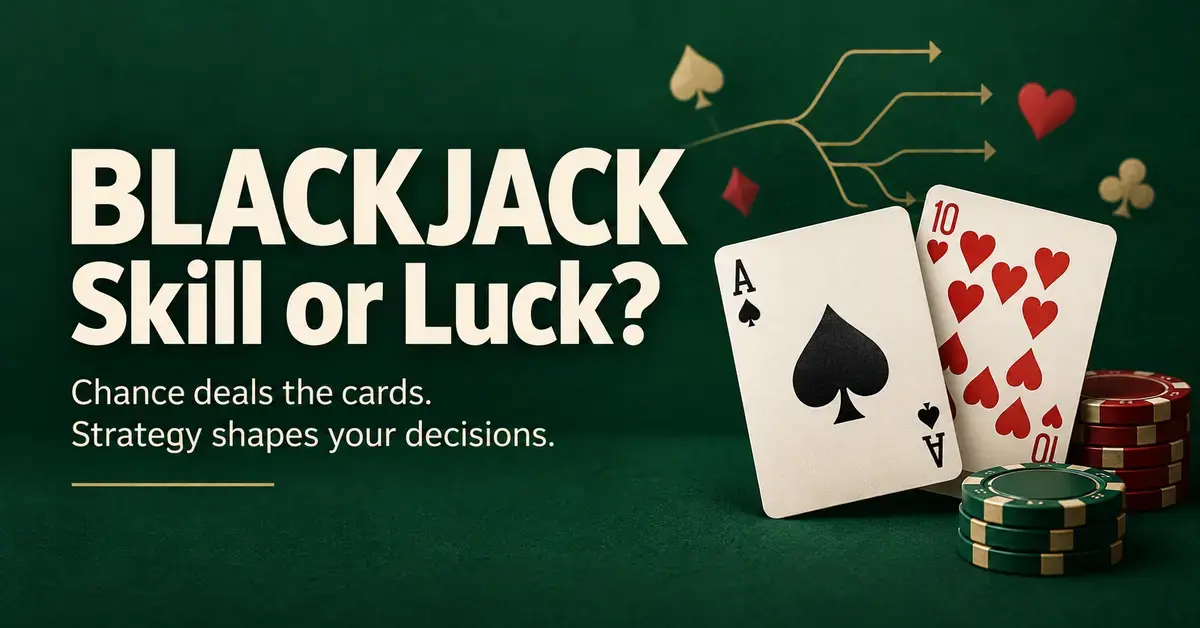
Blackjack sits in an unusual spot among casino games: the cards you are dealt are pure chance, yet almost every table has a “right” and “wrong” way to play them. That mix is why the same question keeps coming up — is blackjack skill or luck? The honest answer is both, but the two do very different jobs. Luck decides what happens on any single hand; skill decides what happens over hundreds and thousands of them. This guide separates the two clearly, with verified numbers, so you can see exactly how much each one really controls.
Key Points
- Both, on different time scales: luck decides each hand, skill decides your long-run results.
- Luck controls the cards you and the dealer are dealt and the short-term swings — nothing removes that.
- Skill controls every decision after the deal: hit, stand, double, split, surrender and bet sizing.
- Basic strategy played perfectly cuts the house edge to about 0.5% on a standard game.
- Card counting can flip the edge to roughly 1–2% in the player’s favour — hard to do and discouraged by casinos.
- No system can guarantee a winning session, because the deal itself is always random.
The short answer: luck rules the hand, skill rules the long run
Every casino game keeps a built-in advantage called the house edge — the average percentage of each bet the casino expects to win over time. In most games (slots, roulette, keno) you cannot change that number no matter how you play. Blackjack is the rare exception: your decisions directly move the house edge up or down.
That is what makes blackjack a game of skill in the meaningful sense. You cannot control which cards come out of the shoe — that is luck, and it never goes away. But you fully control how you respond to them, and those responses are what turn a 2% loss rate into a 0.5% one. Over a single night, luck can bury good play or flatter bad play. Over a long stretch, skill is what your results settle toward.
What luck controls in blackjack
Luck — more precisely, randomness — owns everything about the deal itself:
- Your two cards. Whether you start with a pat 20 or a stiff 16 is chance.
- The dealer’s up-card and hole card. You react to it; you never choose it.
- The order of the shoe. Which card lands when you hit is random within the remaining deck.
- Short-term swings. You can play a flawless session and still lose, or play badly and win. That is variance, not a verdict on your skill.
Because of this, no strategy — and no “system,” hot streak or lucky seat — can promise a winning session. Anyone claiming a method that removes the luck from a single hand is describing something that does not exist.
What skill controls in blackjack
Skill lives entirely in your decisions after the cards are dealt. Blackjack gives you real choices — hit, stand, double down, split or surrender — and each one has a mathematically correct answer for every combination of your hand and the dealer’s up-card.
Basic strategy: the maths of every decision
Basic strategy is the complete set of best plays, worked out from probability rather than hunches. It is not a modern gimmick: it was first derived in 1956 by four U.S. Army mathematicians — Roger Baldwin, Wilbert Cantey, Herbert Maisel and James McDermott — in a paper titled The Optimum Strategy in Blackjack, published in the Journal of the American Statistical Association. Later computer simulations of millions of hands confirmed and refined it. Because the game has a fixed, knowable structure, blackjack is effectively a “solved” game: for any hand you hold, the single best action is already known.
Playing that strategy perfectly is what pulls the house edge down toward roughly 0.5% on a standard game. You do not have to invent anything — you memorise or read a chart. Our blackjack basic strategy chart shows the correct play for every hand, and the broader maths is broken down in our guide to blackjack odds and the house edge.
Card counting: turning the edge around
The far end of skill is card counting, made famous by MIT mathematician Edward O. Thorp, who proved it worked and published Beat the Dealer in 1962. Counting does not predict the next card. It tracks the ratio of high cards to low cards still in the shoe: when plenty of tens and aces remain, the player’s odds improve, and a counter raises bets accordingly.
Done well, counting can flip the small house edge into a roughly 1–2% advantage for the player — which is why it is the clearest proof that blackjack rewards skill. It is also demanding, error-prone and actively discouraged by casinos, who shuffle more often, use more decks and can refuse play. For the vast majority of players, correct basic strategy — not counting — is where all the practical skill lies.
The house edge, measured
The clearest evidence that skill matters is the house edge itself, because it changes with how you play and which table you sit at. Blackjack already carries the lowest built-in edge of the major table games, and good decisions squeeze it further, while poor rules or careless play give it back.
House Edge by Play Style
| How you play | Approximate house edge | Driven by |
|---|---|---|
| Guessing / ignoring strategy | ~2% or more | Mostly avoidable mistakes |
| 6:5 blackjack table, decent play | ~2%+ | Poor payout rule |
| Perfect basic strategy, 3:2 table | ~0.5% | Skill (correct decisions) |
| Best single-deck games, perfect play | ~0.26% | Skill plus favourable rules |
| Skilled card counting | ~1–2% in player’s favour | Advanced skill |
Two things on that list are worth stressing. First, the payout rule matters enormously: a table that pays 6:5 for a natural blackjack instead of the traditional 3:2 quietly adds well over 1% to the house edge before you have made a single decision. Second, the edge is a long-run average, not a guarantee for tonight.
Short-term luck vs long-term skill
The reason the “skill or luck” debate never dies is that both are visibly true depending on the time frame. Statisticians measure the swing with standard deviation — a number describing how far real results scatter around the average. In blackjack it is about 1.15 betting units per hand, which is large relative to a 0.5% edge.
In plain terms: over one session, luck can easily swamp the tiny edge in either direction, so a skilled player can lose and a reckless one can win. But standard deviation shrinks relative to the average as you play more hands. Over tens of thousands of hands, the swings cancel out and results converge on the underlying edge — which is set by skill. That is the whole picture in one sentence: luck decides the session, skill decides the lifetime.
Common mistakes that hand the edge back
Because skill is real, it can be thrown away. The most common ways players convert a near-even game into a bad one:
- Ignoring basic strategy and playing on feel — the single biggest leak.
- Taking insurance. It looks like protection but is a losing side bet; our guide to blackjack insurance shows why basic strategy skips it almost every time.
- Playing 6:5 tables when a 3:2 game is available nearby.
- Chasing losses by raising bets to “get even,” which changes nothing about the odds and only increases how much is at risk.
- Believing in streaks or systems that claim to beat the deal itself.
So is blackjack skill or luck? The verdict
Blackjack is a game of luck played with skill. Chance controls the cards and therefore the outcome of any given hand — that part is fixed and cannot be beaten. Skill controls every decision you make about those cards, and over time that is what separates a 0.5% game from a 2% one, and, for a rare few, a losing game from a winning one. If you want your results to reflect skill rather than only luck, the path is the same for everyone: learn the rules, play correct basic strategy every hand, and choose good tables. The luck will still come and go — but you will have taken control of the part that is actually yours.
Responsible gambling
Blackjack always keeps a house edge over the long run, and no level of skill turns it into a reliable source of income — basic strategy only reduces the average loss rate, and short-term results remain unpredictable. Treat any money wagered as entertainment spending you can afford to lose, set limits before you play, and never bet to recover losses. This article is educational and is not gambling or financial advice. In Canada, free and confidential support is available 24/7 from ConnexOntario at 1-866-531-2600, and from the Responsible Gambling Council. You can also read our responsible gambling page. You must be of legal gambling age in your province or territory to play.
Sources
- Wizard of Odds – Blackjack House Edge Calculator
- Wizard of Odds – Variance in Blackjack
- Blackjack Apprenticeship – The History of Blackjack and Card Counting
- The House Edge and the Basic Strategy of Blackjack (SHS Web of Conferences)
- ConnexOntario – Gambling Support Helpline
- Responsible Gambling Council (Canada)
Frequently asked questions (FAQ)
Is blackjack more skill or more luck?
It depends on the time frame. On any single hand, luck dominates because you cannot control the cards. Over thousands of hands, skill dominates because your decisions set the house edge your results converge toward. Both are real; they simply act on different time scales.
Can skill guarantee a winning session at blackjack?
No. Even perfect play cannot remove the randomness of the deal, so a skilled player can lose over a session and an unskilled one can win. Skill improves your long-run expectation and reduces your average loss rate, not the outcome of any particular night.
How much does basic strategy actually help?
A lot, relatively speaking. Playing basic strategy perfectly pulls the house edge down to roughly 0.5% on a standard game, compared with 2% or more for a player guessing. It is the single most effective thing an ordinary player can do, and it requires only a chart, not memory tricks.
Does card counting really give players an edge?
Yes, in principle. Card counting tracks the ratio of high to low cards left in the shoe and can shift a small house edge into a roughly 1–2% player advantage. It was mathematically proven by Edward Thorp in the 1960s, but it is difficult to do accurately and casinos take active steps to prevent it.
Is blackjack the best casino game for a skilled player?
Among common casino games, blackjack offers the lowest house edge when played correctly, and it is one of the few where your decisions change the odds at all. That combination makes it the game where skill has the most measurable effect, though the house still keeps an edge unless a player is counting successfully.
