
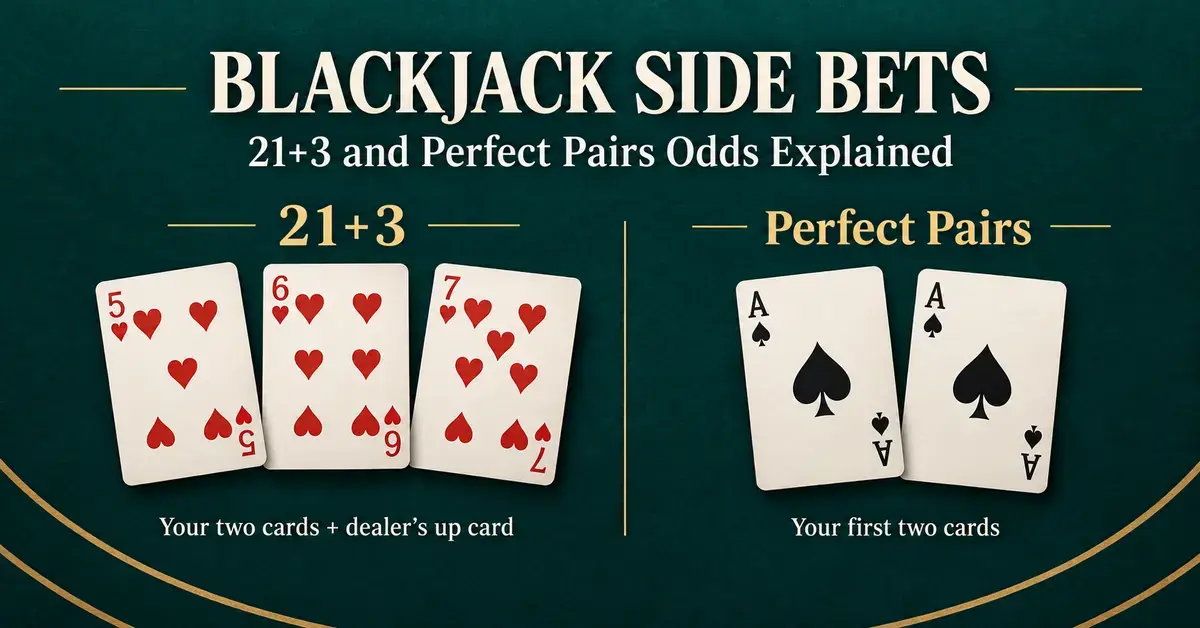
Side bets are optional wagers you can place alongside your main blackjack hand. They have nothing to do with whether you beat the dealer — instead they pay out on specific card combinations, often with eye-catching odds like 100:1. The two you will see most often, in Canadian casinos and at online tables, are 21+3 and Perfect Pairs. This guide explains how each one works, the real probabilities behind them, the typical pay tables, and why every side bet costs you more, on average, than the main game.
Key Points
- 21+3 pays on the poker value of your two cards plus the dealer’s up card (flush, straight, three of a kind, straight flush).
- Perfect Pairs pays if your first two cards match — mixed, coloured or perfect pair.
- Both are optional wagers placed before the deal and settled separately from your main hand.
- Side bets carry a far higher house edge (about 2%–13%+) than well-played blackjack (under 1%).
- Pay tables and deck counts vary by casino — always check them before betting.
- No skill or strategy improves side bet odds; they are pure chance.
What Are Blackjack Side Bets?
A side bet is a small extra wager, usually placed in a marked circle next to your main betting spot before the cards are dealt. It is settled on its own rules and does not affect how your regular hand plays out. You can win your side bet and lose your main hand in the same round, or the other way around.
The appeal is obvious: side bets promise large payouts for rare card combinations. The trade-off is just as important. Every side bet carries a much higher house edge — the long-run percentage the casino keeps — than the main game. A well-played blackjack hand can trim the house edge to under 1%, while side bets typically run anywhere from about 2% to well over 13%. In other words, they are built for entertainment and the occasional big hit, not for steady returns.
You may already know one side bet without thinking of it that way: blackjack insurance is technically a side bet on whether the dealer has a natural. The two covered below are the classic “proposition” style side bets that use the poker value or the pairing of your cards.
The 21+3 Side Bet Explained
21+3 combines blackjack with three-card poker. It looks at your first two cards plus the dealer’s face-up card and pays if those three cards form a qualifying poker hand. The name is a nod to that structure: your 21 (blackjack) hand, plus three cards.
How 21+3 works
You place the 21+3 wager before the deal. Once you and the dealer receive cards, the game checks your two cards and the dealer’s up card together. The qualifying hands, from most to least common, are:
- Flush — all three cards the same suit.
- Straight — three cards in sequence, any suits (for example 7-8-9).
- Three of a kind — three cards of the same rank, mixed suits.
- Straight flush — three cards in sequence, all the same suit.
- Suited three of a kind — three cards of the same rank and the same suit (only possible in multi-deck games, and the rarest of all).
Understanding the ranks helps here; if you are unsure what each card is worth, our guide to card values covers the basics.
21+3 pay tables and odds
There is no single 21+3 pay table — each casino chooses one. The two most common formats are the original flat-pay version and the modern tiered version.
Classic version: every qualifying hand pays the same, usually 9:1. In a six-deck game the combined chance of hitting any qualifying hand is about 8.6%, and the house edge is roughly 3.24% (falling to about 2.74% with eight decks).
Tiered version: higher payouts for rarer hands. A widely used table pays flush 5:1, straight 10:1, three of a kind 30:1, straight flush 40:1 and suited three of a kind 100:1, for a house edge in the region of 3.7% at six decks. A more aggressive “21+3 Xtreme” table (straight flush 30:1, three of a kind 20:1, straight 10:1, flush 5:1) looks generous but carries a house edge of about 13.39% at six decks — one of the worst on the table.
The approximate probabilities for a six-deck game are shown below.
- Flush: about 4.72% (roughly 1 in 21)
- Straight: about 3.10% (roughly 1 in 32)
- Three of a kind: about 0.52% (roughly 1 in 190)
- Straight flush: about 0.21% (roughly 1 in 480)
Two lessons stand out. First, the pay table matters enormously — a flat 9:1 game is far kinder than an Xtreme table. Second, unlike the main game, more decks lower the 21+3 house edge, because extra decks make straights, flushes and three-of-a-kinds slightly more likely.
The Perfect Pairs Side Bet Explained
Perfect Pairs is simpler. It ignores the dealer entirely and pays if your own first two cards form a pair — two cards of the same rank, such as two eights or two queens. How much you win depends on how closely the two cards match.
The three pair types
- Mixed pair (also called red/black) — same rank, one red and one black card. Example: the 8 of hearts and the 8 of clubs. This is the most common and pays the least.
- Coloured pair — same rank and the same colour but different suits. Example: the 8 of hearts and the 8 of diamonds (both red).
- Perfect pair — same rank and the same suit. Example: two 8 of spades (only possible in multi-deck games). This is the rarest and pays the most.
Perfect Pairs pay tables and odds
A common pay table pays 25:1 for a perfect pair, 12:1 for a coloured pair and 6:1 for a mixed pair, though you will also see 30:1 / 10:1 / 5:1 and other variations. In an eight-deck game the probabilities are:
- Perfect pair: about 1.69% (roughly 1 in 59)
- Coloured pair: about 1.93% (roughly 1 in 52)
- Mixed pair: about 3.86% (roughly 1 in 26)
With the 25/12/6 pay table the house edge is about 4.10% on eight decks. As with 21+3, the deck count matters, but in the opposite direction to the main game: because a perfect pair needs an identical duplicate card, more decks make pairs easier to hit and lower the edge. The same 25/12/6 table jumps to roughly 6.11% on six decks, and a two-deck game is dramatically worse for the player. Always check the pay table and deck count before you bet.
Side Bet Odds vs. the Main Game
The single most useful thing to understand about side bets is how much more they cost than playing blackjack well. The table below compares the popular options. Payouts and house edges are typical figures and vary by casino and pay table.
Side Bet Comparison
| Side bet | Wins when | Typical top payout | Typical house edge |
|---|---|---|---|
| 21+3 (classic 9:1) | Your 2 cards + dealer up card make a poker hand | 9:1 (all hands) | ~3.24% (6 decks) |
| 21+3 (tiered) | Same, higher pay for rarer hands | 100:1 (suited trips) | ~3.7% (6 decks) |
| 21+3 Xtreme | Same as tiered, different table | 30:1 (straight flush) | ~13.39% (6 decks) |
| Perfect Pairs (25/12/6) | Your first 2 cards form a pair | 25:1 (perfect pair) | ~4.10% (8 decks) |
| Insurance | Dealer has a natural blackjack | 2:1 | ~7% (6 decks) |
By contrast, the main blackjack game — especially when a natural blackjack pays 3:2 and you follow correct basic blackjack strategy — keeps the house edge under 1%. Every dollar you move into a side bet is a dollar facing a much steeper edge.
Common Mistakes to Avoid
- Treating side bets as strategy. No amount of skill changes side bet odds — they are pure chance settled on the cards dealt. There is no counting or basic-strategy adjustment that turns them into a long-term winner.
- Ignoring the pay table. Two tables with the same name can have very different edges. A 21+3 Xtreme table can cost four times as much as a flat 9:1 version.
- Betting too much. Because the house edge is high, a side bet the same size as your main wager can quietly become the biggest drain on your bankroll.
- Confusing a win with an edge. Hitting a 100:1 suited three of a kind feels great, but the rarity is exactly why the long-run maths still favours the casino.
Who Side Bets Suit
Side bets are best understood as a small, optional thrill rather than a way to make money. They suit players who enjoy the chance of a large payout on a tiny stake and who treat the extra wager as part of their entertainment budget. If your goal is to make your bankroll last, the lower-edge choice is to skip side bets, learn the core player actions, and put your money on the main hand.
Responsible Gambling
Side bets carry a high house edge and are decided entirely by chance; no strategy, tip or system improves your odds of winning them. Payout figures describe long-run averages, not what will happen in any single session or hand. Gambling should only ever be treated as paid entertainment, using money you can afford to lose, and it is legal in Canada only for players who meet the minimum age in their province or territory (18 or 19). If gambling stops being fun, free and confidential help is available across Canada — see our responsible gambling resources, contact ConnexOntario, or reach the Responsible Gambling Council. This article is informational only and is not betting, financial or legal advice.
Sources
Frequently Asked Questions (FAQ)
What are the most common blackjack side bets?
The two you will see most often are 21+3, which pays on the poker value of your two cards plus the dealer’s up card, and Perfect Pairs, which pays if your first two cards form a pair. Insurance is also technically a side bet, and some tables offer extras such as Lucky Ladies or Buster Blackjack.
Are blackjack side bets worth it?
Financially, no. Side bets carry a much higher house edge than the main game — often 4% or more, and sometimes over 13% — so they lose money faster over time. They can be fun for the chance of a big payout on a small stake, but they are entertainment, not a winning strategy.
What is the house edge on 21+3?
It depends on the pay table and deck count. A classic flat 9:1 version has a house edge of about 3.24% on six decks, while an aggressive “Xtreme” pay table can push the edge to around 13.39%. Always check the specific pay table posted at the table before you bet.
What is the difference between a perfect pair and a coloured pair?
A perfect pair is two cards of the same rank and the same suit, such as two 8 of spades, and pays the most. A coloured pair is the same rank and the same colour but different suits, and a mixed pair is the same rank in different colours, which pays the least.
Do side bets affect my main blackjack hand?
No. A side bet is settled independently on its own rules and has no impact on how your main hand plays or pays. You can win one and lose the other in the same round.
