
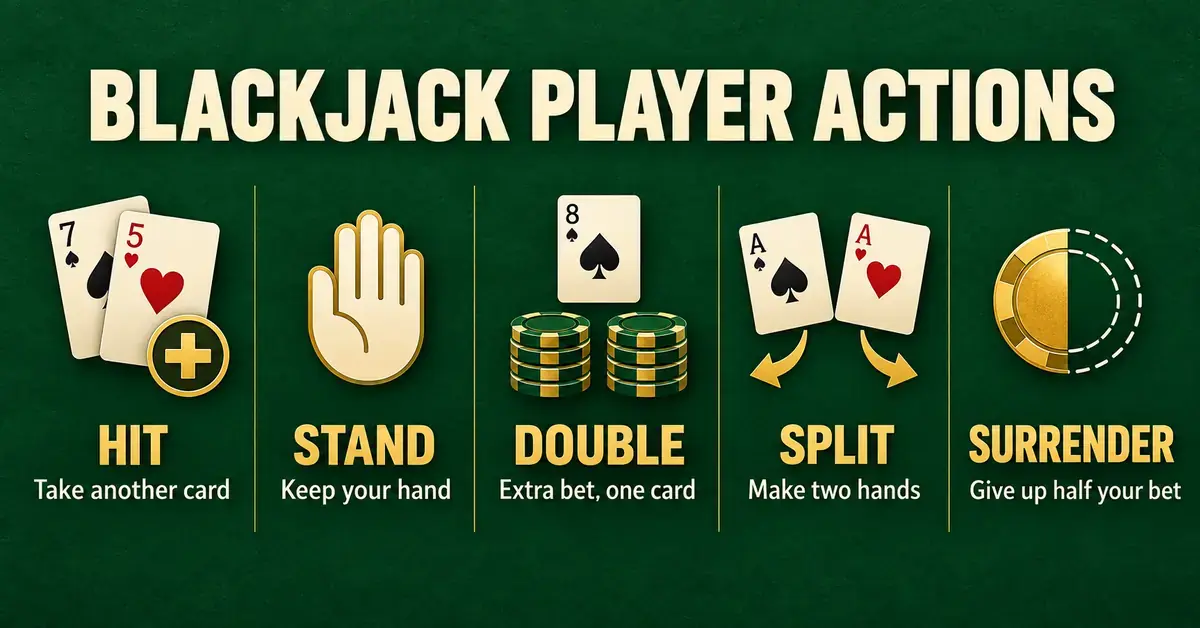
Every hand of blackjack comes down to a short list of choices. Once you see your first two cards and the dealer’s face-up card, it is your turn to act — and each option has its own rules, its own hand signal at the table, and its own effect on your odds. Mastering these five player actions is the real foundation of the game, more so than memorising any single chart. This guide explains exactly what hit, stand, double down, split and surrender mean, when each one is available, and how to make the move at a live table. If you are brand new, it pairs well with our walkthrough of how to play blackjack.
Key Points
- Five core actions: hit, stand, double down, split and surrender — decided after you see your cards and the dealer’s upcard.
- Hit or stand are available on every hand; double and split depend on your cards and house rules; surrender is offered only at some tables.
- Double down gives you exactly one more card for an extra (usually equal) bet.
- Always split aces and 8s; never split 5s or 10s. Split aces get just one card each.
- Surrender is a first-move-only option that returns half your bet on a losing hand.
- Correct use of these actions, following basic strategy, brings the house edge to about 0.5% in favourable games.
The five player actions at a glance
After the deal, you play your hand before the dealer plays theirs. Depending on your two cards and the house rules, you can choose from up to five moves. Three of them — hit, stand and double down — are available on almost every table. Split appears whenever you hold a matching pair, and surrender is offered only at some casinos. You keep acting until you stand, double, bust (go over 21), or run out of options.
The sections below explain each action in plain terms. For the mathematically correct choice in every situation, see our full guide to basic blackjack strategy; here we focus on what each action does and how to use it.
Hit — taking another card
Hitting means asking the dealer for one more card, added to your current hand. You may keep hitting as many times as you like until you either decide to stand or your total goes above 21, which is a bust and an automatic loss of your bet.
Hitting is the default move when your hand is weak and unlikely to beat the dealer as it stands — for example, a hard total of 8 or less, where no single card can bust you. A “hard” hand is one with no ace, or one where the ace must count as 1 to avoid busting; a “soft” hand contains an ace counted as 11.
Hand signal: in a shoe game where the cards are dealt face up, tap or scratch the felt lightly with your finger behind your cards. In a hand-held game, gently scrape your cards toward you on the table.
Stand — keeping your hand
Standing means you are satisfied with your total and want no more cards. Your turn ends and play passes to the next player or to the dealer. You stand when your hand is already strong, or when taking another card is more likely to bust you than to help — a hard 17, 18, 19 or 20 is almost always a stand.
Hand signal: wave your flat hand horizontally over the cards, palm down, in a shoe game. In a hand-held game, slide your cards face down under your chips.
Double down — one card for twice the bet
Doubling down lets you increase your original bet — usually to double it — in exchange for exactly one more card. After that single card you must stand, whatever the total. You trade flexibility for value, so it pays off when you have a strong starting hand and the dealer looks weak.
The classic doubling hands are hard totals of 9, 10 and 11, where one good card often produces 19, 20 or 21. Many tables also let you double on soft hands such as A-6 or A-7 against a weak dealer upcard. Rules vary: some casinos allow doubling on any two cards, while others restrict it to totals of 9 to 11 only.
A related rule is double after split (DAS). Where it is offered, you may double down on a hand created by splitting a pair, which is a small but real advantage to the player.
Hand signal: place a second stack of chips next to — not on top of — your original bet, then hold up one finger to signal a single card.
Split — turning a pair into two hands
When your first two cards form a matching pair (for example two 8s or two aces), you may split them into two separate hands. You place a second bet equal to your first, one card goes onto each split card, and you then play each hand in turn.
A few rules shape how splitting works:
- Split aces get one card each. After splitting aces you normally receive a single card per ace and cannot draw again, even if the total is low.
- Re-splitting is limited. Most casinos let you split up to three times for a maximum of four hands, but usually will not let you re-split aces.
- Doubling after a split may or may not be allowed, depending on the DAS rule above.
Two split decisions almost never change: always split aces and 8s, and never split 5s or 10-value cards. Splitting aces gives you two chances at a strong hand, splitting 8s escapes a weak total of 16, while a pair of 5s is better played as a 10 and two tens already make an excellent 20.
Hand signal: place a matching second bet beside your original chips and hold up two fingers in a V shape.
Surrender — folding a bad hand for half your bet
Surrender lets you give up a hand you expect to lose and reclaim half of your original bet, forfeiting the other half. It is only available as your first decision, before you take any other action, and only at casinos that offer it. Once you hit, double or split, the option is gone.
There are two versions:
- Late surrender is the common one. You decide after the dealer checks for a natural blackjack; if the dealer has one, you lose your full bet and surrender is not offered. Late surrender trims only about 0.07% to 0.10% off the house edge, so it helps a little in a narrow set of situations.
- Early surrender lets you fold before the dealer checks for blackjack. It is much more valuable to the player, worth well over half a percent, which is exactly why it is now extremely rare.
Under common multi-deck late-surrender rules, the textbook plays are to surrender a hard 16 against a dealer 9, 10 or ace, and a hard 15 against a dealer 10 (and, in games where the dealer hits soft 17, a few more totals such as 15 and 17 versus an ace). Never surrender a pair of 8s — split them instead. Surrender only when the hand is so poor that giving up half is cheaper than playing on.
Hand signal: surrender is usually declared out loud (“surrender”), and many dealers ask you to draw an imaginary horizontal line on the felt behind your bet with your finger.
Player actions compared
The table below summarises what each action does, when it is available and how it changes your bet.
Player Actions Compared
| Action | What it does | When it is available | Effect on your bet |
|---|---|---|---|
| Hit | Take one more card; repeat until you stand or bust | Any hand, any number of times | No change |
| Stand | End your turn and keep your total | Any hand | No change |
| Double down | Take exactly one more card, then stand | First two cards (often limited to 9–11) | Usually doubled |
| Split | Separate a pair into two hands, one card each to start | First two cards are a matching pair | Second equal bet added |
| Surrender | Fold the hand and reclaim half your bet | First decision only, where offered | Lose half the bet |
How rules change which actions you get
Not every table offers every action, and the fine print matters. Surrender is missing from most tables. Doubling may be limited to totals of 9 to 11. Doubling after a split, re-splitting aces and the number of allowed splits all vary from casino to casino, and each of these rules shifts the house edge slightly. Played perfectly with a friendly rule set, basic strategy brings the house edge down to roughly 0.5%, so the available actions genuinely affect your long-run results. If you are playing at home, our overview of blackjack in Canada covers what to expect from Canadian tables and online games.
Common mistakes to avoid
- Hitting a hard 17 or higher. The risk of busting almost always outweighs the small chance of improving.
- Splitting 10s. Breaking up a 20 to chase two weaker hands is a losing move over time.
- Doubling for less. If you double, put up the full extra bet unless your bankroll truly forces a smaller one; a partial double throws away part of the advantage.
- Forgetting surrender is first only. You cannot surrender after hitting, so decide before you take any card.
- Taking insurance as “protection.” Insurance is a separate side bet, not one of the five core actions, and it is a poor wager for most players.
Which players benefit most
Understanding these five actions matters for everyone from the first-time player to the seasoned regular. Beginners gain the confidence to act without holding up the table, and more experienced players use the same framework to apply full strategy charts correctly. The moves themselves never change; only knowing exactly when to use each one separates a guessing player from a disciplined one.
Responsible gambling
Blackjack is a game of chance, and even flawless play leaves the house with a small mathematical edge — no action, betting pattern or system can turn the odds in your favour over the long run. Set a budget you can afford to lose, treat any winnings as a bonus rather than income, and never chase losses. In Canada, free and confidential support is available around the clock through ConnexOntario at 1-866-531-2600, and the Responsible Gambling Council provides a national directory of provincial helplines. For more, see our page on responsible gambling. You must be of legal gambling age in your province or territory to play.
Sources
Frequently asked questions (FAQ)
What are the five player actions in blackjack?
The five in-hand decisions are hit (take another card), stand (keep your current total), double down (double your bet for exactly one more card), split (turn a matching pair into two hands with a second bet), and surrender (forfeit half your bet to fold a poor hand). Hit, stand and double are offered almost everywhere; split appears when you hold a pair, and surrender only at some casinos.
When should you surrender in blackjack?
Surrender only makes sense when your hand is very likely to lose and giving up half your bet costs less than playing on. Under common late-surrender rules that means a hard 16 against a dealer 9, 10 or ace, and a hard 15 against a dealer 10. You can only surrender as your first move, before hitting, doubling or splitting.
Can you double down after splitting?
Only if the table allows it. This rule is called double after split (DAS). Where it is offered, you may double one or both hands created by a split, which is a small advantage to the player. Note that split aces normally receive just one card each and cannot be doubled or hit again.
What is the difference between hitting and standing?
Hitting asks the dealer for another card to improve a weak total, at the risk of busting if you go over 21. Standing ends your turn with the cards you already hold. In short, you hit when your hand is too weak to beat the dealer and stand when it is strong enough or when another card would likely bust you.
Which pairs should you always split?
Always split aces and 8s. Splitting aces gives you two chances at a strong hand, and splitting 8s replaces a weak 16 with two fresh hands. Just as reliably, never split 5s (play the pair as a 10) or two 10-value cards (a made 20 is already excellent).
