
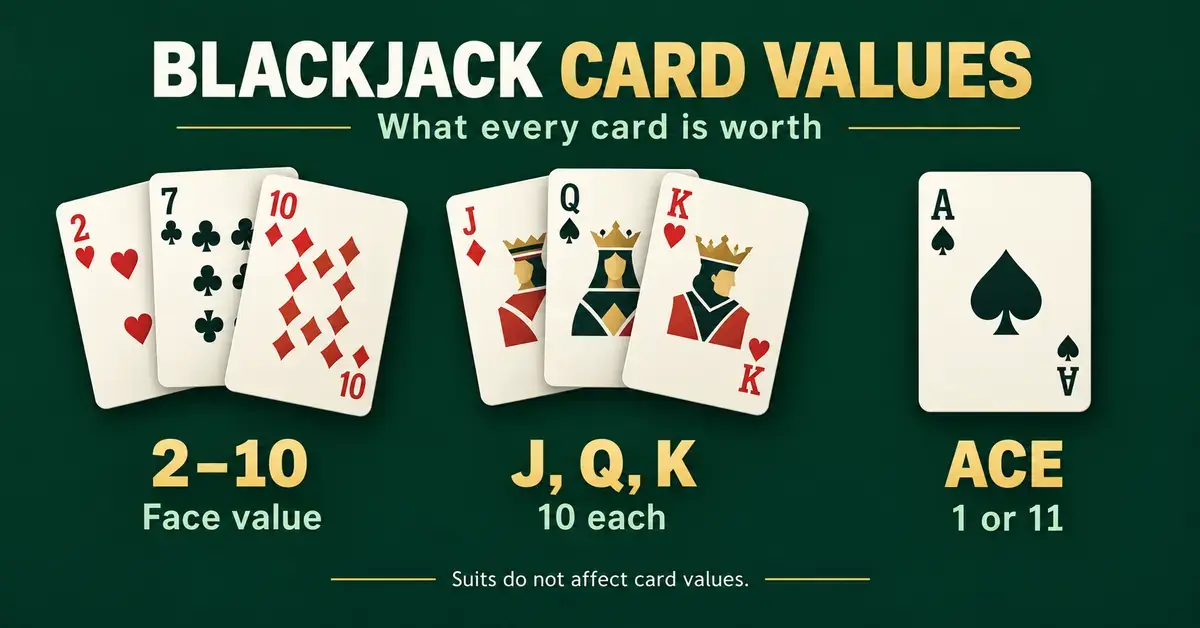
Before you can add up a hand, split a pair or decide whether to hit or stand, you need to know one simple thing: how much each card is worth. Blackjack uses a scoring system that is easy to learn but has one clever twist — the ace. This guide explains the value of every card in the deck, why the ace can be worth either 1 or 11, and how those values combine to form the totals you play against the dealer.
Key Points
- Cards 2 to 10 are worth their printed number; suits never matter.
- The jack, queen and king are each worth 10 — identical to a 10 and to one another.
- The ace is worth 1 or 11, whichever keeps your hand at 21 or below.
- An ace counted as 11 makes a “soft” hand that cannot bust on the next card.
- An ace plus any 10-value card is a natural blackjack — an instant 21.
The value of every card in blackjack
In blackjack, the suit of a card (hearts, diamonds, clubs or spades) never matters. Only the number or rank counts. There are just three rules to remember, and the chart below sums them up at a glance.
Card Value Chart
| Card | Value in blackjack |
|---|---|
| 2 to 9 | Face value (2 to 9 points) |
| 10 | 10 points |
| Jack | 10 points |
| Queen | 10 points |
| King | 10 points |
| Ace | 1 or 11 points |
Number cards (2 to 10)
Cards numbered 2 through 10 are worth exactly their printed number. A 2 is worth two points, a 7 is worth seven points, and a 10 is worth ten points. There is nothing to memorise here — the value is written right on the card. This is the same whether you are playing at a casino table or learning the basics of how to play blackjack online.
Face cards (jack, queen, king)
The three face cards — the jack, the queen and the king — are each worth 10 points. This surprises some beginners who expect a king to outrank a queen or a jack, as it would in other card games. In blackjack it does not: a jack, a queen, a king and a 10 are all identical in value. Because there are four of each rank in a standard 52-card deck, that means sixteen cards in every deck (the four 10s plus the twelve face cards) are worth 10 points.
The ace — worth 1 or 11
The ace is the only card that can take two different values. It is worth either 1 or 11 points, and you always use whichever value helps your hand the most. In practice the ace counts as 11 by default, but it automatically drops to 1 the moment counting it as 11 would push your total over 21 (a “bust”). You never have to declare which value you are using — the count simply takes the best option for you at each moment. This flexibility is what makes the ace the most powerful card in the game.
Why the ace’s value matters: soft and hard hands
Because the ace can be worth 1 or 11, blackjack hands are described as either “soft” or “hard”. Knowing which one you are holding changes how safely you can draw another card, and it is the foundation of nearly every decision in basic blackjack strategy.
Soft hands
A soft hand is any hand that contains an ace being counted as 11 without going over 21. It is called “soft” because you cannot bust on the next card — if a big card arrives, the ace simply switches from 11 to 1. For example, an ace and a 6 is a “soft 17”: it counts as 17, but if you draw a 10, the ace becomes 1 and your total is a safe 17 instead of a busting 27. This safety net is why players can draw more aggressively on soft hands.
Hard hands
A hard hand is any hand that either has no ace, or has an ace that must count as 1 because counting it as 11 would bust the hand. In a hard hand every card adds a fixed amount, so drawing another card carries real risk. For example, a 9 and a 7 make a hard 16; if you then draw an ace, it can only count as 1, giving you a hard 17. Hard totals of 12 or more are the hands where the danger of busting is highest.
How card values create a blackjack (a natural 21)
The best possible starting hand is a “blackjack”, also called a “natural”. It happens when your first two cards are an ace (worth 11) plus any 10-value card — a 10, jack, queen or king — for an instant total of 21. This is the strongest two-card hand in the game and normally pays more than an ordinary win. Because so many cards in the deck are worth 10, a natural is more common than beginners expect, which is exactly why the ace’s ability to be worth 11 is so valuable.
Adding up a hand: how totals work
Your hand total is simply the sum of your card values, always using the ace value that keeps you at or under 21. A few quick examples make it clear:
- King + 7 = 17 (a hard 17, no ace flexibility).
- Ace + 8 = 19 (a soft 19, because the ace counts as 11).
- Ace + 5 + 9 = 15 (the ace must drop to 1, because 11 + 5 + 9 = 25 would bust).
- Queen + Jack = 20 (two 10-value cards).
The dealer counts their cards using exactly the same values as the players — the scoring is never different for the house. If any hand goes over 21, it busts and loses immediately.
Card values in card counting
Card values also sit at the heart of card counting, a legal (though casino-discouraged) technique used by advanced players to track whether the remaining deck favours the player. The most common method, the Hi-Lo system, does not track exact card values but instead groups cards into three tags: low cards 2 to 6 count as +1, middle cards 7 to 9 count as 0, and the high cards — every 10, jack, queen, king and ace — count as -1. A running positive count means more high cards remain, which slightly favours the player. For most casual players this is background knowledge only; you do not need it to enjoy the game correctly.
Common mistakes with card values
- Thinking face cards differ in value. A king does not beat a queen — all face cards are worth exactly 10.
- Forgetting the ace can be 1. Beginners sometimes bust by assuming the ace is always 11. It drops to 1 automatically to protect your hand.
- Confusing soft and hard totals. A soft 17 (ace + 6) plays very differently from a hard 17 (10 + 7), even though both show “17”.
- Assuming suits matter. Standard blackjack ignores suits entirely; only the card’s rank affects its value.
These fundamentals stay the same across licensed tables, including the games available when you play blackjack in Canada.
Responsible Gambling
Blackjack is a game of chance, and understanding card values does not guarantee winning outcomes — the house always keeps a mathematical edge, and no knowledge of the rules changes that. This article is educational information only and is not gambling advice. In Canada you must be of legal gambling age in your province or territory to play for real money. If gambling is affecting you or someone you know, free and confidential help is available: in Ontario you can reach ConnexOntario any time at 1-866-531-2600, and every province offers its own support service. You can also read our guide to responsible gambling for tools and resources.
Sources
Frequently Asked Questions (FAQ)
What is each card worth in blackjack?
Number cards 2 through 10 are worth their printed value. The jack, queen and king are each worth 10 points. The ace is worth either 1 or 11, whichever is better for your hand. Suits have no effect on value.
Is an ace worth 1 or 11 in blackjack?
Both — the ace is worth 1 or 11 at the same time. It counts as 11 by default, but automatically becomes 1 whenever counting it as 11 would take your total over 21. You always keep the value that gives you the best result without busting.
How much is a king, queen or jack worth?
All three face cards are worth exactly 10 points each, the same as a 10. None of them outranks another in blackjack, so a king, a queen, a jack and a 10 are completely interchangeable in value.
What is the difference between a soft hand and a hard hand?
A soft hand contains an ace counted as 11 and cannot bust on the next card, because the ace can drop to 1. A hard hand has no ace, or an ace that must count as 1, so every extra card adds fixed value and carries a real risk of busting.
What card values make a blackjack?
A blackjack, or “natural”, is an ace (counted as 11) plus any 10-value card — a 10, jack, queen or king — in your first two cards, for an instant total of 21. It is the strongest starting hand and usually pays more than a standard win.
