
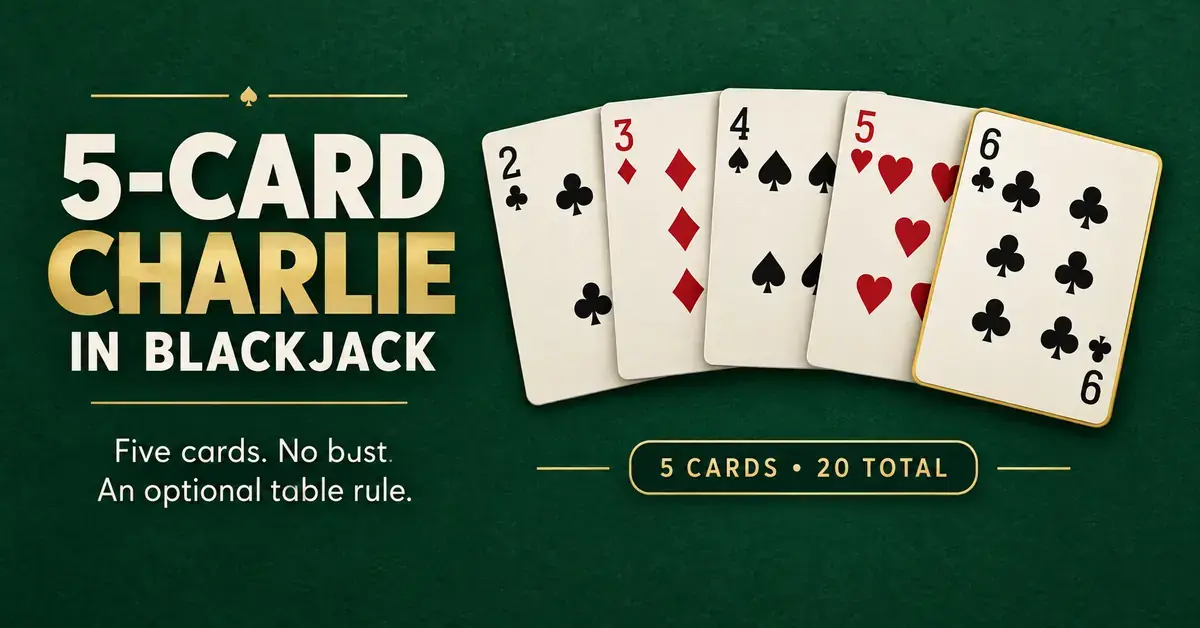
A 5-card Charlie is an optional blackjack rule that rewards you for drawing a lot of cards without going over 21. In its classic form, if your hand reaches five cards and still totals 21 or less, you win automatically — no matter what the dealer is holding. It is a player-friendly rule, but it is also uncommon, often misunderstood, and sometimes sold back to you as a side bet rather than given for free. This guide explains exactly what the 5-card Charlie rule is, when it applies, how it changes your odds, and where you are likely to run into it.
Key Points
- What it is: an optional rule where a five-card hand of 21 or less wins automatically.
- When it applies: only if the table or game offers it, and only if you reach five cards without busting.
- Dealer blackjack: a Charlie usually does not beat a dealer natural, which is settled first.
- Odds impact: a free 5-card Charlie is worth about +1.46% to the player; six- and seven-card versions add far less.
- Watch out: the version sold as a side bet favours the house, unlike the free rule.
What is the 5-card Charlie rule?
A “Charlie” is a blackjack hand that wins simply because it contains a set number of cards without busting — busting meaning your total goes over 21. The 5-card Charlie is the most common version: collect five cards that add up to 21 or less and your hand is declared an automatic winner.
The appeal is that it turns awkward, low-value hands into winners. Normally, a scrappy total like 16 made up of several small cards is a losing proposition. Under a Charlie rule, every extra card you can safely take moves you closer to an automatic win instead of just closer to busting.
The most important thing to understand is that the 5-card Charlie is not part of standard blackjack. Most casino and online base games do not offer it at all. It appears in specific table versions, certain online and live-dealer titles, and a few blackjack relatives, so you should never assume it is in play — check the rules first.
How the rule works at the table
When a Charlie rule is active, the hand plays out normally: you hit (take another card) to improve a weak total, and you stand (take no more cards) when you are happy. The difference is your incentive. Because reaching five cards without busting wins outright, you are often rewarded for hitting hands you would normally leave alone.
For example, say you are dealt a two-card 12 and draw a 3, then a 2, giving you a four-card 17. Under ordinary rules you would stand. With a 5-card Charlie available, taking one more small card could complete a five-card hand of 21 or less and win on the spot. The trade-off is real: another card could also bust you and lose the hand immediately.
When does a Charlie apply?
A 5-card Charlie only applies when all of these are true:
- The table or game explicitly offers the rule.
- Your hand reaches exactly five cards (or more, depending on the table) without busting.
- Your total is 21 or less when the fifth card lands.
If you bust before reaching five cards, the Charlie is gone — there is no rescue. And if you stand on four cards, you have chosen to resolve the hand the normal way against the dealer instead of chasing the Charlie.
Does a Charlie beat the dealer’s blackjack?
This is the single most important piece of fine print, because it decides how much the rule is actually worth. In almost every version, a Charlie does not beat a dealer’s natural blackjack. The dealer typically checks for blackjack before players draw extra cards, so if the dealer already has an ace-plus-ten natural, the hand is settled before you can ever build a five-card winner.
Tables also differ on what a Charlie pays and whether it is a true win at all. Depending on the game, a five-card hand of 21 or less might be an automatic win at even money, a push (a tie, with your bet returned), or a bonus condition tied to a separate wager. Always confirm three things before relying on it: whether it beats a drawn dealer 21, whether it loses to a dealer natural, and whether it pays extra or just even money. For how a natural is defined and paid, see our guide to what counts as a blackjack.
How the 5-card Charlie affects the house edge
The house edge is the casino’s built-in long-run advantage, expressed as a percentage of your bet. A genuine, free 5-card Charlie rule shifts that edge toward the player because it hands you wins you would otherwise lose.
According to the Wizard of Odds’ rule-variation analysis, adding an automatic-win 5-card Charlie is worth roughly +1.46% to the player — a large swing in blackjack terms, where good basic strategy already trims the edge to around half a percent. In practice the exact value depends on the rest of the rules (number of decks, doubling and splitting limits, and whether the dealer hits soft 17), so treat 1.46% as a strong guideline rather than a fixed number.
That large benefit is also why you rarely see the automatic-win rule given away. Casinos that once offered it tended to remove it or repackage it as an optional side bet, where the odds favour the house instead. If you understand how small rule changes move the maths, our explainer on when to hit or stand shows how those percentages translate into real decisions.
Charlie Rule Comparison
| Charlie type | Cards needed (21 or less) | Approx. value as a free rule | Example side-bet payout |
|---|---|---|---|
| 5-card Charlie | 5 | About +1.46% to the player | Around 5:1 |
| 6-card Charlie | 6 | About +0.16% to the player | Around 10:1 |
| 7-card Charlie | 7 | About +0.01% to the player | Around 30:1 |
| Rule values follow Wizard of Odds and vary with deck count and other rules. Side-bet payouts are examples only, differ between games and carry a house edge. | |||
Six-card and seven-card Charlie variants
The Charlie idea is not limited to five cards. Some games use a higher threshold, which makes the automatic win rarer and therefore far less valuable:
- Six-card Charlie — you need six cards of 21 or less. It triggers much less often, so it is worth only about +0.16% to the player.
- Seven-card Charlie — a seven-card non-bust hand is very rare, so the rule adds only about +0.01%. It is close to a novelty.
The pattern is simple: the more cards required, the harder the hand is to assemble and the smaller the benefit. A five-card version is genuinely meaningful; six- and seven-card versions are mostly for show.
The Charlie as a side bet
Because the automatic-win rule is so player-friendly, many modern games offer the Charlie as an optional side bet instead — a separate wager placed alongside your main bet. You win the side bet if your hand reaches the required number of cards without busting, often regardless of whether the main hand wins or loses.
Example pay tables look generous — for instance 5:1 for a five-card hand, 10:1 for six cards, and 30:1 for seven cards — but payouts vary widely between games and every one of them carries its own house edge. A Charlie side bet is a long-shot wager, not a strategy edge: the attractive multipliers are there precisely because the triggering hands are uncommon. To see how these optional wagers compare with one another, read our overview of blackjack side bets.
Where you will find the 5-card Charlie
You are most likely to meet the Charlie in these places:
- Pontoon — the British relative of blackjack has a built-in “five-card trick”: a five-card hand of 21 or less beats any dealer total except a Pontoon and usually pays 2:1. It is the clearest living example of a Charlie-style rule. See our full guide to how Pontoon works.
- Select online and live-dealer blackjack titles — some software studios include a Charlie rule or a Charlie side bet as a feature.
- Home and informal games — the five-card rule survives in plenty of kitchen-table versions of 21.
Standard brick-and-mortar casino blackjack, by contrast, almost never includes it. If you enjoy exploring how different tables change the game, our guide to blackjack variants compares the main types side by side.
How it changes basic strategy
When a true 5-card Charlie is in play, standard basic strategy shifts slightly toward hitting multi-card hands you would normally stand on. The logic is that each additional card you can safely draw creates a second way to win — by completing the Charlie — on top of simply beating the dealer.
A few practical points:
- The adjustment mainly affects low-to-middling totals (such as a multi-card 12 to 16) where one more small card can either finish the Charlie or bust you.
- The effect is strongest when you already hold four cards, because you are one card away from the automatic win.
- If the rule is only a side bet and does not change how the main hand is settled, your core strategy should stay the same — you are just hoping the main bet happens to produce enough cards.
Do not over-adjust. Chasing a five-card hand with a strong total you should keep, like a solid 18 or 19, throws away a good hand for a long-shot. The Charlie rewards marginal totals, not good ones.
Common misconceptions
- “A Charlie always beats the dealer.” Usually false against a dealer natural, which is normally settled before you can draw a fifth card.
- “Five cards means I win no matter the total.” No — you must still be at 21 or less. Bust and the hand is lost like any other.
- “The side bet gives me an edge.” It does not. Only the free automatic-win rule helps the player; the side bet favours the house.
- “Every blackjack table has it.” Most do not. Treat the Charlie as a special feature you have to confirm, not a default.
Responsible gambling
Blackjack is a game of chance with a built-in house edge, and no rule — including the 5-card Charlie — makes it a reliable way to make money. This article is informational and is not betting advice. In Canada you must be of legal gambling age in your province or territory (18 or 19). Set a budget, treat any losses as the cost of entertainment, and never chase them. If gambling stops being fun or feels hard to control, free, confidential help is available — see our responsible gambling resources or contact the Responsible Gambling Council.
Sources
Frequently Asked Questions (FAQ)
What is the 5-card Charlie rule in blackjack?
It is an optional rule under which a hand that reaches five cards without going over 21 wins automatically, regardless of the dealer’s total. It is player-friendly but not part of standard blackjack, so it only applies when a specific table or game offers it.
Does a 5-card Charlie beat a dealer blackjack?
In almost all versions, no. The dealer normally checks for a natural blackjack before players draw extra cards, so a dealer ace-plus-ten is settled before any five-card hand can form. Always confirm this fine print, because it decides how much the rule is really worth.
How much does the 5-card Charlie lower the house edge?
A genuine automatic-win 5-card Charlie is worth roughly 1.46% to the player, depending on the other table rules. A six-card version adds only about 0.16% and a seven-card version about 0.01%, because those hands are much rarer.
Is the Charlie a side bet or a rule?
It can be either. As a free rule it benefits the player. Many modern games instead offer it as an optional side bet with large multipliers, but that wager carries its own house edge and does not give you a long-run advantage.
Which games use a 5-card Charlie?
Pontoon includes a built-in five-card trick, and some online and live-dealer blackjack titles offer a Charlie rule or side bet. Standard casino blackjack rarely includes it, so check the rules of each game before relying on it.
